4 Hidden Costs of Accessory Dwelling Units You Should Plan For

 
patrick-perkins-iRiVzALa4pI-unsplash.jpg
 

Constructing a "granny flat" or garage apartment? It can be a pricey undertaking—albeit one that pays off in the long run. Make sure you're aware of these potential ADU (Accessory Dwelling Unit) costs that can sneak up on you.

Referred to interchangeably as in-law suites, garage apartments, and even "granny flats," accessory dwelling units (ADUs) have recently become a housing trend across the United States. In fact, a new national study released by Freddie Mac reveals dramatic growth in this type of construction, particularly in areas impacted by the joint forces of an affordable housing shortage and a population uptick. Freddie Mac found that 4.2% of all homes sold on MLS in 2019 included an ADU compared to a paltry 1.1% in 2000.

Affordable housing challenges aren’t the only factor driving the ADU boom. From a personal finance perspective, these units when used as rentals provide an incredible return on investment, according to industry experts. This is thanks to today's steep rental prices and intense demand. In some places, it’s possible to recoup your investment in an ADU in less than 10 years.

Even using an ADU to house a family member, which has become popular amid the realities of COVID-19, can be a financial win given that the cost of a monthly construction loan payment is likely to be far lower than rent on an apartment.

Still, constructing a flat or garage apartment is hardly inexpensive. An ADU is defined as a home with its own full kitchen and bathroom (as opposed to an in-home room for rent with shared amenities, for example). The construction costs of an ADU vary based on a long list of factors, including where in the country you’re building and whether you’re renovating an existing structure or starting from scratch. Overall, the price tag can range from $30,000 to more than $300,000. There are also plenty of hidden expenses to be aware of when embarking on ADU construction.

Here are some of the under-the-radar costs associated with ADU projects that you'll want to keep in mind as you contemplate whether there’s a "granny flat" in your future.

1. Utility Upgrades

Many of us live in homes that were built a few decades ago, which means the electrical panels were most likely not designed to support a second, fully functioning living unit, says Caitlin Bigelow, CEO and cofounder of Maxable, a leading provider of resources for building ADUs.

“A 100-amp panel is fairly standard for most older homes,” says Bigelow. “But in most cases, a 200-amp panel is needed when you construct an ADU in order to pull enough electricity to run two washing machines, two refrigerators, and more.” The cost of upgrading your electrical panel will likely be a few thousand dollars, says Bigelow.

2. Site Work

Getting your property ready for an ADU is another cost many homeowners don’t anticipate, says Bigelow. “Depending on what the property looks like, you might need to do a significant amount of site work,” she says. “You might need to remove a tree or level a sloped back yard, and grading is expensive if you have to get a bulldozer involved.”

3. Interior Finishes

There’s also a great deal of price variability associated with the interior finishes and design you select for your ADU. Do you want top-of-the-line kitchen appliances and custom tile? Or will it be outfitted with off-the-rack options from big-box stores like IKEA or The Home Depot?

When it comes to deciding on interior design costs, Bigelow recommends thinking carefully about how you intend to use the ADU. In other words, will you be living in it the unit yourself one day, or will it always be a rental?

“If you’re building it for yourself, you might want to splurge on special or unique finishes that you love versus when you’re building a rental, in which case you might want to look at finishes that are durable and will hold up to having renters in the unit,” says Bigelow.

4. Protracted Construction Timeline

One more unanticipated factor to keep in mind—construction timeline. Building an ADU isn’t necessarily a quick or easy project. You’ll need to review designs, meet with contractors, review bids, select finishes, and more. It takes time to plan and manage construction, which can impact how soon you will be making any money back on your investment if creating a rental.

“As a homeowner embarks on this journey, be prepared for it to take anywhere from nine to 12 months from start to finish,” says Bigelow. “There’s a lot of time that goes into these projects; it’s not like doing a kitchen remodel. It’s more involved and you need to factor that in.” Working with professionals who can help guide the process, will alleviate some of the burden, says Bigelow.

What to Know Before Constructing Your Accessory Dwelling Unit

The demand for accessory dwelling units is highest in regions of the U.S. that have been witnessing the most growth, such as the Sun Belt states of California, Florida, Texas, and Georgia, which account for half of the 1.4 million ADUs identified by the FreddieMac study. Meanwhile, Portland, Dallas, Seattle, Los Angeles, and Miami are the fastest-growing metros, each seeing double-digit growth of ADUs since 2015.

There are many factors to consider before undertaking such a significant project, including the steep price-tag of construction and the fact that ADUs cannot be sold independently from the main property.

Still, these projects can have a variety of benefits, not the least of which is the potential to generate a lucrative income stream. “A lot of people have sticker shock when they see it will cost $200,000,” says Bigelow. “But when you look at the monthly loan payment on that amount it would be about $800.”

Meanwhile, rental rates in some places have shot up significantly, such as in California, where over the past decade they’ve increased by 65%. A 550-square-foot ADU can rent for $1,300 or more in the Golden State.

When you do the math, it’s clear that you're coming out ahead financially. And as an added bonus, your property will be much more valuable overall, says Bigelow.

For more, visit Better Homes and Gardens.


If there is a home that you would like more information about, if you are considering selling a property, or if you have questions about the housing market in your neighborhood, please reach out. We’re here to help.

Search Homes in Colorado

Search Homes in Oklahoma

How Long Do Homeowners Stay in Their Homes?

 
dan-meyers-kgnjlLvv5LM-unsplash.jpg
 

As of 2018, the median duration of homeownership in the U.S. is 13 years

Compared to previous years, homeowners opt to spend more time holding onto their residences. Median tenure has increased by 3 years since 2008.

Nevertheless, homeownership duration varies from area to area. Homeowners in some metro areas move more frequently than homeowners in the rest of the country. To begin our analysis, we looked at the median years of residence for owner-occupied homes located in the 100 largest U.S. metro areas. The American Community Survey provides estimates about the median year that owners moved into their homes. As data shows, homeownership duration varies from 6 to 18 years in the 100 largest metro areas. In more than half of these metro areas, homeowners spend less time holding onto their primary residences than the typical homeowner across the country. 

Screen Shot 2021-04-09 at 7.36.56 AM.png

As the data shows, many of the fastest-growing metro areas had the lowest median tenures. For instance, in Austin-Round Rock, TX, owners typically stay for 8 years in their homes while 18 percent of the total population moved within the last 12 months in 2018. Respectively, in Colorado Springs, CO the median homeownership duration was 8 years while the share of recent movers was 21 percent.

Search for Homes in Colorado Springs

In contrast, in New York-Newark-Jersey City, NY-NJ-PA where fewer people moved recently (9%), the typical homeowner stayed for 15 years. Similarly, the median homeownership duration was 15 years in Los Angeles-Long Beach-Anaheim, CA while 9 percent of the total population moved within the last 12 months.

Screen Shot 2021-04-09 at 7.37.12 AM.png

Housing supply shortage and low affordability are two of the main reasons that people stay longer in their homes. Firstly, the number of building permits for single-family homes issued in 2018 compared to a year earlier was lower in the metro areas with median homeownership duration above 13 years. While there are fewer inventory options, sellers in these areas may find it harder to find and purchase their next homes. Thus, they stay longer in their homes and fewer homes are available for first-time homebuyers. On the contrary, permits increased by 4% in the metro areas where homeowners stay less than 13 years in their homes.

Moreover, housing is more expensive in the areas with the highest median tenures. Although short supply increases the seller’s profit, it also difficult for these sellers to afford to purchase their next homes. As data reveals, the median home price of recently purchased homes was 10 percent higher in the areas with a median homeownership duration above 13 years compared to other metro areas.

Homeowners staying longer in their homes can further reduce the number of homes for sale. Homeowners will likely be further locked in place because it is difficult to sell and buy a home at the same time. That being said, finding ways to build more housing will help, but the ultimate goal is to increase the number of existing homes available on the market. This can only happen if these existing owners’ homes go on the market.

However, metro areas with smaller homeownership duration are expected to have a boost of housing activity in the upcoming years. Since these areas have more homes available for first-time homebuyers than other metro areas, more newcomers will likely arrive. As first-time homebuyers become a greater proportion of all homeowners, the median homeownership duration will fall further in these areas.

For visuals and more, visit the National Association of Realtors.


If there is a home that you would like more information about, if you are considering selling a property, or if you have questions about the housing market in your neighborhood, please reach out. We’re here to help.

Search Homes in Colorado

Search Homes in Oklahoma

Should You Paint Your House to Increase Resale Value?

 
nik-guiney-asQmJZWmfgM-unsplash.jpg
 

If your home is about to hit the real estate market, a fresh coat of paint could be the ticket to a more profitable transaction.

For potential sellers, the current real estate market is sizzling. According to Realtor.com, inventory is low (down 52 percent since last year), prices are at all-time highs and listings are flying off the proverbial shelves. People are scrambling and even competing to buy homes that better accommodate a more-time-at-home lifestyle.

Does this mean you can just put a for sale sign in the yard and call it good, without dealing with aging exterior paint or bedroom walls with dings, scuffs and outdated color schemes? After all, someone is probably going to buy the place anyway — right?

Wrong! Though sellers have the upper hand at the moment, repainting your interior and/or exterior is a wise move to get the most money for your home, says New York real estate agent Betsy Ronel.

A survey by the National Association of Realtors indicates Ronel is not alone. Its 2021 Profile of Home Staging says 63 percent of real estate agents recommend painting interior walls prior to selling.

“You can get a huge bang for your buck,” Ronel says. In her experience, buyers may overlook a lot of other flaws in a home if they know they won’t have to repaint immediately upon receiving the keys.

How Much Does Paint Increase the Value of My Home?

OK, but what are we talking here? Is the increase negligible once you consider all the time and energy required to get the job done? Or are you going to pocket several thousand additional dollars if you paint your home?

“It is hard to generalize,” says Houston-based real estate agent Bincy Jacob. It depends in part on the cost of labor and supplies in your area compared to the cost of housing, Jacob says. Other factors include the quality of competing listings, the size of your home, how much of the home needs paint, and whether you are going to do the work yourself or hire a professional crew.

Plus, it’s important to consider more than dollars. Brian Carlson of Hillsboro, Oregon-based Windermere Real Estate says a freshly-painted home is likely to draw more attention and sell faster than one still sporting paint circa 1999. So even if you don’t add a ton to the bottom line, the paint job will pay off in other ways.

Curb appeal is real,” he says.

The Cost of Interior or Exterior Paint

Naturally, your personal return on investment depends on how much money you spend on painting. The cost will vary. Home Advisor reports the average for interior paint is $3.50 per square foot and between 50 cents and $3.50 per square foot for exterior. In all, the average whole-house cost is $1,891 for interior paint and $2,940 for exterior paint.

Since painters charge between $20 and $50 per hour, painting it yourself will save a ton. Aside from your time, the main expense for a DIY paint job is the paint itself. Expect to spend between $15 and $40 per gallon, depending on the type of paint.

Interior, Exterior or Both?

Here are some things to consider when deciding what to paint:

  • Prioritize the most visible spaces. If you can’t afford to paint everything, that’s OK, says Ronel. Just paint the spaces potential buyers will focus on when they walk through the front door, like the great room, the entryway, the hallway and the primary bedroom.

  • Repair any paint damage, even if the interior paint is in good condition. Chips and other signs of paint deterioration will not only stand out to potential buyers, Carlson says, but to appraisers, who often determine the value of your home.

  • Select neutral interior colors. Red, bright blue or neon stripes might appeal to you, but buyers want a clean slate, Ronel says. And don’t go crazy with variety. One color throughout is recommended.

  • Same goes for the exterior. Data indicates that painting your home yellow significantly reduces what buyers are willing to pay. Greige (a melding of gray and beige), on the other hand, is an appealing paint color to would-be buyers.

  • Touching up damaged areas and/or painting the trim will improve curb appeal if a tight budget prevents a full exterior paint job.

Food for thought: Increasing the value of your home isn’t the only reason to consider repainting. Maybe you have no plans to sell, but an upgrade like fresh paint can give a bright new look to your living space. These days, that’s priceless.

Keep reading on Family Handyman.

If there is a home that you would like more information about, if you are considering selling a property, or if you have questions about the housing market in your neighborhood, please reach out. We’re here to help.
Search Homes in Colorado

Search Homes in Oklahoma

6 ways you can help save bees and other pollinators

unsplash-image-yg5CTVizOL4.jpg

There are simple steps to take to protect species that are under threat.

Bumblebees are some of our most effective pollinators, but more than one-quarter of the species is facing extinction.

Bees, butterflies and other pollinators are under threat by habitat loss, pesticides, disease and climate change.

Bees sustain our lives in ways we sometimes fail to recognize. They are as an essential part of our food web -- from blueberries to pumpkins -- and even play a role in growing the cotton used in much of our clothing.

European honeybees that farmers bring in to pollinate crops have suffered from colony collapse disorder and parasites. While 15% of the world's food is pollinated by them, nearly 80% is pollinated by native bees and other wildlife, according to the U.S. Fish and Wildlife Service. Honeybee keepers can rebuild their colonies, but bumblebees and other native species need our help.

MORE: Nearly 40% decline in honeybee population last winter 'unsustainable,' experts say

As our primary pollinators, bees efficiently collect and transport pollen from plant to plant. Butterflies, moths, beetles ants and some birds and bats also help move pollen accidentally but are no match for the efficiency of bees. There are 3,600 species of native bees in the United States and an estimated 20,000 species worldwide, according to the Xerces Society. Currently, only the Rusty Patched bumblebee is listed as endangered. There are simply too many other species to track in order to protect in this way.

Here's how you can help:

Avoid pesticides

Neonicotinoids and other systemic pesticides are devastating to bees and butterflies. In Oregon, more than 50,000 bumblebees died after a group of trees were sprayed with the pesticide.

These types of systemic chemicals can poison wildlife for years after their use. Avoid using weed killers and other insecticides on your lawn or your garden. Ask your local nursery if they use neonicotinoids and shop at ones that practice organic or integrated pest management. Share plants with like-minded neighbors, or grow plants from untreated seeds. Nature centers, local native plants sales and native nurseries are also good sources of pesticide-free plants.

Plant native plants

Like monarchs, which only feed and lay eggs on milkweeds, many bees feed on certain plants that they've adapted to over millions of years.

Provide food via nectar- and pollen-producing plants with regionally specific species. Aim to have three different plants blooming from early spring through late fall. Different bee species feed at different times, and many can only reach the nectar and pollen from certain types of flowers.

Plant diversity supports bee diversity. Many cultivated plants are sterile and produce no pollen or nectar for bees. Like the monarch, many butterfly and moth species lay eggs on specific plants, so include host plants for species native to your area. Even a balcony or small patio with pots of blooming natives will help.

To find information about native plants in your area, contact your state native plant society or search by your zip code on the National Wildlife Foundation's Native plant finder or at the Audobon Society.

Provide nesting sites

Don't be too neat and tidy. Most native bees are solitary -- they don't make hives and rarely ever sting, so you don't have to worry about inviting them into your yard. About 70% are ground-nesting, so leave some areas of bare soil, especially if you see them emerging from small holes in the ground. Lawns, mulch and pavement reduce the amount of available nesting sites.

Cavity nesters make up the other 30%, and they use hollow-stemmed plants and other woody plants to overwinter and lay eggs. Help them by creating brush piles if you have a discreet spot, and don't clean up your dead perennials and other woody plants until late spring. Insect hotels, which have recently become popular, require careful maintenance to avoid spreading pathogens, so a safer alternative are plant stems that have died and other naturally occurring woody material. Beetles and other insects hide under leaves, so "leaving the leaves" in the fall, is another way to help insects survive winter.

Remove Invasives

Non-native plants can become invasive, taking over habitats that support pollinators. Invasives can kill trees and move into forested land, out-competing native species. Non-native plants support very few insects and create food deserts for insects, birds and wildlife. You can find lists of invasive species at the Invasive Plant Atlas of the U.S.

Reduce your lawn

Lawn grass isn't native and does little to support insects or other wildlife -- and it's frequently the target of harmful chemicals. Gardens with trees, shrubs, native grasses and perennials are a much better for the bees and the environment. Try not to mow early in the spring where seasons change. A recent study in Appleton, Wisconsin, dubbed "No Mow May," determined that lawns that weren't mowed that month showed fives times greater bee abundance and three times as many bee species compared with regularly mowed areas.

Spread the word

Put up a sign announcing your pollinator habitat. Tell your neighbors and/or ask your homeowners association to participate. Ask your local nursery to stock pesticide-free native plants for pollinators. Stay informed and support local, state and national efforts. Have your town or campus join Bee City USA or take the Pollinator Protection Pledge at the Xerces Society.

"Every little bit helps," said renowned entomologist Doug Tallamy, who has extensively studied relationships among plants and insects.

"Our preserves and national parks are not adequate to prevent the predicted loss of species, and we have run out of the space required to make them big enough," he wrote in his new book, "Nature's Best Hope." "If Americans replanted half of their lawns with native plants, shrubs and trees, we would have more wildlife habitat than all the national parks combined."

Plant a square yard of native plants or fill a few pots on your balcony or stoop and you'll be amazed who shows up.

For more information: Xerces Society

Make a Tin Can Bee Hotel to Celebrate Earth Week!


If there is a home that you would like more information about, if you are considering selling a property, or if you have questions about the housing market in your neighborhood, please reach out. We’re here to help.

Search Homes in Colorado

Search Homes in Oklahoma

Middle Aged Millennials Are Burdened by Housing Costs

unsplash-image-fgmLRBlUIpc.jpg

Many older millennials are burdened by housing costs, and it could keep them from reaching other financial goals

As millennials begin to turn 40 in 2021, CNBC Make It is launching Middle-Aged Millennials, a series exploring how the oldest members of this generation have grown into adulthood amid the backdrop of the Great Recession and the Covid-19 pandemic, student loans, stagnant wages and rising costs of living.

When it came to buying a home, Jessica Kenney didn’t stress about the style of the house or the number of bathrooms. She dreamed of finding the perfect setting for her backyard wedding and a comfortable home to start her family.

In 2010, Kenney and her then fiance purchased a 1,700-square-foot, three-bedroom, two-bathroom ranch-style house in upstate New York for about $80,000 — under their original $100,000 budget. But since the couple was also planning a wedding at the time, they didn’t have the spare cash for a down payment. Instead, they put 0% down and rolled the closing costs into the mortgage, also known as a “no closing-cost mortgage.”

But the couple quickly realized it was a struggle to make their new budget work — especially when Kenney got pregnant right after the wedding and opted not to return to working full time. “The cliche picture of what I thought life was supposed to look like led us to make some poor financial decisions,” Kenney, 34, admits.

Like most millennials, Kenney’s financial struggles over the years are due to a confluence of factors, including increased housing and living costs, student loans, a sometimes tough employment market, and the cost of raising children.

Chief among these concerns: paying for housing. As the oldest millennials begin to turn 40 this year, some members of this cohort have been hit by a perfect storm in housing: rising costs, scarcity of supply, lack of new development, increased debt and stalled wage growth. These factors have forced many millennials to stretch their already-overburdened budgets to the max and, in some cases, hampered their ability to get ahead and save for the future.

About one-third of older millennials, those born between 1981 and 1989, say that housing is their most burdensome monthly expense, according to a recent survey conducted by The Harris Poll on behalf of CNBC Make It among 1,000 U.S. adults ages 33 to 40. 

financial-burden.png

Among both renters and homeowners, the average older millennial spends a median amount of $1,200 a month on housing costs, the survey finds. But that same cohort only takes home about $3,200 a month in pay, which means the typical older millennial is paying more than the recommended 30% of their income on housing. Many are spending more than 37%. 

Long term, spending that much or more for housing may hamper millennials’ ability to afford other necessities and save for the future.

Scarcity driving up housing costs

Finding affordable housing is a challenge across generations. In 2019, before the Covid-19 pandemic hit, about 37.1 million U.S. households paid more than 30% of their incomes for housing, according to the latest State of the Nation’s Housing report by the Harvard Joint Center for Housing Studies. Of those, about 17.6 million were spending more than 50% of their incomes on housing.

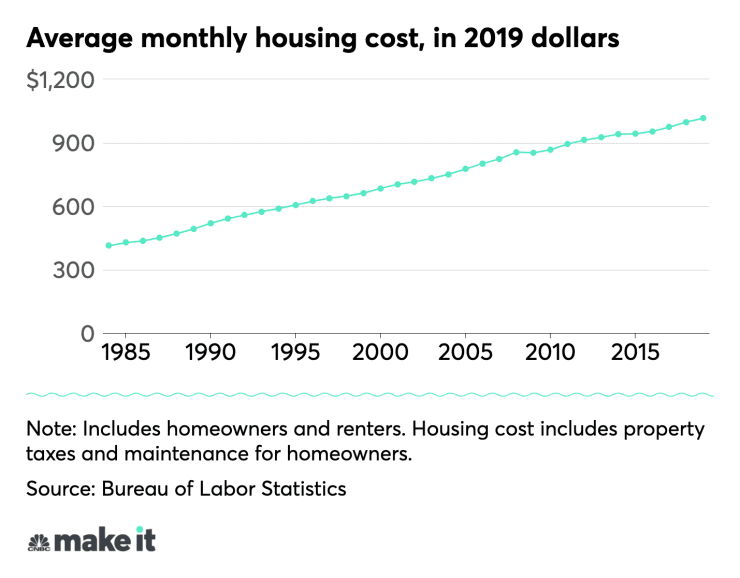
Housing costs have been on the rise for decades, more than doubling since 1985. That’s because one of the biggest drivers of affordability is supply.

It’s a simple equation: A lack of homes is pushing prices up. And the housing supply, especially the number of new homes being built, never fully recovered after the last housing crash in 2008, says Daniel McCue, a senior research associate at the center.

“The housing stock has not been growing as fast as demand,” he says. “Construction has been so low for so long that we’ve seen kind of a constriction of opportunities to buy homes.”

housing-costs.png

Before the Covid-19 pandemic started last year, the number of single-family homes for sale was at the lowest level since 1982, according to the Center for Housing Studies. By September 2020, only about 1.24 million homes were listed nationwide, down from the already low figure of 1.6 million listed in September 2019. 

This low supply led to a jump in home prices on both new and existing homes, especially those in the lower price ranges, McCue says. Across the U.S., home prices have consistently been on the rise since early 2012, according to CoreLogic. Before the pandemic, home prices increased 4.4% year over year in January 2019.

It’s not just homeowners who are feeling the squeeze. Spending on rent across all generations has steadily increased as well. In fact, the rise in rent expenses has outpaced the increase in homeowners’ spending on housing, according to data from the annual consumer expenditures survey conducted by the Bureau of Labor Statistics. And renters’ incomes have lagged costs for about 18 years running, according to Census data. From 2001 to 2019, rents rose by 15% while the median renter household income rose just 3.4%

“Home prices have consistently outpaced people’s income growth,” says Lawrence Yun, chief economist and senior vice president of research at the National Association of Realtors. “That is a key reason why home purchases for millennials and first-time buyers has become increasingly more difficult.”

The pandemic hasn’t helped. Home prices increased by about 11.2% in January 2021 compared with a year prior, according to CoreLogic. The median price of an existing home was $313,000 as of February, according to research from the Realtors.

And about 63% of renters and 41% of homeowners are still concerned about their ability to make their housing payments, according to research from Freddie Mac

The impact of high housing costs 

It’s not unusual for rent or a mortgage to be a person’s biggest monthly expense, but there can be negative consequences if housing costs make up more than 30% of the budget, McCue says. “In order to pay for housing, people spend a third less on food and two-thirds less on health care,” he says of Americans who earn lower incomes. And generally, their savings rates are much lower or even nonexistent. 

Although Kenney makes about $38,000 a year now as a bookkeeper, she and her husband had to take on debt in the early years of their marriage to keep up with the bills. That included personal loans to pay for home repairs and emergency expenses such as a new roof. And while the couple didn’t get help from family to pay for the house, Kenney’s father did chip in to pay for some of her car and a portion of her $72,000 student loan balance. 

But even with help from her dad, Kenney says she felt like her family was just breaking even. “We were just scraping by for a while,” she says. “We were just kind of working to get by and never really making any headway. Things would come up with the house, like we needed a new roof or vehicles would die, and we’d have to run and get a personal loan to cover it.”

Jessica Kenney and her husband bought their 1,700-square-foot, three-bedroom, two-bathroom ranch in upstate New York for about $80,000 in 2010.

Millennials are still making it work 

In spite of the rising housing costs, millennials old and young are continuing to purchase homes. For the past seven years, millennials have made up the largest share of homebuyers, according to the latest report from the National Association of Realtors.

Yet changing workplace trends could offer some relief when it comes to housing costs, Yun says. Because of the Covid-19 pandemic, companies may offer some additional flexibility to work remotely more often. Maybe not 100% work from home, Yun says, but even if workers don’t have to go to the office five days a week, it may drive younger workers to look further from city centers to find more affordable options. “We may begin to see a trend among millennials where work-from-home flexibility offers them larger geographic areas to choose from,” he says. 

And some existing homeowners like Kenney are finding ways to bring down their expenses as well — in many cases by making big sacrifices to prioritize debt repayment so that they pay it off and start to build long-term savings. Five years into homeownership, Kenney says she’d finally had enough of simply scraping by. “We had our kind of ‘ah-ha’ moment where we realized we were sick and tired of being sick and tired,” she says. 

Kenney and her husband started a strict no-spending financial diet in 2015. At that point, Kenney says she had about $42,000 in student loans left to pay off, an $8,000 personal loan they had taken out to pay for a new roof, about $4,000 on a Lowe’s card and a mortgage balance of roughly $71,600.

“I always considered myself frugal and good with money. The idea of getting buried in credit card debt was just horrifying, and I never wanted any of that, but somehow I rationalized student loans,” she says. Kenney paid off her student loans in 2018, wiped out her personal debt and then saved up to repay her father $8,500 for his earlier financial help. 

Today, Kenney and her husband have no debt outside their mortgage, which is more than 50% paid off. The goal: pay it off completely by the end of 2024 so they no longer have to worry about their $700 monthly payments. 

“We have to happen to our money, rather than allowing our money to happen to us,” Kenney says. “Having a plan for every dollar that we make has allowed us more freedom than we could have ever hoped for.”

CNBC Make It will be publishing more stories in the Middle-Aged Millennials series. If you’re an older millennial (ages 33 to 40) and interested in sharing your experiences, please email senior reporter Megan Leonhardt at megan.leonhardt@nbcuni.com.


If there is a home that you would like more information about, if you are considering selling a property, or if you have questions about the housing market in your neighborhood, please reach out. We’re here to help.

Search Homes in Colorado

Search Homes in Oklahoma