Breaking News: Mortgage rates fall to an all-time low

low-rates-Insta-01 (1).jpg

The average U.S. rate for a 30-year fixed mortgage dropped to 3.29% this week

The average U.S. rate for a 30-year fixed mortgage fell to 3.29% this week, the lowest ever recorded by Freddie Mac in a series that goes back to 1971.

The rate fell 16 basis points from the prior week after the worst stock retreat since the 2008 financial crisis sent investors piling into the bond markets. The yield on 10-year Treasuries, a benchmark for mortgage investors, fell to a record low this week as money managers sought safe havens amid coronavirus fears.

Screen Shot 2020-03-05 at 11.52.10 AM.png

Falling home-loan rates have boosted mortgage applications, a sign the housing market may help the U.S. economy stave off a recession, said Sam Khater, Freddie Mac’s chief economist.

Mortgage applications increased 10 percent last week from one year ago and show no signs of slowing down,” Khater said. “Given these strong indicators in rates and sales, as well as recent increases in new construction, it’s clear the housing market continues to be a positive force for the broader economy.”

In addition to making home purchases more affordable as the housing market enters its spring selling season, falling rates are spurring more Americans to refinance, according to the Mortgage Bankers Association. That will lower their monthly bills and give them more money for the consumer spending that accounts for about 70% of the U.S. economy.

Conventional refinance applications jumped more than 30% last week, Mike Fratantoni, MBA chief economist, said in a report on Wednesday.

Mortgage rates are falling “amidst increasing concerns regarding the economic impact from the spread of the coronavirus, as well as the tremendous financial market volatility,” Fratantoni said. “Refinance demand jumped as a result.”

In addition to a drop in the 30-year fixed, other rates dropped as well, according to the Freddie Mac survey. The 15-year fixed rate averaged 2.79%, down from 2.95% last week.

The five-year Treasury-indexed hybrid adjustable-rate mortgage averaged 3.18%, down from last week’s rate of 3.20%. 

If you have questions about any of this information, or need a recommendation to a great lender for a refi or purchase, contact us ASAP!

Increasing amount of Americans are getting mortgages before marriage licenses

Only 53% of first-time homebuyers are married.

According to the National Association of Realtors, the first-time homebuyer composition is now mirroring the change in marriage rates.

In the 1960s, more than seven in 10 American homeowners were married. Two decades later, in the 1980s, a peak of 75% of first-time homebuyers entering the market were married couples. Today, only 53% of first-time homebuyers are married.

real_estate_before_rings.png

According to American Housing Surveys, 35% of first-time homebuyers in 2017 had never been married, compared to 23% twenty years prior.

Married homebuyers made up 61% of the first-time homebuyers in 1997 and declined to 46% in 2013. But, that percentage increased over the next three years, hitting 52% in 2017.

“This drop is likely due to housing affordability,” Jessica Lautz, NAR’s vice president of demographics and behavioral insights said in a statement.

So while the amount of married homeowners has seen an overall decline in the past few decades, that’s not to say that an increasing amount of people are buying homes on their own.

“It is harder for a single-income individual to enter the competitive housing market the U.S. is facing today. Notably, while single men have traditionally had smaller shares of home buyers, the share of single men has now crept up to 10% of the first-time buyer market,” Lautz said.

More and more homebuyers are purchasing homes in platonic relationships, too. This share has gone up from 2% to 4% in the last year alone.

Why? NAR says unmarried couples and roommate buyers have a little advantage over single buyers helping them to increase their numbers – a dual income.

“Dual incomes allow them to navigate the housing market and perhaps allow them to purchase a home that is at a higher price point where they may face less competition in the buying market,” Lautz said.

West + Main Realtor Katie Robinson was one of those “put the Real Estate before the ring” first-time homebuyers, and it all worked out!

Screen Shot 2020-03-01 at 5.02.01 PM.png

Katie’s Facebook Post:

"~feeling nostalgic today~ ⁣

"Those of you that have known Tim and I since the beginning know that we first started living together in Tim’s 1 bedroom apartment downtown. It was disgusting! ⁣

Anyways,
I wanted to be a home owner and get out of that apartment more than anything! I was so sick of dumping money on rent in Denver. ⁣

At the time, I had just turned 24 and honestly I had
no clue what I was doing or where to begin with the home buying process. ⁣

My older brother had recently become a licensed Realtor in Denver so I relied pretty heavily on his expertise. *annoying brothers is what life’s all about, am I right?* ⁣

In the Summer of 2016 I found a home I loved out in Commerce City / East Denver. Unfortunately, I couldn’t qualify for a loan with my baby credit and I needed a co-signer. I called up my dad like I always do and begged him to co-sign... respectfully he told me to find another way. He has always taught us to work hard for our dreams. ⁣

Tim and I had only been dating for 1 year at the time and had no firm plans for the future. All we were sure of was that we loved each other and we wanted to be home owners! We agreed to become financial partners before even being engaged and Tim stepped up to co-sign on my behalf. ⁣

We have grown up a lot from the first time home buyers we were in 2016. Today is our last day in our first home together. This home has so many beautiful memories and it will always have a special place in my heart. So much that I just couldn’t sell it 🤣 ⁣

Instead we begin a new adventure... as landlords!!! The decision to become home owners at a young age has saved us thousands that we would have spent in rent. ⁣

We are so excited for our tenants and only hope they will love this community and home as much as we do. As we turn the page and start on this new journey together in Arvada, I want to express our love and gratitude to everyone who has helped us move and stay level headed! ⁣

To my husband... thanks for entertaining my wildest dreams and for living them out with me, here’s to a new beginning 
#bittersweet

If you have questions about your home purchase options, contact Katie or any West + Main agent, they will be happy to make recommendations, answer questions, and show you homes that you might want to put a ring on!

A Guide: How To Prepare Your Home For Coronavirus

A Guide: How To Prepare Your Home For Coronavirus

The Centers for Disease Control and Prevention is telling Americans that they should be prepared for the possibility of a COVID-19 outbreak in their community.

But what does preparedness look like in practice? The short answer: Don't panic — but do prepare.

“That means not only contingency planning but also good old-fashioned preparedness planning for your family," says Rebecca Katz, director of the Center for Global Health Science and Security at Georgetown University. In other words, what you'd do in case of a possible hurricane or another natural disaster.

We spoke with Katz and other health experts about common-sense things you can do to be ready should the virus hit where you live.

Should I stock up on food and meds?

The reason to stock up on certain products now isn't so much to avoid potential shortages in the event of an outbreak but to practice what experts call social distancing. Basically, you want to avoid crowds to minimize your risk of catching the disease. If COVID-19 is spreading in your community, the last place you want to be is in line at a crowded grocery store or drugstore.

If you take daily medications — for example, blood pressure pills — make sure you have enough to last a couple of weeks, suggests Katz, as long as you can get approval for an extended supply from your insurance provider.

Also worth pre-buying: fever reducers like acetaminophen or ibuprofen, says Edith Bracho-Sanchez, a pediatrician with Columbia University Medical Center.

Think about adding enough nonperishable foods to your pantry to carry you through for a couple of weeks, adds Amesh Adalja, an infectious disease physician and a senior scholar at Johns Hopkins University's Center for Health Security.

Bracho-Sanchez suggests having on hand your go-to sickbed foods, like chicken or vegetable broth and crackers in case of illness, as well as hydrating drinks such as Gatorade and Pedialyte for kids (though so far, kids seem less vulnerable to COVID-19). That's because if you do get sick, you want to be ready to ride it out at home if need be. So far, 80% of COVID-19 cases have been mild. (Think cold or flu symptoms.)

Are special cleaning supplies needed?

We still don't know exactly how long the coronavirus that causes COVID-19 can survive on surfaces. But Stephen Morse, a professor of epidemiology at Columbia University Medical Center, says what we know from other coronaviruses is that most household cleansers — such as bleach wipes or alcohol — will kill them.

Even wiping down surfaces with soap and water should do the trick, he says, because this coronavirus has a lipid envelope around it — like a coat that keeps the RNA inside the viral particle. And soap is a detergent that can break down lipids. "We use them to take grease and oil, which is a lipid, off our dishes," he notes.

If COVID-19 does start circulating in your community or there's someone sick at home, plan on cleaning surfaces that get touched frequently — such as kitchen counters and bathroom faucets — several times a day, says Dr. Trish Perl, chief of the infectious disease division at UT Southwestern Medical Center. That advice, she says, comes from studies on other diseases "where they've shown that if you do clean up the environment, you can actually decrease the amount of virus that is on hard surfaces significantly."

What about face masks?

The science on whether it's helpful to wear a face mask out in public is really, really mixed, as we've reported in depth. (For starters, it depends on what kind of mask you are wearing and whether you use it correctly.)

Some infectious disease experts are reluctant to recommend that people wear masks as a preventive measure because they can provide a false sense of security.

What experts do agree on is that wearing a mask is a good idea if you are sick, so you can reduce the chances that you'll infect others, whether it's family members at home or people at the doctor's office if you go in to be seen. Perl says that wearing a mask when sick is especially a good idea if you live with someone whose immune system is compromised or who's elderly, since people in their 60s and above seem to be the most vulnerable to COVID-19.

Some research suggests that wearing a mask can help protect you if you're caring for a sick family member, but only if you wear it all the time in the presence of the sick person and if you are careful not to touch the front of it, which could be contaminated with pathogens.

What to do about work — and telecommuting?

Now is the time to talk to your boss about your ability to work from home if COVID-19 is spreading locally, says Morse. Obviously, if you're sick, you should stay home. But even if you are well, telecommuting makes sense in the event of a local outbreak to reduce the chances that you'll be infected.

"That might be the prudent thing for many people to do if they're able to do it," he says, especially in big cities like New York, where large crowds of people are concentrated on public transport.

What's the plan if you get sick?

If you show early signs of illness — like a fever or a dry cough — Bracho-Sanchez says you should call your doctor's office but don't necessarily head straight to the emergency room or urgent care, where you might infect others.

"Do you really need to come into the office? Can we work this out through the phone?" Bracho-Sanchez says. "Of course, if you're having trouble breathing, if you're dehydrated, that's a different story."

Do you have a plan for kids and older relatives?

Perl and Katz suggest you start figuring out now what you would do if day care centers or schools start closing because of an outbreak. Do you have a backup child care plan in place?

"Having a plan for these kinds of eventualities now — instead of like it happened in China, where one minute things were open and the next minute they weren't — can be very helpful and a lot less disruptive," Perl says.

"For example, for me, I'm trying to think about, what if my mother gets sick? She doesn't live in Dallas," where Perl is. "What am I going to do? How am I going to get her cared for?"

Perl says it would be wise to reach out now to friends or neighbors who might be able to help in such situations.

Are there any habits I can practice at home to stay healthy?

Bracho-Sanchez suggests everyone in the house start a new habit today: Wash your hands as soon as you walk through the door.

You've heard it over and over, but one of the best ways to protect yourself against infection from COVID-19 — or cold or flu, for that matter – is good old-fashioned hand hygiene. Washing your hands frequently, as well as avoiding touching your face, eyes and nose, is a tried-and-true way to cut down on respiratory infections, Perl says.

Studies have shown that "good hand-washing and frequent hand-washing will decrease the risk of transmission of these viruses anywhere from 30 to 50 percent," she says. "You can use the alcohol-based hand gels, or you can use soap and water. It doesn't need to be any kind of antibacterial soap." And you should scrub your hands for at least 20 seconds — about as long as it takes to sing the "Happy Birthday" song twice.

Also, if you're not already doing it, start practicing good respiratory etiquette: Cough into your elbow instead of spewing virus-laden particles into the air (and wash your hands right after), and make sure to throw out your used tissues, since they might have virus particles on them.

"Those are very, very effective kinds of measures just in terms of decreasing exposure of others," says Perl.

The Coronavirus OutbreakWhat you should know

Subscribe to NPR’s Goats and Soda's newsletter for a weekly update on the outbreak.

Accessory Dwelling Units: 6 Things You Need to Know About ADU's

Backyards with extra space are being used beyond gardening and recreation. Small, detached structures or attached apartments offer the essentials of a home for extended family, caregivers, or paying tenants.

Homeowners are recognizing the untapped potential of maximizing a property’s square footage by converting unused areas into living space. Basements and attics have long been hot spots for these transformations, but now so are backyards. Accessory dwelling units—small, detached outdoor structures built for living quarters—are sparking nationwide interest.

The appeal of ADUs is that they’re typically more affordable than a large addition. They also offer numerous living possibilities, from a grown child returning home after college to aging grandparents who want to remain independent but close to family. An ADU could also house a caregiver and provide more privacy than a room inside the home. They’re the equivalent of a small apartment a stone’s throw away.

Then there are nonfamily reasons making ADUs increasingly popular. ADUs are a way to provide affordable housing in markets where prices have skyrocketed. These small dwellings are a way for homeowners to host short- and long-term renters while continuing to live on site since many municipalities require owner occupancy to help retain a neighborhood’s feeling of long-term ownership. Also, more cities are rewriting their zoning codes so single-family lots can accommodate one or even two such structures. “This will help meet demographic demands for one- or two-person households as nuclear families decrease in size,” says Kol Peterson, who encourages acceptance of ADUs in his book, Backdoor Revolution: The Definitive Guide to ADU Development (Accessory Dwelling Strategies, 2018), and his website, buildinganadu.com.

The Rebirth of ADUs

The concept of denser living on single-family lots isn’t new. Ancillary buildings have long existed, though they were known by different names, says John Geary, who co-founded Abodu with Eric McInerney in Redwood City, Calif., a development company partnering with modular builders to construct ADUs. In the past, homeowners had carriage or coach houses to shelter their buggies and horses, and drivers sometimes lived on the premises. These structures became the first garages when cars were invented in the early 20th century; again, living quarters were often included.

But it took decades for accessory dwellings to reemerge and be used primarily for people. Geary pegs the uptick to the mid-2000s in response to the housing crisis, particularly along the West Coast’s expensive cities such as Los Angeles and San Francisco. In Vancouver, which he describes as a mature ADU market, more than 35 percent of single-family homes have an ADU. There is no definitive U.S. number, Peterson says, but he estimates there may be 50,000 that are legally permitted and as many as 3 million without a permit.

What’s more significant, he says, is that the number may skyrocket. In Log Angeles, for instance, the average number of ADU permits issued from 2003 to 2016 was 95 permits per year. Since California’s 2017 ADU legislation passed, the number of permits has climbed to 4,513 in 2019. The prime reason, which Peterson outlines in a recent blog post, is the regulatory changes that loosened rules to make municipalities more open to increased density on individual sites by eliminating some of the hurdles. For example, no additional off-street parking requirements are needed when a garage is converted, and HOAs can no longer bar ADUs.

Search For Homes

The increase in ADUs can also be attributed to the increase in companies like Abodu offering readily available models. And, an even bigger game changer may be Airbnb’s project Samara, which is working to develop units that can be dropped into yards to increase its short-term rental network, says Dror Poleg, a developer, co-chair of the Urban Land Institute’s Technology and Innovation Council, and author of the forthcoming Rethinking Real Estate (Palgrave McMillan, 2019).

Due to their enhanced popularity, ADUs—or the possibility of one—are appearing as an amenity in more real estate professionals’ listing materials. “Many buyers may not want one right away, but they want to know that the space exists and that their city or town will allow it,” says Dulcinea Myers-Newcomb, a broker with Aryne + Dulcinea with Living Room Realty in Portland, Ore., who has taken classes with Peterson to help homeowners understand what’s required.

Myers-Newcomb cautions clients who might be interested in an ADU because they’re not yet universally embraced. “Some buyers want them, but others will say, ‘I had other plans for that space [in the basement] or out back’ and lose interest in a listing with one,” she says. She also notes that the return on investment is not always 100 percent.

6 Key Facts About ADUs

Help educate clients about variables in cost, size, design, and municipal regulations, as well as how ADUs differ from tiny houses with these takeaways.

  1. Use. The prime uses for ADUs is split between rentals and family needs. The majority of homeowners who want one for their family say it’s for an affordable place to live, followed by the desire for extra space to work from home or pursue an activity or hobby (home gym, music space, art studio), says Geary. “It’s definitely less expensive to house family rather than buy a second home [in another location],” says Myers-Newcomb. So far, Peterson says there’s a slight preference for detached rather than attached or internal ADUs, even though they’re more expensive.

  2. Size. ADUs are larger than tiny houses, which measure 400 square feet or less and may rest on wheels to travel. ADUs must be smaller than the main house on the property, though the main house can grow to accommodate a larger ADU on the site if the local code permits, according to developer and contractor Eli Spevak of Orange Splot LLC and Melissa Stanton of AARP Livable Communities. They co-wrote a booklet on the topic, The ABCs of ADUs, A Guide to Accessory Dwelling Units, which can be downloaded for free and offers a variety of ADU case studies with different sizes and looks. Most ADUs average between 500 and 800 square feet so they can comfortably accommodate a living room, bedroom, kitchen, and bathroom, says Geary. The goal is to have them be big enough for living quarters without taking up an entire backyard. Some states, like California, limit the size to 1,200 square feet. Ceilings in Geary’s model are generally 11 feet, which makes them seem larger. His also include the option for a site-built deck.

  3. Construction. ADUs can be stick-built or prefabricated. A modular design can be erected quickly. Geary says his typical timetable is about three months. In addition to speed of construction, another advantage is that companies like Abodu simplify the process by pulling permits and handling everything through the final installation. Because his models are constructed in California, they comply with that state’s strict energy code and are sustainable with ample insulation and earthquake resistance. Though usually built with outside fiber cement walls, Abodu offers an option to upgrade to natural cedar. Next year the company will offer solar panels.

  4. Cost. Costs vary depending on size, construction type, and the labor market where the ADU is built or installed. Abodu has worked to keep its price to $200,000, which includes everything needed to hand over the keys, Geary says. Peterson pegs the typical cost at $250,000 for ADUs in California and a slightly lower price in Oregon. But there are some less expensive versions. Many homeowners want to keep their costs to around $100,000, says Spevak, whose development company has made it their mission to pioneer new models of community-oriented, affordable, green housing. He says the average cost to convert an internal house space into an ADU is much less—about $50,000, though redoing a basement could climb higher depending on features and finishes.

  5. Return on investment. To date, there is not enough data to calculate how ADUs increase a home’s value. “They help with resale, but the increase won’t yet cover the entire cost of the purchase or work done,” Peterson says. For this reason, Myers-Newcomb urges homeowners not to add one right before they sell. “It takes time to recoup the investment,” she says.

  6. Municipal regulations. Any homeowner who’s thinking about constructing an ADU in their backyard or carving out space within their home must check their municipality’s regulations, since they vary widely. They usually require a permit and don’t allow an ADU to be sold separately from the primary home. Real estate professionals can help clients by knowing local regulations in advance. Also, be aware that rules are changing, Peterson says. Besides passing reforms to reduce regulations on ADUs in recent years, California’s current governor, Gavin Newsom, recently signed into law multiple bills that further relax rules to help ease the state’s housing crisis. For example, two ADUs are now allowed on many properties and property setbacks have been pared to four feet, he says. Portland, Ore., has also loosened its rules, including removing owner occupancy and off-street parking requirements. In New Hampshire, a new law says that local zoning codes must allow ADUs nearly everywhere single-family housing is permitted. “The change stemmed in large part from the frustration of builders who couldn’t construct the type of amenities, such as backyard cottages and garage apartments, that their clients desired,” according to Spevak and Stanton’s booklet. (Editor's note: It's not just government regulation that owners need to adhere to; many homeowners associations prohibit the addition of ADUs and the conversion of garages to housing. California is currently the only state that requires HOAs to allow ADUs, and the California law is likely to be challenged by opponents.)

While today’s new take on ADUs is still in its infancy in many parts of the country, the innovation and perseverance of the current proponents will continue to usher in this innovative housing solution.

Read more at Realtor Magazine.

The longest job boom ever is exactly what housing needed

Job and economic expansion is boosting the next wave of first time and move-up homebuyers

From one of our fave writers at HousingWire (If you like stuff like this as much as we do, you should subscribe to their newsletter!)

For 10 years, I have held a core belief that the U.S. housing market would not fully recover in terms of mortgage demand until sometime between 2020 to 2024. 

From the span of 2008 to 2019, we had the weakest new home sales and housing starts cycle ever. But, we also had the most prolonged economic and job expansion ever.

Case in point, last week the U.S. added one more stable jobs report to the streak of 112 straight months of job gains. This is the fertile economic ground to which the most massive demographic patch of 26 to 32-year-olds will come into “home-buying age.” Currently, the median first-time homebuyer age is 33. Back in 1981, it was 29. 

Labor force growth for ages 25 to 54 has been on an upswing since the lows of 2015, so some of these would-be home buyers should have the economic chops necessary to enter into homeownership. The graph below shows this trend:

25-54-labor-force.png

You’ll notice a similar trend to the purchase application data in the graph below as well.

job_boom2.png

American homeowners typically follow a well-trodden path to homeownership, albeit these days people get married and buy homes later in life. As younger Americans work longer with no recession to stop this flow, their financial profile to buy a home enhances. Here’s a look at the path of today’s first-time homebuyers:

1. We rent.  After leaving the parental home for college or career, our first home away from home is usually a rental.

2. We date. We start looking to pair up with the family formation, still a vague and distant concept.

3. We mate.  Usually, after a few false starts and broken hearts, we identify a mate that just might be the one.

4. We marry.  Or otherwise commit to a couple-hood and a shared future.

5. We have kids. According to averaged data from the Census Bureau, in three and half years after marriage (if we make it that far), children enter the picture.

6. We buy. The first time median age home buyer is now 33. Once a baby is one the way or needs to start school, the desire to purchase and settle down becomes more pressing.

The longest economic and job expansion ever recorded in history has facilitated an excellent backdrop to go into 2020-2024 with a healthy dose of first-time buyers coming into the marketplace.

Never forget: Now more than ever, dual-income households give the housing market an extra boost.

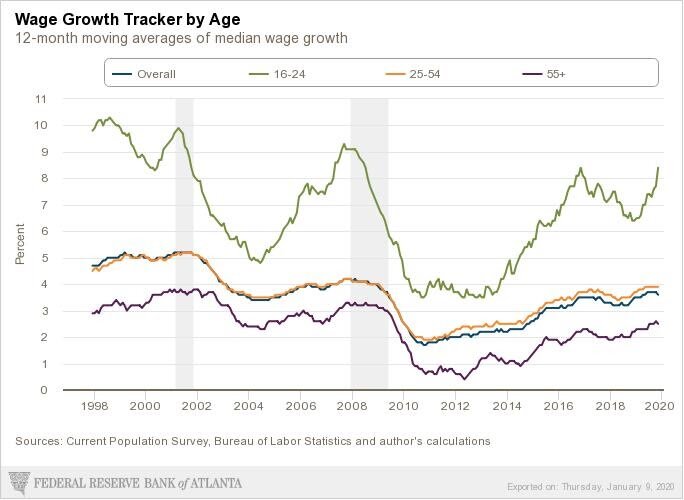
One positive thing about the longest job expansion ever is that a tighter labor market is suitable for everyone. This means wage growth, while not extremely hot, is stable year over year.

Wage growth also looks better when you account for the prime age factor into the equation in some of the wage data (see below).

december-wage-growth-ages-1.jpeg

Not only do we have a large demographic patch coming up, but we also have a solid 10 year base of current homeowners who bought homes with the capacity to own the debt. If this group needs to move up, which still happens every year, they’re in a lovely spot financially to do so, especially Americans who bought homes from 2010-2016.

Don’t forget home buying is a process, not something you buy on Instagram, well, not yet at least.

Having the longest job and economic expansion after the Great Recession has been a stable force for creating the next wave of first time and move-up homebuyers. The current housing trends have fewer dangerous bridges to cross for all these young Americans ages 26-32, unlike what we had in the previous economic expansion.

I don’t believe that this big demographic patch will create another housing boom but will instead provide a stable source of replacement buyers for the existing home market. The only issue we need to be concerned about is affordability… But more on that soon.

If you have questions about how this information might impact a move or investment purchase or sale that you have been considering, contact us, we’re here to talk it out!