
Mortgages

Mortgage rates expected to hold firm even with another Fed cut on the horizon


Mortgage rates remain in a holding pattern at the start of December and the general consensus among market experts is that little will change even if the Federal Reserve implements another interest rate cut next week.

Mortgage News Daily reported that 30-year fixed-rate mortgages averaged 6.31% on Monday, virtually unchanged from a week ago.

HousingWire’s Mortgage Rates Center, which relies on locked loan data across all credit profiles, reported 30-year conventional loan rates of 6.36% on Tuesday, down 1 basis point from a week ago. Rates for 30-year loans through the Federal Housing Administration (FHA) averaged 6.13%, up 2 bps during the week, while rates for 30-year jumbo loans were down 1 bps to 6.19%.

The stable nature of mortgage rates in recent weeks is partially tied to the consistency in mortgage spreads. The spread between the 30-year mortgage rate and the 10-year Treasury rate is higher than its historic average of 1.60% to 1.80%, but at a current figure of 2.19%, it’s much lower compared to where it was in late 2023 and late 2024.

“Mortgage spreads were the unsung superheroes of the housing sector this year, because we wouldn’t have had mortgage rates near 6% without them improving,” HousingWire Lead Analyst Logan Mohtashami wrote over the weekend.

Despite the ongoing friction between employment data and inflation data that could pull the economy in opposite directions, interest rate traders are confident that the Federal Reserve will lower benchmark rates on Dec. 10.

The CME Group’s FedWatch tool shows that 87% of traders are anticipating a cut of 25 bps, which would bring the federal funds rate to a range of 3.50% to 3.75%. It hasn’t been that low since September 2022.

Bright MLS chief economist Lisa Sturtevant said last week that she didn’t expect much movement for mortgage rates even with a third straight Fed cut.

“We are entering the traditionally slowest period for the housing market. Monthly home sales are lowest in November, December and January. Listing activity slows down during the winter as prospective sellers set their sights on early spring,” Sturtevant said in written commentary.

“We are in a ‘wait-and-see’ housing market as we head into 2026. There are both buyers and sellers on the sidelines, watching not just where mortgage rates and the economy are headed, but also how confident they feel about their own personal situations.”

What will the Fed do?

Under the watch of Jerome Powell, the Federal Reserve has typically shown solidarity with its monetary policy decisions. But dissension has grown in 2025 and was evident at the central bank’s late October meeting, when Kansas City Fed President Jeffrey Schmid voted for no cut, while Gov. Stephen Miran voted for a larger cut of 50 bps.

An article published Monday by The Wall Street Journal illustrated the divide. It listed four policymakers as “more likely to favor a cut” and five who are “less likely to favor a cut.” Powell, along with Gov. Lisa Cook and Vice Chair Philip Jefferson, could serve as the swing votes as their stances are less clear.

Beyond this month, the direction of interest rates could become more divisive. President Donald Trump is expected to announce Powell’s replacement soon, with the pick likely to align with Trump’s desire for much lower rates.

Kevin Hassett is the rumored frontrunner for the Fed chair job, according to a recent report from Bloomberg. Hassett is the director of the White House National Economic Council and a Trump ally who could push for lower rates on a faster timeline. Other candidates include current Fed governors Christopher Waller and Michelle Bowman; former Fed Gov. Kevin Warsh; and BlackRock executive Rick Rieder.

Whoever takes over as chair when Powell’s term ends in May 2026 will lead similar debates over interest rate policy and its impact on housing demand. And according to Mark Fleming, chief economist at First American, there are other factors at play that will influence home sales and mortgage origination volumes next year.

“An important dynamic for affordability is that household income is expected to rise faster than house prices next year,” Fleming said. “According to the New York Fed’s Survey of Consumer Expectations, median expected household income growth is 2.8 percent. When income growth exceeds house price growth, house-buying power improves — even if mortgage rates don’t decline meaningfully.

“This is a key driver of the roughly 3 percent improvement in affordability we expect between the end of this year and end of 2026, which would return affordability to levels not seen since the summer of 2022.”

Read more at Housingwire

Related Links

If there is a home that you would like more information about, if you are considering selling a property, or if you have questions about the housing market in your neighborhood, please reach out. We’re here to help.


Search Homes in Colorado

Search Homes in North Carolina

Search Homes in Oklahoma

The VA Home Loan Advantage: What Every Veteran Should Know Right Now


If you’ve served in the military (or if your spouse has), you have access to one of the most powerful homebuying tools out there. The chance to buy a home without having a down payment.

Unfortunately, 70% of Veterans (that’s 7 out of every 10) don’t know about this benefit, according to Veterans United.

And that’s a big missed opportunity for those who’ve earned this benefit through service. So, let’s break down what you really need to know about Veterans Affairs (VA) home loans right now.

Why VA Home Loans Can Be a Great Option

For nearly 80 years, VA loans have made homeownership possible for millions of Veterans and active-duty service members. Here are just a few of the top perks according to the Department of Veteran Affairs:

Options for $0 Down Payment: Many Veterans can buy a home without spending years saving up.

Fewer Upfront Costs: The VA limits which types of closing costs Veterans have to pay, helping you keep more cash on hand when you’re finalizing your purchase.

No Private Mortgage Insurance (PMI): Unlike many other loan types, VA loans don’t require PMI, lowering your monthly costs.

These features make VA loans a great way for service members (or their family) to build stability, save money, and start creating long-term wealth through homeownership.

Can You Still Get a VA Loan with the Government Shutdown?

But lately, there’s been some confusion about whether VA loans are still available due to the government shutdown. And that uncertainty has kept some Veterans from taking the next step.

While there may be processing delays, Veterans United explains you can still get a loan:

“There’s been a lot of confusion and uncertainty about how a government shutdown will affect VA home loans . . . The good news is that the shutdown has minimal impacts on VA lending. Lenders are still able to order appraisals, obtain a borrower’s Certificate of Eligibility, submit the VA Funding Fee and more. In short, Veterans are still able to use their home loan benefit to buy a home or refinance an existing mortgage.”

So, despite the headlines, you can still use your VA home loan benefits today. The process is ready when you are. It just may take more time to go through.

Why the Right Agent and Lender Matter

Just remember, using your VA home loan is easier (and smoother) when you have the right team behind you. As VA News puts it:

“Choosing a military-friendly broker or agent who understands the VA home loan application process can make all the difference in the homebuying experience. Finding the right agency or brokerage is just as important as locking in a good VA mortgage lender. Communication is key to getting to the loan closing table.”

A knowledgeable agent and an experienced lender can help you navigate every step, all the way from qualifying to closing. With their help, you can make sure you’re getting the most out of your benefits.

Bottom Line

If you’re a Veteran, a VA home loan is one of the most valuable benefits you’ve earned through your service. It offers options for no down payment, limited closing costs, and more.

Read more at Keeping Current Matters

Related Links

If there is a home that you would like more information about, if you are considering selling a property, or if you have questions about the housing market in your neighborhood, please reach out. We’re here to help.
Search Homes in Colorado

Search Homes in North Carolina

Search Homes in Oklahoma

How much would a 50-year mortgage cost homebuyers?


In a social post on Saturday, President Trump floated the idea of a 50-year mortgage to boost housing affordability, but the idea got a frosty reception online.

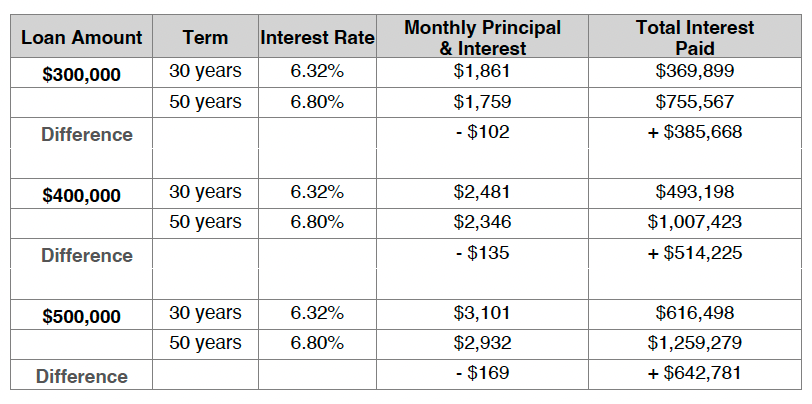
One reason is that stretching the loan term out that long ends up costing much more in interest over the life of the loan while only shaving a few hundred dollars off the monthly payment.

You also have to factor in a higher mortgage rate than what you get with a 30-year fixed loan.

On Sunday, FHFA Director Bill Pulte responded to the backlash with this post: “We hear you. We are laser focused on ensuring the American Dream for YOUNG PEOPLE and that can only happen on the economic level of homebuying. A 50 Year Mortgage is simply a potential weapon in a WIDE arsenal of solutions that we are developing right now. STAY TUNED!”

What’s the interest rate on a 50-year loan?

So how much would a 50-year mortgage end up costing homebuyers? To answer that, we have to consider the mortgage rate and the interest paid over the life of the loan, and compare that to the benefit of a lower monthly payment.

HousingWire Lead Analyst Logan Mohtashami outlined what the rate on a 50-year loan could look like.

“Traditionally, the longer the amortization, the higher the mortgage rate,” said Mohtashami. “Looking at the difference between a 20-year mortgage and a 30-year mortgage, the best-case scenario for a government-backed 50-year loan product would put rates most likely between 0.42% to 0.57% higher than a 30-year fixed mortgage.

“Using the 30-year fixed mortgage rate at the close on Friday of 6.32%, you could be looking at mortgage rates of 6.74%-6.89% for a 50-year loan. It could be higher than that, but that’s the best-case scenario I see,” Mohtashami said.

Taking that 6.32% for the 30-year and using 6.80% for the 50-year, here are the payments according to the Fannie Mae mortgage loan calculator, at different price points. This is only calculating the principal and interest payment, as the rest of the monthly payment — taxes and insurance — vary too much by location to provide a valuable average.

Regulatory challenges could mean higher rates

The interest difference could be much starker depending on how a 50-year mortgage is structured for the market. After the great financial crisis, Congress passed the Dodd-Frank Wall Street Consumer Protection Act which stipulated the kinds of mortgages that Fannie Mae and Freddie Mac would buy on the secondary market.

“A 50-year mortgage would not violate the Dodd-Frank Act outright, but it would not qualify as a Qualified Mortgage (QM) under the Act’s Ability-to-Repay (ATR) rules,” said James Brody, managing partner at Brody Gapp LLP. “Current regulations cap QM loans at a 30-year term, so any loan exceeding that duration falls outside the standard.”

“In practice, this means a 50-year loan could only be originated as a non-QM mortgage, which lacks the legal safe harbor protections of a QM and typically carries higher interest rates. Unless the ATR rules are amended to include 50-year terms, lenders would be unable to sell these loans to the GSEs (Fannie Mae and Freddie Mac), severely limiting the product’s liquidity.

“In short, while not illegal, a 50-year mortgage has very limited salability in the secondary market under the current Dodd-Frank framework,” Brody said.

Read more at Housingwire

Related Links

If there is a home that you would like more information about, if you are considering selling a property, or if you have questions about the housing market in your neighborhood, please reach out. We’re here to help.

Search Homes in Colorado

Search Homes in North Carolina

Search Homes in Oklahoma

One Homebuying Step You Don’t Want To Skip: Pre-Approval


There’s one essential step in the homebuying process you may not know a whole lot about and that’s pre-approval. Here’s a rundown of what it is and why it’s so important right now.

What Is Pre-Approval?

Pre-approval is like getting a green light from a lender. It lets you know how much they’re willing to let you borrow for a home. To determine that number, a lender looks at your financial history. According to Realtor.com, these are some of the documents a lender may ask you for during this process:

  • W-2s from the last two years

  • Tax returns from the last two years

  • Pay stubs from the last 30 days

  • Bank statements from the last 60 days

  • Investment account statements (if applicable)

  • Two years of history of where you’ve lived

The result? You’ll get a pre-approval letter showing what you can borrow. Keep in mind, that any changes in your finances can affect your pre-approval status. So, after you receive your letter, avoid switching jobs, applying for new credit cards or other loans, or taking out large sums of money from your savings.

How It Helps You Determine Your Borrowing Power

This year, home prices are expected to rise in most places and mortgage rates are still showing some volatility. So, since affordability is still tight, it’s a good idea to talk to a lender about your home loan options and how today’s changing mortgage rates will impact your future monthly payment.

The pre-approval process is the perfect time for that. Because it determines the maximum amount you can borrow, pre-approval also helps you figure out your budget. You should use this information to tailor your home search to what you’re actually comfortable with as far as a monthly mortgage payment. That way, you don’t fall in love with a house that’s out of your comfort zone.

How It Helps You Stand Out

Once you find a home you want to put an offer on, pre-approval has another big perk. It not only makes your offer stronger, it shows sellers you’ve already undergone a credit and financial check.

When a seller sees you as a serious buyer, they may be more attracted to your offer because it seems more likely to go through. As Greg McBride, Chief Financial Analyst at Bankrate, says:

“Preapproval carries more weight because it means lenders have actually done more than a cursory review of your credit and your finances, but have instead reviewed your pay stubs, tax returns and bank statements. A preapproval means you’ve cleared the hurdles necessary to be approved for a mortgage up to a certain dollar amount.”

Bottom Line

If you’re planning on buying a home, getting pre-approved for a mortgage should be one of the first things on your to-do list. Not only will it give you a better understanding of your borrowing power, it can put you in the best position possible to make a strong offer when you find a home you love. Connect with a trusted lender to learn more.

Read more at Keeping Current Matters

Related Links

If there is a home that you would like more information about, if you are considering selling a property, or if you have questions about the housing market in your neighborhood, please reach out. We’re here to help.

Search Homes in Colorado

Search Homes in North Carolina

Search Homes in Oklahoma