
Closing Costs Unpacked: State-by-State Breakdowns for Today’s Buyers


If you’re planning to buy a home this year, there’s one expense you can’t afford to overlook: closing costs.

Almost every buyer knows they exist, but not that many know exactly what they cover, or how different they can be based on where you’re buying. So, let’s break them down.

What Are Closing Costs?

Your closing costs are the additional fees and payments you make when finalizing your home purchase. Every buyer has them. According to Freddie Mac, they typically include things like homeowner insurance and title insurance, as well as various fees for your:

  • Loan application

  • Credit report

  • Loan origination

  • Home appraisal

  • Home inspection

  • Property survey

  • Attorney

National vs. Local: Why the Numbers Look So Different

When you search for information about closing costs online, you’ll often see a national range, usually 2% to 5% of the home’s purchase price. While that’s a useful starting point if you’re working on your homebuying budget, it doesn’t tell the whole story. In reality, your closing costs will also vary based on:

Taxes and fees where you live (like transfer taxes and recording fees)

Service costs for things like title and attorney work in your local area

While the home price is obviously going to matter, state laws, tax rates, and even the going costs for title and attorney services can change what you expect to pay. That’s why it’s important to talk to the pros ahead of time so you know what to budget for. It can put you in control before you even start shopping.

To give you a rough ballpark, here’s a state-by-state look at typical closing costs right now based on those factors for the median-priced home in each state (see map below):
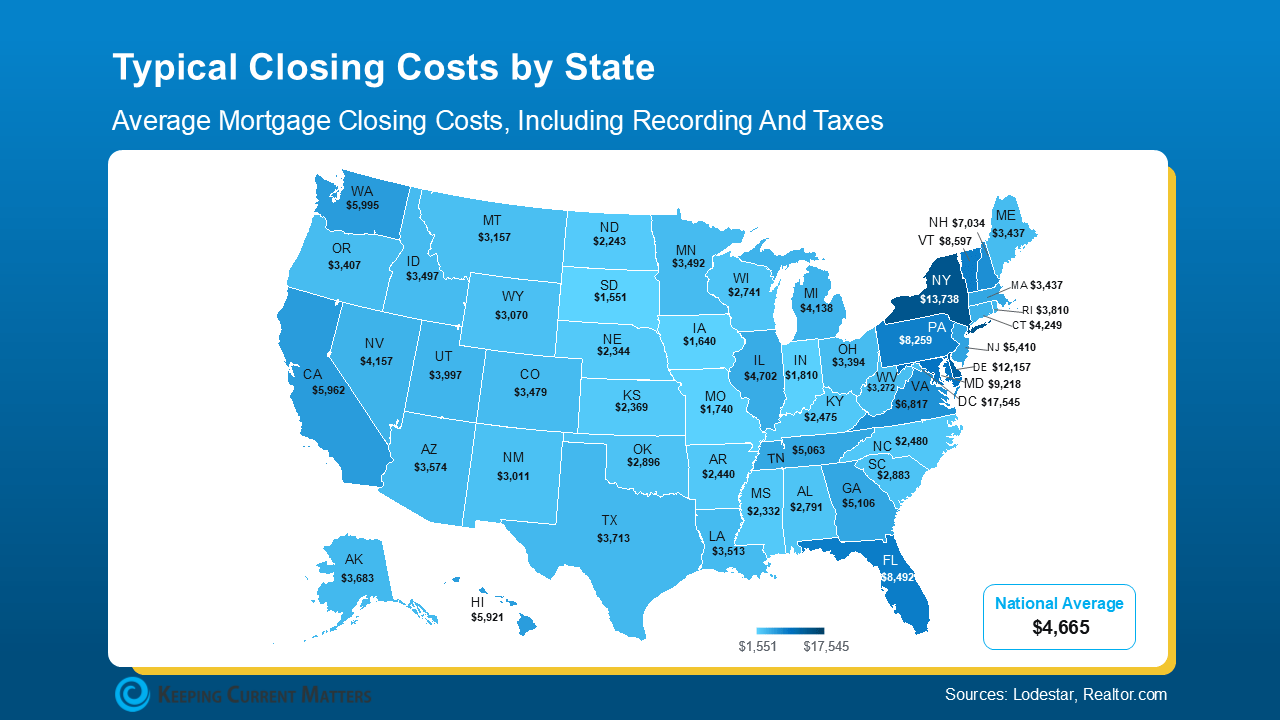
As the map shows, in some states, typical closing costs are just roughly $1-3K. In a few places, they can be closer to $10-15K. That’s a big swing, especially if you’re buying your first home. And that’s why knowing what to expect matters.

If you want a real number to help with your budget, your best bet is to talk to a local agent and a lender. They can run the math for your price range, loan type, and exact location.

And just in case you’re looking at your state’s number and wondering if there’s any way to trim that bill, NerdWallet shares a few strategies that can help:

  • Negotiate with the seller. Ask for concessions like a credit toward your closing costs.

  • Shop around for homeowner’s insurance. Compare coverage and rates before you commit.

  • Check for assistance programs. Some states, professions, and neighborhoods offer help. Your agent and lender can point you to what’s available locally.

Bottom Line

Closing costs are a key part of buying a home, but they can vary more than most people realize. Knowing your numbers (and how to potentially bring them down) can go a long way and help you feel confident about your purchase.

Read more at Keeping Current Matters

Related Links

If there is a home that you would like more information about, if you are considering selling a property, or if you have questions about the housing market in your neighborhood, please reach out. We’re here to help.

Search Homes in Colorado

Search Homes in North Carolina

Search Homes in Oklahoma

What the Government Shutdown Means for Mortgage Rates as Financial Markets React


The federal government has halted most operations for the first time in nearly seven years, a move that will have ripple effects through the financial markets that determine mortgage rates.

The government shutdown began at 12:01 a.m. on Wednesday, after Republicans and Democrats in Congress failed to reach a deal on a new spending bill to fund federal operations.

At Wall Street's opening bell, the major stock indexes opened slightly lower, all losing less than 1%, while long-term bond markets saw a moderate decline in yields, easing recent upward pressure on mortgage rates.

During a government shutdown, hundreds of thousands of federal workers are placed on unpaid furloughs, which can slow economic growth. Typically, the effect is temporary and most of that lost growth is regained when the shutdown ends and furloughed workers receive retroactive pay.

However, this shutdown comes at a time of heightened economic uncertainty, with recent federal reports sending mixed messages suggesting that overall growth appears strong while the labor market seems to weaken.

The Federal Reserve's next decision on interest rates later this month hinges on how those trends play out. But during the shutdown, the government will cease issuing crucial reports on inflation and the economy, including the highly anticipated monthly jobs report that had been due on Friday.

That leaves Fed policymakers, and the investors who ultimately determine mortgage rates, groping in the dark as they try to assess economic conditions, introducing new uncertainty and volatility into the market.

"The loss of federal labor and inflation reports comes at a critical time in the monetary policy cycle," says Realtor.com® Chief Economist Danielle Hale. "The Fed recently recalibrated its policy rate for the first time in nine months and may or may not continue to do so depending on what the incoming data suggest is appropriate."

Markets will instead rely heavily on private-sector economic data, such as Wednesday morning's ADP employment report that showed a surprise decline of 32,000 in private payrolls in September—the biggest monthly decline in more than two years and a troubling sign for workers.

That news sent 10-year Treasury yields to their lowest level in two weeks, as investors gauged the Fed as being extremely likely to cut rates again later this month. Mortgage rates typically follow the 10-year yield, meaning the move reversed recent upward pressure on rates.

However, the longer the government shutdown persists, putting a blackout on gold-standard federal economic data, the greater the risk that market expectation will stray from reality, and sharply correct when reporting resumes.

"Markets and investors will continue to make decisions with the best information available, but when the information bottleneck finally clears and the government issues reports again, we may see a bigger adjustment in interest rates, including mortgage rates," says Hale.

Hale predicts that mortgage rates will remain steady or rise slightly during the shutdown, and then resume easing once the disruption resolves and federal economic data resumes.

"In the meanwhile, home shoppers can rate-test their budget by using mortgage calculators to determine how swings in mortgage rates will affect their housing payments," she says.

Last week, average rates for 30-year mortgages ticked higher to 6.3%, up from an 11-month low of 6.26% the prior week, according to Freddie Mac.

How the shutdown affects the housing market

Most homebuyers won't be directly affected by the government shutdown, which isn't expected to significantly affect the processing and approval of traditional mortgages.

However, the shutdown will disrupt small but important elements of the housing market, and a lengthy shutdown could generate significant uncertainty, weighing on home sales.

Perhaps the most significant impact on homebuyers is a lapse in authorization for the National Flood Insurance Program (NFIP), which provides more than 90% of flood insurance policies sold across the country.

Although existing policies remain in force and the program will continue to pay claims, the NFIP cannot write new policies until a new spending bill is passed.

Mortgage lenders typically require flood insurance for homes that are located in areas at risk of flooding, and the suspension of NFIP underwriting will leave thousands of homebuyers scrambling for alternative coverage, or unable to close.

The National Association of Realtors® estimates that the pause in new NFIP policies will delay or disrupt some 1,400 home transactions each day, and many buyers in high-risk areas without flood insurance coverage.

“Each day that passes during the shutdown, potential real-life impacts will be felt in America’s housing market, which accounts for nearly 20% of the U.S. economy," says NAR Chief Advocacy Officer Shannon McGahn.

Meanwhile, the hundreds of thousands of federal workers who are furloughed or working without pay may struggle to pay rent or make mortgage payments.

"If the shutdown lasts for weeks, the resulting financial strain could weaken home sales, particularly in metros with a higher share of federal workers," says Realtor.com senior economist Anthony Smith. "Over time, this could even contribute to softening home prices in these markets."

A recent Realtor.com analysis identified markets with a significant share of residents employed by the federal government, including Washington, DC (11%), Virginia Beach, VA (7%), Oklahoma City (4.2%), Baltimore (3.7%), San Diego (3.1%), and San Antonio, TX (3%).

Overall, uncertainty from the shutdown threatens to derail an early fall bounce in the housing market, afer falling mortgage rates finally boosted activity following a historically weak spring and summer.

"A government shutdown adds uncertainty into a housing market that is already under pressure from high home prices and elevated mortgage rates," says Smith. "Anything that further discourages prospective buyers from entering the market and risks slowing sales even more in a slow housing market is not helpful."

Read more at Realtor.com

Related Links

If there is a home that you would like more information about, if you are considering selling a property, or if you have questions about the housing market in your neighborhood, please reach out. We’re here to help.

Search Homes in Colorado

Search Homes in North Carolina

Search Homes in Oklahoma

West + Main Strengthens Colorado Footprint With Front Range Collective


DENVER (October 1, 2025) – NextHome Front Range has joined West + Main Homes and rebranded as the Front Range Collective team. The collaboration strengthens resources for agents, deepens West + Main’s presence in Fort Collins and Colorado Springs, and reinforces both companies’ commitment to independence and to creating more opportunities for agents to thrive.

Front Range Collective initiated the merger to provide its agents with expanded resources, stronger branding, and greater opportunities for growth. The team had long admired West + Main’s locally owned brand and distinctive aesthetic. Once conversations began, it became clear the companies shared the same priorities around culture and support. By joining forces, they bring together Front Range’s hands-on support and lead-generation systems with West + Main’s marketing, community presence, and brand recognition.

“While larger brokerages continue to consolidate, we saw the opportunity to grow in a way that keeps us true to our values,” said Chris Pranger, Team Leader of Front Range Collective. “By joining West + Main, we’re giving our agents and clients the hands-on guidance we’ve built, along with the offices, marketing tools and community presence that distinguish West + Main.”

Front Range Collective’s team of 28 agents closed over $100 million in sales over the past year. By joining West + Main, the team will gain access to offices throughout the Front Range, including upgraded space in Fort Collins and new opportunities in Colorado Springs, while maintaining its culture of collaboration and support. The move provides agents with stronger resources, expanded market reach, and a brand platform designed to help them grow their businesses.

“We’re thrilled to welcome the Front Range Collective team to West + Main,” said Stacie Staub, CEO and Founder of West + Main Homes. “This partnership supports our shared mission of empowering agents with the tools and community they need to thrive, while creating sustainable growth across the Front Range.”.

For more information, visit westandmainhomes.com

ABOUT WEST + MAIN HOMES
West + Main Homes is an independently owned and operated boutique real estate brokerage specializing in residential and commercial properties across Colorado, Oklahoma, and Minnesota. The company’s team of carefully selected local experts brings deep knowledge of both the real estate process and the distinctive communities they serve. West + Main prioritizes personalized service, helping clients with everything from purchasing their first home to selling investment properties or building their dream home. With innovative storefront locations in walkable neighborhoods, West + Main fosters community through events such as First Friday art events, pop-up shops, and homebuyer classes. Supported by an extensive international network of real estate professionals, West + Main is well-equipped to assist clients in buying, selling, or investing—wherever life takes them. For more information, please visit www.westandmainhomes.com

Related Links

If there is a home that you would like more information about, if you are considering selling a property, or if you have questions about the housing market in your neighborhood, please reach out. We’re here to help.

Search Homes in Colorado

Search Homes in North Carolina

Search Homes in Oklahoma

Featured at West + Main Highlands: Adam Anglin


Join us for First Friday in RiNo Ft Adam Anglin

2632 Blake St #102
10.3.2025, 6-9pm

RSVP Here

Meet Adam Anglin

Adam Anglin (b.1984, Rogers, AR) is a fine artist and musician with a background in graphic design. Adam paints impressionist landscapes with color-field forms. Recipient of the 2024 Cherry Creek Art Festival “Emerging Artist” grant. He lives and works in Denver, Colorado.

Artist Statement - I am a self-taught landscape painter who connects synthetic and natural forms in purposeful dissonance for those who long for beauty in a world that is too often satisfied with distraction. I use vibrant color-field compositions overlaying western landscapes and interwoven perspective lines to move the viewer between worlds.


Learn more about Adam in our Q+A!

What are you known for? - I'm known for painting impressionistic landscapes that intersect with color-field and abstract compositions.

Who/What are your biggest influences? - My biggest influences are abstract painters - Frank Stella, Josef Albers, and Clyfford Still.

What is your dream project? - I've been really enjoying working bigger lately, so a dream project for me would have to involve making something huge. I love when work takes up a big wall. It's so satisfying. My work needs scale to accentuate the colors and composition of the abstract elements so if I could make some real big boys, I think the payoff would be incredible.

What are you working on right now? - Currently, I've been chipping away at some commissions. That's been a big part of my workload this year and I love it. Making something unique for a particular space or client is the best feeling. I really love when everything comes together in just the right way. I'm hoping to do more in the future.

Is a hotdog a sandwich? - Let me answer your question with a question - Is a corndog a sandwich? Or a slice of pizza? What is a sandwich? If it's bread and some other essential bits then I think we could just as easily turn this around and say, What isn't a sandwich? If I put enough croutons on my salad, am I now eating a sandwich?! Is my soup in a bread bowl actually just a really wet sandwich?! What becomes of pancakes, crepes, or tortillas? Is a taco a sandwich? Are tacos just thinly folded sideways sandwiches?! Where does it end?!

What are your thoughts about your city's creative scene for artists, designers, crafters, makers, and/or small businesses? - I'm so lucky to live in a place that really values the work of creatives. Denver has been home for me and my family for almost 20 years. We love feeling like we live in a place where artists can pursue their passions and be supported by a number of incredible small businesses. I've been lucky to be invited into some really wonderful shops, design stores, and galleries to show my work. Every artist has to figure out the right approach for them, but it's sweet to know that in Denver carving that path is encouraged in so many ways.

What was the best day at work you've had in the past three months? - Last month I showed my work at the Golden Fine Arts Festival just down the road in Golden, CO. I sold more in that show than any other show all year. I almost sold out of a new series I've been working on and I landed a pretty large commission.


Get in touch with Adam


Instagram: @galleryatfdc

Website: www.galleryatfdc.com

If you are a local artist/crafter/maker/indie business owner and would like to be featured on our blog, please fill out this form or contact Joy at joym@westandmainhomes.com with questions...we can't wait to learn all about you!

Why Now May Be a Key 2025 Moment To Sell Your House


Mortgage rates are finally heading in the right direction – and buyers are starting to jump back in.

According to the data, buyer demand picked up considerably once mortgage rates hit a new low for 2025. The Mortgage Bankers Association (MBA) reports that applications for home loans were up 23% compared to the first week of September last year.

If you’ve been waiting to sell, or your listing recently expired because the market was slower than you hoped it would be, now’s the time to reconsider your move. Buyer demand is the highest it’s been since July – and you don’t want to miss this window.

When Rates Drop, Buyers React

Here’s what’s happening. The 30-year mortgage rate dropped to 6.13% earlier this week. And that’s the lowest it had been since October 2024. That decline followed weak job growth and other economic indicators that are fueling speculation the Federal Reserve may cut the Federal Funds Rate multiple times this year. Mortgage rates started dropping because financial markets are anticipating those Fed decisions. And that opens the door for more buyers to act.

Since today’s buyers are looking at every angle to make home purchases more affordable, they’re much more sensitive to even the slightest movement in mortgage rates. Basically, it boils down to this. As affordability improves, so does buyer demand.

And that’s a change you’re going to feel – in a good way. Since about this time last year, we’ve been in a plateau of “limited” buyer demand. But now that rates are coming down, buyer demand is getting better.

What This Means for You

If you’re looking to move, it’s time to get serious about what’s happening in the market, and how you can use these key moments to your advantage. Maybe you have an expired listing that sat without offers earlier this year, or you held off on selling altogether, thinking buyers weren’t out there. This is your signal – they’re coming back. Now, it’s not in the big surge the market saw a few years ago, but this could be your window.

Here’s the opportunity. You can list, while buyer activity is rising and before more sellers in your neighborhood do too. Other homeowners may not see this shift for a while, so you can get a leg up on your competition if you act now.

On the flip side, if you wait, sure there may be more buyers if rates continue to inch down. But there are also going to be more sellers too. So, why take that risk?

A trusted local agent can help you assess your home’s value, fine-tune your pricing strategy, and make sure it stands out to the serious buyers who are taking action today.

Bottom Line

Buyers are watching rates, weighing their options, and starting to get off the sidelines. If you’re thinking about selling, this may be your chance to get ahead.

Want to make sure your house shows up for the right buyers, at the right time?

Connect with an agent to walk through the steps together so you can make the most of this moment.

Read more at Keeping Current Matters

Related Links

If there is a home that you would like more information about, if you are considering selling a property, or if you have questions about the housing market in your neighborhood, please reach out. We’re here to help.

Search Homes in Colorado

Search Homes in North Carolina

Search Homes in Oklahoma