For a live map, click here.
“Real-time analysis maps show intensities of actual nocturnal bird migration as detected by the US weather surveillance radar network between local sunset to sunrise. All graphics are relative to the Eastern time zone. When present, the red line moving east to west represents the timing of local sunset, the yellow line represents the timing of local sunrise. Areas with lighter colors experienced more intense bird migration. Orange arrows show directions to which birds flew. Green dots represent radar locations for which data are available; red dots represent radar locations with no data available. Note that many radars in mountainous areas (e.g. the Rockies) have obstructions that restrict radar coverage, providing the appearance of no migration where migration may be occurring.” - Birdcast.info
How you can help
This high-endurance pilgrimage isn't without danger. Outdoor cats, poorly placed communications towers, unforgiving and — to birds — invisible glass surfaces, and pesticide-laced plants all await. Add to that an ongoing crisis of habitat loss and it's no mystery why so many birds fail to reach their destinations during spring migration.
The good news is that all of us can take steps to make migration a little safer. Even better, many of these activities are simple, free, and require only a few minutes. To get started, have a look at abcbirds.org’s top suggestions — and find the solutions that work for you.
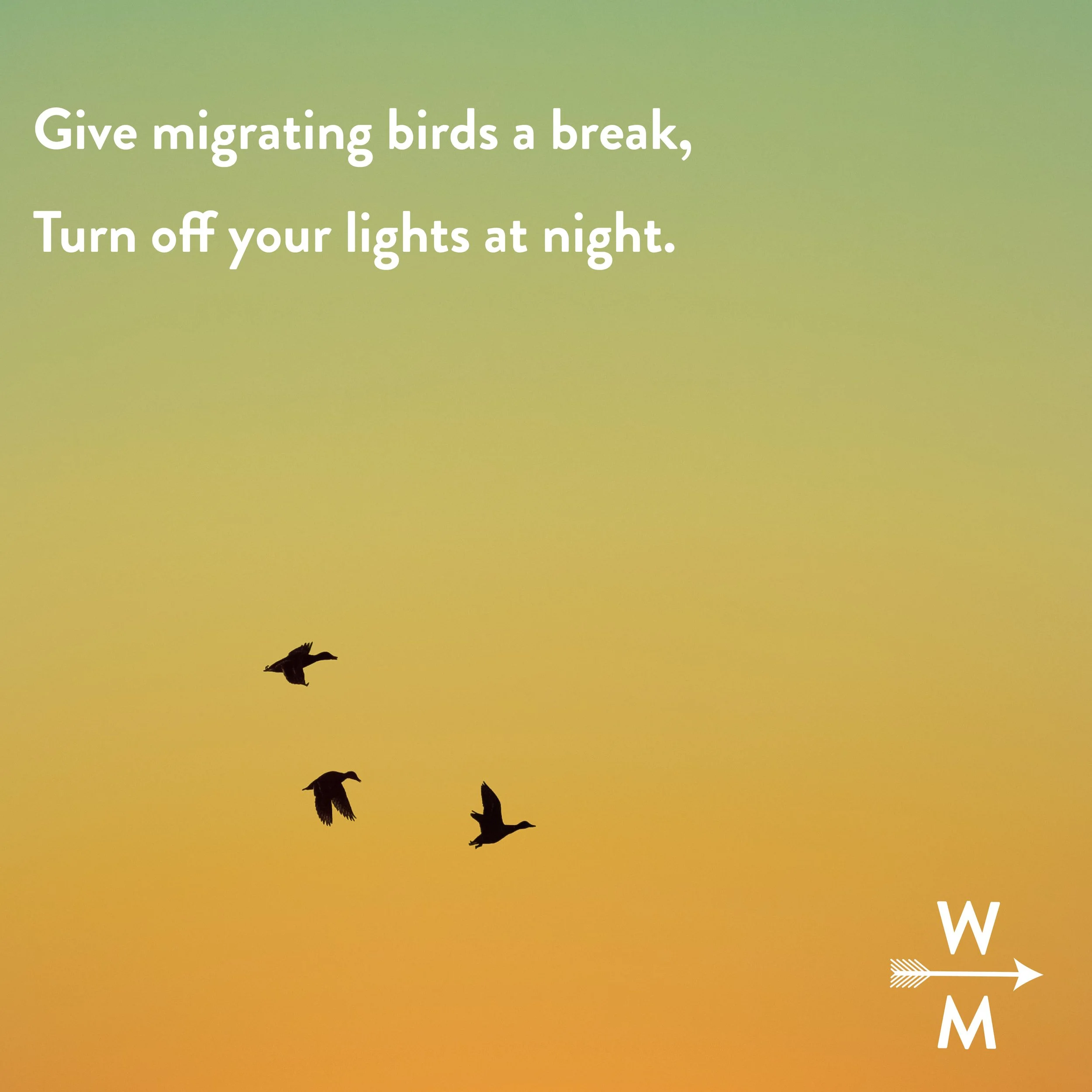
Turn Off the Lights
"Up to 1 billion birds die each year in the United States from colliding with buildings or structures. As migratory birds travel through cities with large buildings and bright lights, they can become disoriented by the lights, causing them to collide.
You can help birds during critical migration periods by turning off all non-essential lights from 11 p.m. to sunrise. Learn more about how you can help by visiting BirdCast's Lights Out webpage. You can also find out if a large number of migratory birds is passing through your area by checking BirdCast's online alerts."
Paint a Window Warning
"Hundreds of millions of birds in the U.S. die from hitting glass every year – almost half of those on home windows. Luckily, there are many ways to make your windows safe for birds. One of my favorite methods is applying tempera paint to the outside surface of glass. Tempera is nontoxic, cheap, easy to use (and remove) and amazingly long lasting — even in rain. If you're short on time, using a sponge is a good way to make a quick pattern. With a little more effort, you can create spring-themed designs or even small works of art depicting your favorite birds; either will help prevent collisions. Remember: Whatever kind of design you use, make sure your lines are no more than two inches apart to help smaller birds avoid collisions."
Support the Laws That Migratory Birds Can't Live Without
"The Migratory Bird Treaty Act (MBTA) is one of the most important pieces of legislation affecting birds in the U.S. Unfortunately, the previous administration made the MBTA harder to enforce by claiming that the law does not address unintentional harm to birds caused by industrial activities. This move is expected to be reversed by the Biden Administration, but we need to ensure that MBTA protections are in place permanently. Please ask your Representative and Senators to be co-sponsors of the Migratory Bird Protection Act, a bill that would strengthen the MBTA and go even further to protect migratory birds."
Protect Birds From Cats
"Cats are lovable pets, but they're also instinctive predators. One cat alone may kill up to 55 birds each year. It all adds up! So keep your cat on a leash or in an enclosure to protect migratory birds (and keep your cat safe, too). Don't have a cat? You can still support bird-friendly practices in your community by encouraging the passage of local ordinances mandating responsible pet ownership. Learn more about other simple actions you can take to protect birds on our Cats Indoors page."
Reduce Your Plastic Footprint
"It's estimated that there are about 330 billion pounds of trash on our coasts and in our oceans, with another 17 billion pounds of plastic entering the marine environment each year. Birds can ingest plastics or become entangled in them, which can cause serious injuries or even death.
No matter how far you live from our coasts, your daily actions can have an impact! Eighty percent of trash in the marine environment comes from land-based sources, as trash easily travels via gutters, rivers, bayous, and other watery pathways to our oceans. Switching from disposable plastic items to reusable alternatives is a great way to reduce trash. Consider using reusable bottles, cups, bags, utensil sets, and more — there are many great ways to reduce your plastic footprint! To learn more, check out ABC's clean coast program, Stopping Plastics and Litter Along Shorelines (SPLASh)."
Buy Bird-Friendly Coffee
"After oil, coffee is the most traded commodity in the world. To meet demand, coffee is often grown on monoculture plantations across the world, which cover hundreds of thousands of acres and reduce habitat for birds and wildlife. However, there is a better alternative. Shade-grown coffee, cultivated under existing tree canopies, doesn't require deforestation, leaving habitat intact for wildlife. It also tastes great.
The Bird Friendly coffee certification developed by the Smithsonian Migratory Bird Center establishes the best coffee farming practices to provide birds with forest-like habitat. Birds are not the only ones to benefit from Bird Friendly coffee; farmers who receive certification from the Migratory Bird Center can also access better prices for their coffee. In early 2021, ABC and its Venezuelan partner, Provita, worked with farmers to help market and sell Venezuela's first-ever Bird Friendly coffee."
Keep Your Woods Wild
"You can provide habitat for birds during spring migration by letting things around the house get a little messy. I have a wooded backyard, so I try to leave it as natural as possible. I let the understory grow and pull invasive plants such as Japanese Stiltgrass and Garlic Mustard. I leave logs and fallen branches in place to shelter insects and other small critters that birds feed on.
When larger trees break or fall, I leave them be — as long as they're not hanging over the roof. This gives snag-nesting migrants like the Great Crested Flycatcher places to nest — along with year-round residents like the Eastern Screech-Owl and Downy, Hairy, Pileated, and Red-bellied Woodpeckers — and is a nice source of grubs and other bird food."
Give Beach-nesting Birds a Break
"As temperatures rise, many of us begin heading to the beach. And we're not alone: This is a critical time for several migratory species — I'm thinking of Black Skimmers, Snowy Plovers, and Least Terns — that lay their eggs in the sand and are particularly vulnerable. One of the biggest challenges they face is the threat from unleashed dogs. Our team in the Gulf Coast region has seen loose dogs eat eggs and take chicks. This is a big problem, considering that nearly all of these birds have declining populations. The obvious solution is to leash dogs. As our team likes to say, 'Bird-friendly beaches have dogs on leashes!'"
Support Groups That Are Making Birding More Inclusive
"Everyone should be able to enjoy the wonders of bird migration, and we all have a role in making that possible. Many who engage in birding face issues related to discrimination, safety, and access, including birders of color, women, LGBTQIA+ people, or folks with disabilities.
In addition to events like Black Birders Week and Latino Conservation Week, groups such as Birdability and the Feminist Bird Club are working to address these and other barriers through advocacy, education, and community engagement. By following and supporting this work, we can help the communities these groups serve and the birding community at large. Bringing more people into the fold, with diverse perspectives and experiences, is also a good way to strengthen bird conservation. As Dr. J. Drew Lanham wrote: ‘If the goal is to conserve, then we need all involved that we can muster.'"
Fuel a Hungry Hummingbird
"Put out those hummingbird feeders during spring migration — the hummers are arriving. Be sure to use a mixture of four parts water to one part sugar. And do without the dye: Red dyes serve no purpose. Most hummingbird feeders already have enough color on them to attract hummingbirds, and, even worse, these dyes contain petroleum that may be harmful to hummingbirds. Don't forget to change the mixture and clean feeders often to be sure it's fresh and safe for those super-charged flying jewels."
Inspire a Future Bird Conservationist
"I have younger nieces and nephews in Wisconsin, and when I visit them during spring migration, I like to make sure they get outside, where I can introduce them to birds: Mr. Blue Jay, Mr. Cardinal, Mrs. Common Yellowthroat. Introducing birds to kids at a young age can instill a desire to explore the natural world. And that's only one benefit. It also helps children bond with wildlife and develop an environmental ethic that will, hopefully, remain with them for the rest of their lives. I'm hoping one of my nieces or nephews will be the John Muir of 2030!”
For more information, be sure to check out bird supporting organizations such as ABC Birds, All About Birds, and Birdcast.
Related Links
If there is a home that you would like more information about, if you are considering selling a property, or if you have questions about the housing market in your neighborhood, please reach out. We’re here to help.
Search Homes in Colorado
Search Homes in Oklahoma
Search Homes in Oregon