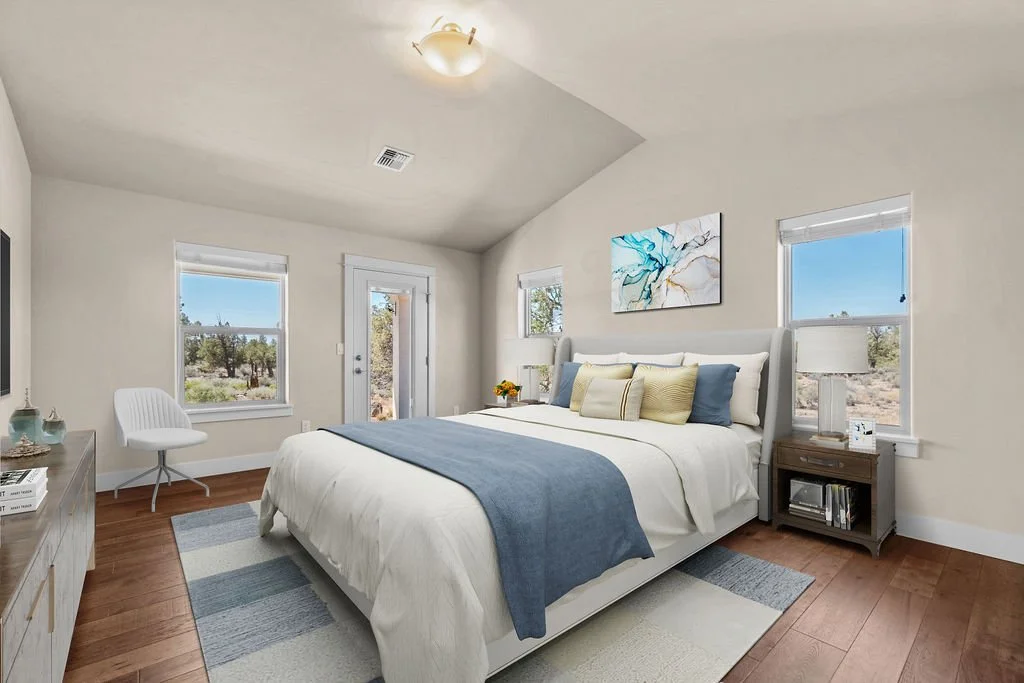
Just Listed: Light and Bright Bend Home Close to Trails


Lovely 4-bedroom home built by Rogers West Construction, light & bright with open floorplan, wood accents, spacious primary suite on the main level & large bonus room.

Located on the desirable Westside at the Lodges at Bachelor View, about 200 feet from trails, 17 miles to Mt Bachelor, & 5 minutes to downtown! Enjoy all the fine interior finishes such as hand-textured walls, hardwood floors, soft close cabinetry, & quartz-slab counter-tops. Beautiful kitchen has plenty of cabinets & drawers with large island & quality appliances to make cooking & entertaining easy. Stay organized with many closets throughout especially with the custom-built drawers/cabinet system in primary suite. Entertain on the covered & extensive back patio with pergola & modern gas firepit table. Low-maintenance backyard is fully fenced with gate. Plenty of room to store your outdoor gear in the garage with upper storage racks & quality cabinets!

Listed by Lisa McCarthy for West + Main Homes. Please contact Lisa for current pricing + availability.


Have questions?
West + Main Homes
westandmain.co
hello@westandmainoregon.com

Presented by:
Lisa McCarthy
(541) 419-8639
lisam@westandmainoregon.com


Search homes in Oregon
 

Just Listed: Beautiful and Upgraded Home on Expansive Acreage in Alfalfa


Who says you can't have it all?

Built in 2020, this amazing 3 bedroom, 2 bathroom New Era built home offers quality craftsmanship with thoughtful design, as well as privacy and room to roam including a den/office space and upstairs bonus room. Escape the hustle and bustle of the city on this expansive 83+ acre lot with native juniper tress, grasses, rock outcroppings and peak-a-boo views of Cascade Mountains. The property is fully fenced and adjoins 1,000's of acres of BLM lands on the North and West sides of the property. No expense has been spared: vaulted ceilings, wood and tile flooring throughout, quartz countertops, matching stainless steel appliances, wine refrigerator, new front loading washer and dryer included, 2 gas fireplaces, soaking tub, walk in shower and heated tile bathrooms, California Closets systems in all bedrooms + garage. 2nd story Trex deck with panoramic and expansive terrain views, Tesla EV charger, sauna, pump house and 2 outbuildings. EFUAL zoning and infrastructure including electrical pedestal, well & 1,500 gallon cistern in place. The list is endless on why you should come make this homestead your home-sweet-home and horse property.

Listed by Shaleana Stout for West + Main Homes. Please contact Shaleana for current pricing + availability.


Have questions?
West + Main Homes
westandmain.co
hello@westandmainoregon.com

Presented by:
Shaleana Stout
(541) 647-3275
shaleana@bendrelo.com


Search homes in Oregon
 

Is Pet Insurance Right for You?


Jean Chatzky from Her Money walks through why she chose pet insurance + the steps she took.

We were driving from our home in the New York suburbs to the Jersey Shore when Teddy, our 3-year-old cockapoo, started to shake. At first, I thought he was just scared – he shook when we went to the vet or to the groomer.  In fact, he had such a canny sense of direction that he would start to shake when we made a left out of our development toward either of those places.  It took about 30 seconds for me to realize this shaking was different.  “Can you pull over?” I asked my husband, Eliot.  “Something is wrong with him.”

“Something” turned out to be a seizure – the first of many in our beloved pup’s 16-year-long life.  It wasn’t life threatening.  We didn’t even put him on medication. Our vet said one of the side effects might be to shorten his life.  Instead, we just watched him, keeping him away from the stairs whenever one started and (despite advice to the contrary to keep our hands off him when one started in case this gentle creature chomped down) holding and comforting him through them.  

That was the moment I decided: The next time I get a puppy, I’m buying pet insurance.  

Why didn’t I buy it then, you might wonder?  Very good question.  I knew that pre-existing conditions wouldn’t be covered and figured — probably incorrectly — that because Teddy already had one it wasn’t worth getting a policy.  We got lucky, aside from a dislocated hip at age 15 (which after a month in a brace of sorts, we treated with acupuncture – really, it works!) he really had no major medical issues.  But thinking back, I should have done more research.  If Teddy had needed chemo or major surgery, I would have paid for it.  Why?  Because he wasn’t just a dog.  He was family.  Insurance – even a policy that excluded his seizure disorder — would have been the way to go. 

Fast forward a decade and a half and the pet-owning world has come a long way, thanks in no small part to “COVID puppies.”  Seventy percent of US households have pets, according to the 2021-2022 Pet Owners Survey, up from 67% in 2019 – 69% have dogs, 45% cats (yes, there’s clearly overlap), 10% have birds and about 6% have some other small animal.  The pet insurance market is growing fast, too – at a rate of about 24% a year from 2016 through 2020.   Most of those policies were for dogs, where annual premiums in 2020 averaged $595 for coverage of both accidents and illnesses and $218 for accidents only, according to the North American Pet Health Insurance Association.

As of a couple of months ago, I hold one of these newly acquired pets.  Norman came into our lives as a 9-week-old, 6-pound snuggle bug.  Yes, he’s another cockapoo, although larger and floppier than Teddy.  (The floppy part may be puppyhood.  As for the large, I’m not so sure.  We were told he’d be small enough to fit in an under-the-seat airline carrier.  At 23-lbs-and-growing, that ship has sailed.  Perhaps we should have named him Clifford.)

Because I’ve spent years as a personal finance reporter, I’ve figured out how to shop for – and evaluate – pretty much everything from credit cards to warrantees to, yes, insurance policies.  As the pet insurance landscape is a crowded one, I thought it might help you to know how I made my final choice.  Here are the steps I took. 

  • Check Eligibility. Some companies have both minimum age requirements (typically around 8 weeks) at enrollment and maximum ones (around a dozen years). Also, as I mentioned before, you want your pet to be relatively healthy when you enroll. Too many excluded conditions and a policy may not make sense. As a pup who’d only been to the vet for well visits and shots, these weren’t issues for Norman.

  • Look at coverage limits. Most insurers cap the amount they’ll pay at anywhere from $2,500 a year and up. That wasn’t enough for me. I wasn’t buying this in case Norman – like Teddy before him – was susceptible to frequent ear infections. At $160 a pop (vet bills and medicine combined) they were annoying, but weren’t going to derail my ability to max out my 401(k). I was insuring against a cancer diagnosis that could cost $10,000 or more to treat.

  • Understand what you’re getting – and what you’re not. In general, pet insurance policies don’t cover well visits, spaying or neutering or — with an exception or two — dental care. (Regularly brushing your pet’s teeth is a highly worthwhile financial exercise. Not only does a teeth cleaning often require anesthesia and cost hundreds of dollars, but neglecting oral care can cause multitudes of other health issues.) Some policies cover hereditary and congenital conditions and others don’t. And some that do cover these conditions mandate a waiting period before this coverage kicks in. Compare apples-to-apples.

  • Price it out. Once you’ve figured out what you’re looking for in greater detail, it’s time to compare companies. I found most insurers have helpful websites that enable you to type in a few details about your new pet which will result in a quick quote. You’ll have to choose a deductible (typically it resets annually) and a reimbursement rate (generally, 60% to 90%) of covered services. The higher your deductible and lower your reimbursement rate, the lower your monthly premium will be. (Pro tip: One thing not to do? Type your information into a pet insurance finder that will get you a quote from multiple insurers. Months later, I’m still deleting emails about Norman.)

Finally, if you’re like me, you’ve got friends who are also pet owners.  Ask them if they have insurance, which company they use and whether they’re happy.  That’s how I heard about Sadie, the pandemic pup my friends Debi and Marc brought home in late 2020.  Poor Sadie happened upon a pack of Trident gum, which she proceeded not to chew, but to eat – wrappers and all.  Gastrointestinal distress ensued – the official diagnosis was Xylitol poisoning — two three-day stints in the hospital followed and although she’s now pretty much back to normal, she’ll be on liver medication for the rest of her life.  The total bill? $5,428.  But, Debi told me their insurer, Healthy Paws, paid $4,636 of it, no questions asked.  “Now [our daughters] can still go to college,” she said, not really kidding.

Get more tips like this.

Related Links

If there is a home that you would like more information about, if you are considering selling a property, or if you have questions about the housing market in your neighborhood, please reach out. We’re here to help.

Search Homes in Colorado

Search Homes in Oklahoma

Search Homes in Oregon

Americans Who Can’t Afford Homes Are Moving to Europe Instead


Prohibitive housing prices, a strong dollar and political rancor have contributed to a wave of Americans relocating to Europe.

More Americans are relocating to Europe, driven across the Atlantic by the rising cost of living, inflated house prices, a surging dollar and political rancor at home.

Italy, Portugal, Spain, Greece and France are among the most popular destinations. Sotheby’s International Realty said requests from Americans looking to move to Greece rose 40% in the April-to-June period compared to a year earlier. In France and Italy, US demand is the highest it’s been in at least three years, according to Knight Frank real estate specialist Jack Harris. And Americans made up 12% of Sotheby’s Italian revenue in the first quarter, compared to just 5% in the same period a year ago. 

Retirees and the wealthy have traditionally been the prime American buyers of real estate in Europe. But relatively cheap housing — particularly in smaller cities and towns — and the rise of remote work have made the continent alluring to a wider range of people, including those who are younger and find themselves priced out of the housing market at home. Growing crime rates in some US cities and political divisions have also led Americans to look across the pond for a quieter lifestyle, buoyed by a euro that just dropped to parity with the US dollar for the first time in more than 20 years.

The average price of a home in Atlanta reached $404,575 as of June 30, up 19% from the previous year, whereas an 800-square foot property in the Palermo region of Sicily cost 86,560 euros on average, according to real estate platforms Zillow and Idealista. 

“The rising cost of living has made it more expensive to live in any major US city than in European cities,” said Michael Witkowski, vice president of US-based expat consultancy ECA international. “Expensive home prices as well as a strong US dollar and political tensions are all contributing factors to the growing allure of Europe.”

Retire at 50

To be sure, it's not always easy to pick up and move to another country. There are visa requirements, and the tax situation can be complicated and costly. The US taxes all its citizens regardless of where they live, and working remotely for an American company while in another country can create tax headaches for you and your employer.

To address some of these issues, Italy will begin offering a remote-worker visa for foreigners later this year, which Synclair is hoping to get.  The government also introduced a program in 2019 to sell one-euro homes in rural areas to foreign buyers who would pay for renovations and boost the local economy. 

Initially lured in by the one-euro homes, Miami-based Cathlyn Kirk, 47, ended up buying a three-bedroom, three-story home in Mussomeli, the same village as Synclair’s, for 37,000 euros last November. Planning to retire in two years, the officer with Homeland Security wanted to move to a country where she would be able to live comfortably on a public pension.

“I'm able to retire at 50 and still live a good life, filled with traveling and eating well,” Kirk said. “Not a lot of people can do that.”

Cost and Safety

The Iberian Peninsula has also become a popular destination. The number of Americans residing in Portugal rose 45% in 2021 from the previous year, according to government data. In Spain, which has the largest American population in Europe, the number of US-born residents rose 13% between 2019 and 2021 and demand has continued to rise this year, according to Alejandra Vanoli, managing director of Spanish real estate agency Viva.

To attract foreign buyers, Portugal and Spain both offer so-called “golden visas,” programs which give residency rights based on an initial investment of 350,000 euros and 500,000 euros, respectively. 

Keep reading on Bloomberg.

Related Links

If there is a home that you would like more information about, if you are considering selling a property, or if you have questions about the housing market in your neighborhood, please reach out. We’re here to help.

Search Homes in Colorado

Search Homes in Oklahoma

Search Homes in Oregon

The Top Up-and-Coming Real Estate Markets Now Have This One Crucial Thing in Common


With the cost of everything from gas at the pump to a box of cereal surging, Americans are desperately looking for a break.

And with rising mortgage interest rates now making it even more expensive to purchase a home, many buyers are looking for real estate deals further off the beaten path.

Many of the up-and-coming housing markets of the summer were smaller cities far from the coasts that boasted more affordable home prices, according to the Wall Street Journal/Realtor.com® Emerging Housing Markets Index. Seven of the top 10 had median list prices that were below the national median of $450,000 in June.

The top emerging housing market was Elkhart, IN, which is no stranger to this list. Prices in the small, Midwestern metropolitan area, about 30 minutes east of the University of Notre Dame and South Bend, IN, and roughly two hours from Chicago, have soared. They rose 17.2%, to a median $279,450 in June, from the same time a year ago, according to the most recent median list prices from Realtor.com.\

“With home prices at record highs and interest rates pushing the mortgage payment of a typical house 60% higher than last year, buyers are attracted to markets which offer more for their money,” says George Ratiu, manager of economic research for Realtor.com.

The index identified the top markets for both buyers and investors out of the 300 largest metropolitan areas. The quarterly index looks at metropolitan areas with strong housing demand and rising prices combined with robust economies, lots of well-paying jobs, a good quality of life, and desirable amenities such as lots of small businesses and reasonable commutes to work. (Metros include the main city and surrounding suburbs, smaller towns, and urban areas.)

“In addition, today’s top emerging markets offer the benefits of a strong local economy,” says Ratiu. “The top 10 metros tend to be home to a good mix of private industries, health care, higher education, along with government agencies and institutions. With low unemployment rates, these locales also offer slightly higher wages.”

Elkhart is a recreational vehicle manufacturing powerhouse with an unemployment rate of just 1.8% in May—about half of the national average. Most of the area’s buyers are from nearby South Bend as well as Chicago. About 44% of the area’s buyers are from outside of Indiana, according to Realtor.com.

The area is particularly appealing because it’s so affordable. Those buying a home in the Elkhart metro area are looking at a roughly $1,275 monthly mortgage payment for a median-priced home, according to Realtor.com data. That’s significantly lower than the national median of $2,100 a month.

“Our market this last year has been extremely strong. Inventory’s been low, and demand’s been extremely high,” says local real estate agent Toni Bontrager, of Berkshire Hathaway HomeServices. However, that’s beginning to wind down. Two local RV manufacturing plants are shutting down this fall, and the national economy has become a bit shakier.

“Everything’s slowing down right now,” says Bontrager. “It’s been a seller’s market. I think we’re slowly transitioning into a buyer’s market.”

Homes priced below $200,000 are still going fast—often with multiple offers, says Bontrager. But most homes priced above that are now taking longer to go under contract as bidding wars are no longer as common for them.

Despite the shift in the local real estate market, Elkhart is likely to remain popular with buyers, particularly those looking for deals.

“People make good money here,” says Bontrager. “Homes here that are $400,000 or $500,000 would be over $1 million in California. … We have lakes and rivers, and it’s an absolutely a beautiful place to call home.”

Top 10 emerging real estate markets of summer 2022

  1. Elkhart, IN, $279,450*

  2. Burlington, NC, $380,150

  3. Johnson City, TN, $350,000

  4. Fort Wayne, IN, $286,400

  5. Billings, MT, $544,000

  6. Raleigh, NC, $499,950

  7. Rapid City, SD, $409,900

  8. North Port, FL, $598,500

  9. Topeka, KS, $225,000

  10. Visalia, CA, $415,995

* Median list prices for the metro area in June from Realtor.com

Keep reading.

Related Links

If there is a home that you would like more information about, if you are considering selling a property, or if you have questions about the housing market in your neighborhood, please reach out. We’re here to help.

Search Homes in Colorado

Search Homes in Oklahoma

Search Homes in Oregon