What’s Next in Front Yard Gardens: 7 Curb Appeal Strategies


Want the latest take on street-view style? Home and landscape designer John Gidding, host of HGTV’s ‘Curb Appeal’ franchise for seven years, has big ideas.

WE AMERICANS LOVE our front lawns. Fairway-like expanses on which to run barefoot, toss a ball, attempt to perfect a so-so golf swing. Not that we often do these things, if ever. Still, we generally leave room for our country-club fantasies, devoting most of our plot to turf, with shrubbery and few trees hugging the edges—what John Gidding refers to, sadly, as a “houses on platters” style of landscaping. 

Since 2004, San Francisco-based Mr. Gidding, who designs homes and landscapes, has hosted television shows in which he transforms living spaces. These include iterations of HGTV’s series “Curb Appeal,” which takes homes’ exteriors and yards from dull to covetable. Many of his beautifying strategies are classic, such as ensuring a clear sight line to the front door and pushing for welcoming lighting. But by the time he was working on “Curb Appeal Extreme,” the 2021 version of the franchise that transformed homes both front and back, he had joined a wave of landscape designers and architects who evangelize gardens that factor in local ecology and dwindling resources. His aim is not unlike that of the United States Golf Association, who urged greenkeepers facing water restrictions back in 2016: “[Reduce] turf in out-of-play areas where turf is not necessary.”

M r. Gidding’s philosophy is as much about aesthetics as it is climate change. Instead of mowed turf bisected by routine pavers that march from curb to doorstep, Mr. Gidding recommends what he calls “sylvan landscaping” (and other advocates term “forest gardening”): a layering of native greenery comprising trees, shrubs, perennials and ground cover. “It’s a much more romantic, naturalistic style,” he said. Sound like a lot of upkeep? Part of the point in choosing native material, he counters, is its low water and chemical requirements. “It’ll take a couple years to establish, but after that, it should be very low-maintenance,” he said, acknowledging that abandoning turf is a huge leap for most yard owners. But he has baby-step suggestions as well other curb-appeal ideas a 41-minute television episode can’t accommodate. Here, some essentials.

1. Glimpses of a facade are more beautiful than a full-frontal

Few people find a front-door approach flanked by keep-off-the-grass-style turf particularly welcoming. Much more inviting: a yard that affords passersby more-oblique, seductive sightings of the house. “It’s not like you’re crowding yourself in with trees and cutting yourself off from neighbors or sunlight,” said Mr. Gidding, who illustrates his vision below. His ideal neighborhood is “a bunch of houses in clearings within trees that create a lifeline for wildlife and reduce our dependence on pesticides and mowing lawns,” he said, referring to the EPA’s estimate that one gasoline-powered lawn mower produces roughly 35 times as much pollution as the average car.

2. A single tree can help

When trying to coax a Nashville couple to adopt his sylvan-yard concept on “Curb Appeal Xtreme,” Mr. Gidding learned the idea is a tough sell. Though the pair initially agreed to replace the lawn with an all-native landscape, he recalled, “As layer upon layer of planting material was delivered, they got scared and called us saying, ‘We’ve changed our minds. We could never take care of all these plants.’” Mr. Gidding was crestfallen. “You see on the show I’m not in the scenes where they’re rolling out sod. I refused.”

Another Nashville couple, Tony and Ann Richardson, admit that garden vegetation is harder to maintain than lawn. As part of the “Curb Appeal Xtreme” makeover of their home, copious planting—not exclusively native—now borders the steppingstones to their door. “However, it is well worth the extra work,” said Ms. Richardson. “We have seen an increase in many species, including bees, turtles, humming birds and frogs, and gardening is therapeutic and meditative for us.”

For the similarly creature-conscious but perhaps less ambitious, Mr. Gidding suggests this first step: Plant one native tree in your front lawn. “Trees are such a bedrock of wildlife support. And it’s a start.”

To single out a tree to try, take a field trip to a nearby nature preserve, he said. Alternatively, the Audubon society’s native-plant database at audubon.org lists trees indigenous to your zip code that will lure birds seeking both food and a happy-making habitat. 

3. Your front yard can become another outdoor living room

“Before Covid, people were like, ‘I don’t want seating in the front yard, that’s weird. I like to sit in my backyard,’” said Mr. Gidding. The isolation of quarantine changed attitudes, he added: “Post Covid, no questions asked. ‘Of course I would have seating in my front yard. It’s such a communal spot.’” This didn’t mean folks plopped themselves in full sight of traffic and passersby. Mr. Gidding replaced the concrete front stoop of the Richardsons’ midcentury-modern house with a cascade of small wood decks, for example. One level down from the door, he created a seating area partially shielded from the street by shrubs and grasses. Today the couple uses it for morning coffee and catch-ups with friends. During the pandemic, the nestled space, half private, half communal, helped combat cabin fever. “Sitting out front, having some kind of interaction with other people, even if just waving...did encourage us to use that area,” Ms. Richardson said. 

4. Facades should not follow color trends

Though Mr. Gidding broke his own rule at times on “Curb Appeal,” he blames the “trend pipeline” that a TV audience requires. “Don’t do what I do, do what I say,” he said, citing the fickleness of trends and the expense of repainting. Save of-the-moment colors for details like planters and fabrics, even shutters and doors.

5. Jewel tones always work on a front door

“Curb Appeal” taught Mr. Gidding this lesson. Sometimes, if he left a main entrance as is because it suited the home’s style, “I would get a note back from the network saying there’s not enough before-and-after pop.” So he’d paint the door, “and it was a revelation,” he said. “I learned over time that I could really push the front-door aesthetic, from a color perspective, as far as I wanted, and it would work almost every time.” Though he consequently has few door-hue rules, he’s found that gem tones—ruby, deep purple, emerald—rarely fail. “They have a richness to them, a sort of groundedness,” he said. Front doors often feature facet- or bevel-like edges, “so the jewel-tone analogy really works,” he said.

6. Every house has an architectural style you can build upon

So that the colors and details of your facade hang together, either identify your home’s style or attach a style onto it and let that be your guide. Every day he worked on “Curb Appeal,” Mr. Gidding says, he referred to “A Field Guide to American Houses” by Virginia and Lee McAlester, which he got while at Harvard’s Graduate School of Design. Even with a house of indeterminate style—say, vaguely ranch or colonial—“all it takes is identifying one or two key architectural features that help you latch the house onto an identity, and you’re off and running.” The McAlesters’ book calls out window trims, materials, etc., appropriate to your home’s type.

When confronted, for example, with a small, single-story house with Craftsman bungalow features—a low-pitched double roof and overhanging eaves—Mr. Gidding used the book to strategize his tweaks. He removed the architecturally inaccurate dentil molding that crowned the large front window, added natural-wood details and painted over the sky-blue exterior with muddy greens and blues, all true to the Craftsman spirit.

Even McMansions can be redirected. “If the developer of your home used unrelated details willy-nilly, resulting in a Garage Mahal, the work might be in removing some architectural features and streamlining your home toward an identifiable style,” he said.

7. Guidance is everywhere

The layperson is still out there, said Mr. Gidding, but in ever fewer numbers, thanks to social media. “Homeowners used to say to me, ‘I don’t really know what to do.’ These days they say, ‘Here’s my seven Pinterest boards.’” Mr. Gidding’s parting advice: Scour websites, DIY videos, Instagram. “There are many resources for facades that have worked. As soon as you start looking up styles of homes, you get very clear cues as to what to do to your house.”

Get more like this on Apple News.

Related Links

If there is a home that you would like more information about, if you are considering selling a property, or if you have questions about the housing market in your neighborhood, please reach out. We’re here to help.

Search Homes in Colorado

Search Homes in Oklahoma

Search Homes in Oregon

As Featured in West + Main Home Magazine: A Historic Bungalow with Potential Turned Denver Dream Home


When West + Main agent Kate Kazell and her family began their search for a new home in early 2021 they encountered an issue many homebuyers face: the houses they wanted were starting within budget and then ended up getting bid out of reach. Their search terms were a bit unique as well.

"We were looking for a bit of a unicorn, as we wanted a historic home...but also wanted some more modern features like an open-concept living space + a primary suite - which just isn’t how houses were built 100 years ago,"

-Kate Kazell


They got creative with the search and started looking for homes with potential to turn into the space they hoped for.

"During our house hunt, we made an offer on a super cute bungalow that had a couple walls taken down to create a huge open living area instead of the small, long and skinny living rooms that are standard in homes of that era,” said Kate. “It was beautiful and the best of both worlds - a charming historic home with a big space that we could envision kids running around in and having friends and family over without feeling cramped. When we didn’t get that house, we were kind of set on re-creating that feel and layout, and knew it would be possible to do ourselves."

Once they closed on this West Wash Park home, they got to work. The project was split into two main parts: knocking down walls on the main floor and removing a small bedroom for the open concept living room, and converting the original attic into a primary suite. This was no small feat.

"Truth be told, it was a pretty big project that required help from several professionals: an architect, a structural engineer, and a general contractor who managed dozens of subcontractors,” said Kate. “We shared with them what our vision was, and they created the plans taking into account what was physically possible, required by permitting, etc."

With a project of this scale, it was important to have professionals guiding Kate through the process and applying their knowledge. While she initially thought the attic conversion would be simple like finishing a basement, it ended up having a fair amount of structural implications and required architectural planning in order to work within the confines of the existing structure. With so many moving pieces, this project required professionals from almost every trade including framing, plumbing, HVAC, drywall + tiling. Using a General Contractor with good contacts in all of these fields to coordinate and manage the project was helpful to keep it all on track.

Below: Before photos of the downstairs of Kate’s home.

After of Kate Kazell’s living space

The new upstairs primary suite features a bedroom, a full bathroom with dual vanities, a shower with a skylight, and a reading nook on the other side overlooking the street.

"The design aspect of it was really fun because we got to pick everything - but it was a little overwhelming at times because there are SO many options," admitted Kate. “Thankfully the vision I had in my head ended up coming together really well! I wanted to bring back some of the original features of the home that had been lost in renovations over the past century, so we chose new Craftsman style trim to match the original window and door casings, traditional 5-panel doors, really cool unique replica doorknobs and a traditional penny-tile in our new bathroom that is similar to what you’d find in original early century homes.”

But overall, it also has a bit of a Scandinavian/minimalist vibe, with some modern features like the stair railing, bathroom finishes, and light fixtures.

As with any renovation, this project came with surprises, delays and additional costs. Kate's advice is to prepare for the unexpected: It’s definitely not a quick episode of 'Fixer Upper,' but it’s worth it in the end to have a space you love!

Kate on Design + Inspiration

Q: When it came to the design + finishes, what was your process?

Kate: “Ultimately our project ended up being two-fold - we knocked a few walls down and turned a small bedroom into part of a big living room…and we also converted the empty unused original attic into a primary suite. Truth be told, it was a pretty big project that required help from several professionals to include an architect, a structural engineer, and a general contractor who managed dozens of subcontractors. We shared with them what our vision was, and they created the plans taking into account what was physically possible, required by permitting, etc. The design aspect of it was really fun because we got to pick everything - but it was a little overwhelming at times because there are SO many options. Thankfully the vision I had in my head ending up coming together really well! I wanted to bring back some of the original features of the home that had been lost in renovations over the past century, so we chose new craftsman style trim to match the original window and door casings, did traditional 5-panel doors, found really cool unique replica door knobs to closely match the originals that were only left on one closet door, and did a pretty traditional penny-tile in our new bathroom that is similar to what you’d find in original early century homes. But overall, it also has a bit of a Scandanavian/minimalist vibe, with some modern features like the stair railing, bathroom finishes, and light fixtures.”

Q: What is your favorite part of the finished project?

Kate": “I absolutely love the bright open living/dining room - it’s a unique space and is super practical. I also love so many of the smaller touches we put on it - like the skylight in the shower, the exposed beams in our bedroom, and the original window in the dormer that we’ve made into a cozy reading nook.”

“A plus side to doing a full renovation is being able to create areas perfect for your own family.”

-Kate Kazell

Upstairs Bed + Bath Serenity

All in the details


If there is a home that you would like more information about, if you are considering selling a property, or if you have questions about the housing market in your neighborhood, please reach out. We’re here to help.

Search Homes in Colorado

Search Homes in Oklahoma

Search Homes in Oregon

41% of People Regret This Kitchen Reno, But You Don’t Have To


What do sage green, baby blue, and mustard yellow all have in common? They’ve been the trendiest kitchen cabinet shades for the past couple of years.

But not everyone is a fan. After surveying 1,000 renovators, MoneyWise found that nearly half of them, 41 percent to be exact, regret painting their cupboards a colorful hue or refinishing their original boxes. However, we can’t get enough of making a statement in the kitchen, whether it’s swathing standard IKEA frames in a poppy coat of fuchsia or mixing plywood and pastels. Ahead, we spotlight a few ideas that will change your mind about this so-called mistake.

Add Metallic Accents

Take a note from Joy Cho’s backyard ADU kitchen and spice up your cupboard doors by adding a brass accent. The seemingly random formation helps keep things casual; just be sure to use the metal fronts sparingly and save the larger panels for a muted hue. 

Keep It Streamlined

In Los Angeles, Rebekah Bowling and Andrew Chen stuck to their gut when choosing a bold cabinetry color. From the lowest drawers all the way up to the skylight, a deep teal swaths everything in sight. The trick with an allover shade like this is to avoid distracting hardware and go with sleek integrated pulls.

Go Totally Tonal

A windowless galley kitchen in a London mews may sound dark and dismal, but thanks to pastel pink millwork, light still finds a way to bounce around. Paired with a bright red ceiling, the statement space is a contrast to the rest of the home’s stark white walls.

Get more like this on Domino.

Related Links

If there is a home that you would like more information about, if you are considering selling a property, or if you have questions about the housing market in your neighborhood, please reach out. We’re here to help.

Search Homes in Colorado

Search Homes in Oklahoma

Search Homes in Oregon

Oregon Pet Ownership Increased Dramatically During the Pandemic


When it comes to what makes Oregonians happy, especially during the pandemic, their pets and their hilarious antics come up again and again, according to a new statewide survey.

Since the onset of the pandemic in early 2020, 1 in 3 Oregonians adopted a pet, a survey on pet ownership conducted by the Oregon Values and Beliefs Center found. In the past two years, the survey showed, many Oregon households, especially women and families or households with children, welcomed a new pet into the family. Nearly half, or 47%, of people with school-aged children adopted pets during that time compared to 31% of other households.

Women were found to be more likely to adopt pets during the pandemic than men.

Oregonians with household incomes of $100,000 or more were more likely to have a friend or family member that adopted a pet during the pandemic-related shutdown than people with lower incomes, the survey showed.

The survey included people of all ages, with nearly half of people under 30 adopting pets, and over half of people 65-74 choosing to adopt dogs.

“Pets bring joy,” said Donna Casey of Deschutes County. “I would love to see more dogs brought into retirement communities. How could that happen? And how can we reduce pets for sale and encourage adoption?”

The survey found, unsurprisingly to anyone who has a beloved pet, that people whose family or friends adopted a pet overwhelmingly, or 85% of survey participants, said the pet seemed to make them happier.

One in six new pet owners, or 18%, said stress related to COVID-19 influenced their decision to bring a new pet into their lives. One in four residents with children at home, or 25% of participants, said the stress from the pandemic factored into their decision to adopt a pet, compared to 15% of people without kids at home, the survey showed.

Rural residents were more likely than urban ones to adopt a pet in the past two years, the survey showed. It was mostly urban residents who said pandemic stress factored into their decision, with more than a quarter of urban residents saying COVID-19 stress absolutely or somewhat influenced their decision. For rural residents, only 5% said that.

The survey pointed out that this disparity could be because there are more young people concentrated in urban areas compared to rural areas, and it was mostly young people who were influenced by pandemic stress to buy pets.

About a quarter of people under age 45 said stress was a factor in their decision to adopt an animal compared to 4% to 16% of people in other age groups, the survey showed.

More dogs were adopted than cats, but not by a very large margin, while about one in 10 Oregonians adopted different types of animals.

“Any pet species now appears to have exceeded humans in every positive quality,” Rob Brazeau of Deschutes County said.

The overwhelming consensus, among 93% of Oregonians who participated in the survey, is that pets make people laugh. People also largely felt pets help people feel less lonely or reduce stress, something that appears to be especially true for women compared to men.

“Two elderly cats, who I serve their every whim, are my household companions,” Robin Johnson of Deschutes County said.

Another not surprising finding in the survey was that nearly all Oregonians consider their pets part of their families, with 71% of people allowing their pets to sleep with them in their beds.

The statewide survey included 1,446 Oregon residents 18 years or older, and took each participant about 15 minutes to complete. To ensure diversity in the survey results, the Oregon Values and Beliefs Center set demographic quotas and recorded data based on the area of the state participants were from, their genders, ages, and education levels. Participants form a wide variety of backgrounds were included.

Read more on The Bend Bulletin.

Related Links

If there is a home that you would like more information about, if you are considering selling a property, or if you have questions about the housing market in your neighborhood, please reach out. We’re here to help.

Search Homes in Oregon

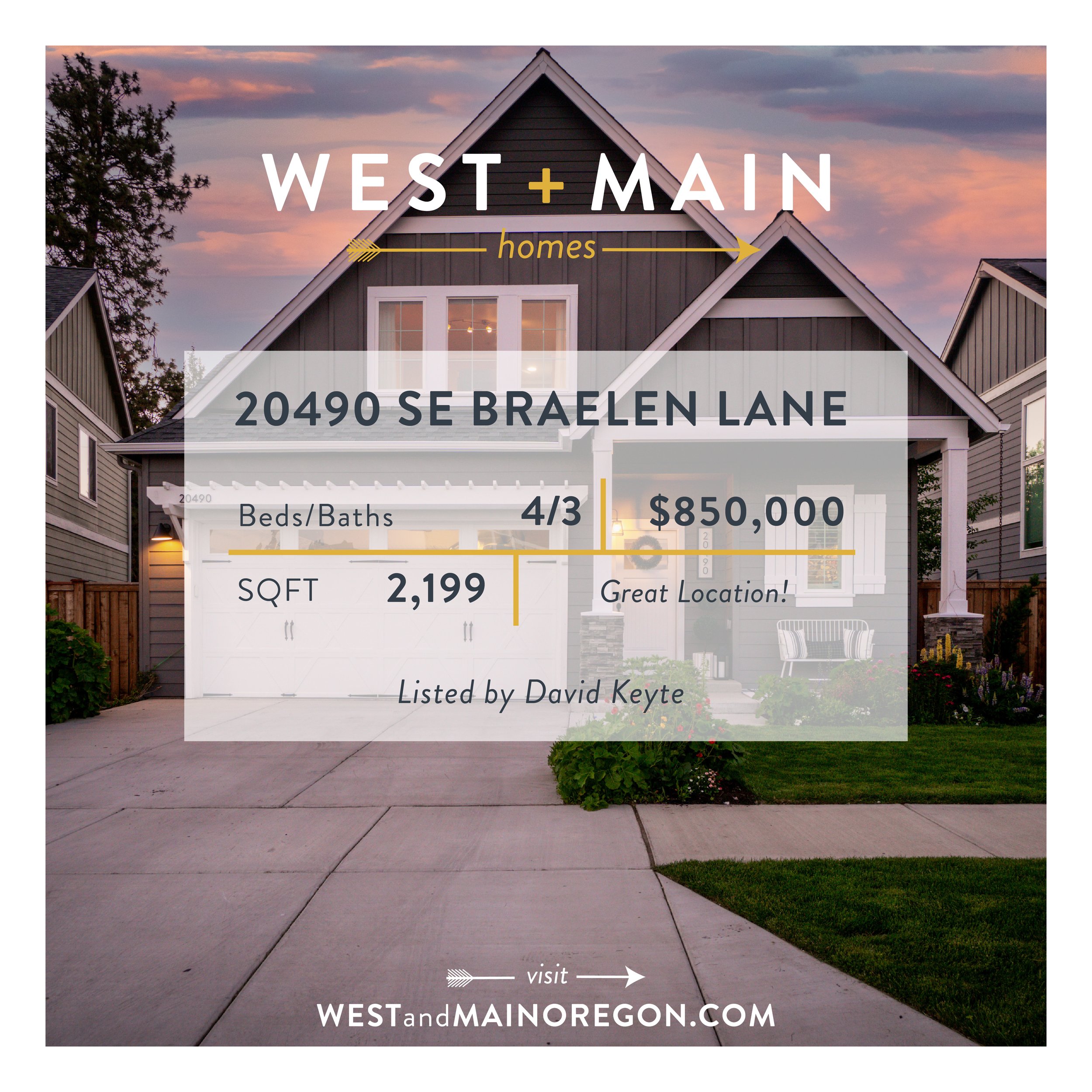
Just Listed: Modern Treasure in Farmington Reserve


Modern treasure in Farmington Reserve!

This 2199 sq ft stunner in SE Bend features countless upgrades, with 4 bedrooms, 3 baths and all the comforts of home. Watch the sunset from the back patio private oasis. This spectacular dream home is a rare find, and beautifully designed for Bend living now.

Listed by David Keyte for West + Main Homes. Please contact Dave for current pricing + availability.


Have questions?
West + Main Homes
westandmain.co
hello@westandmainoregon.com

Presented by:
David Keyte
(541) 797-8356
dave@bendrelo.com


Search homes in Oregon