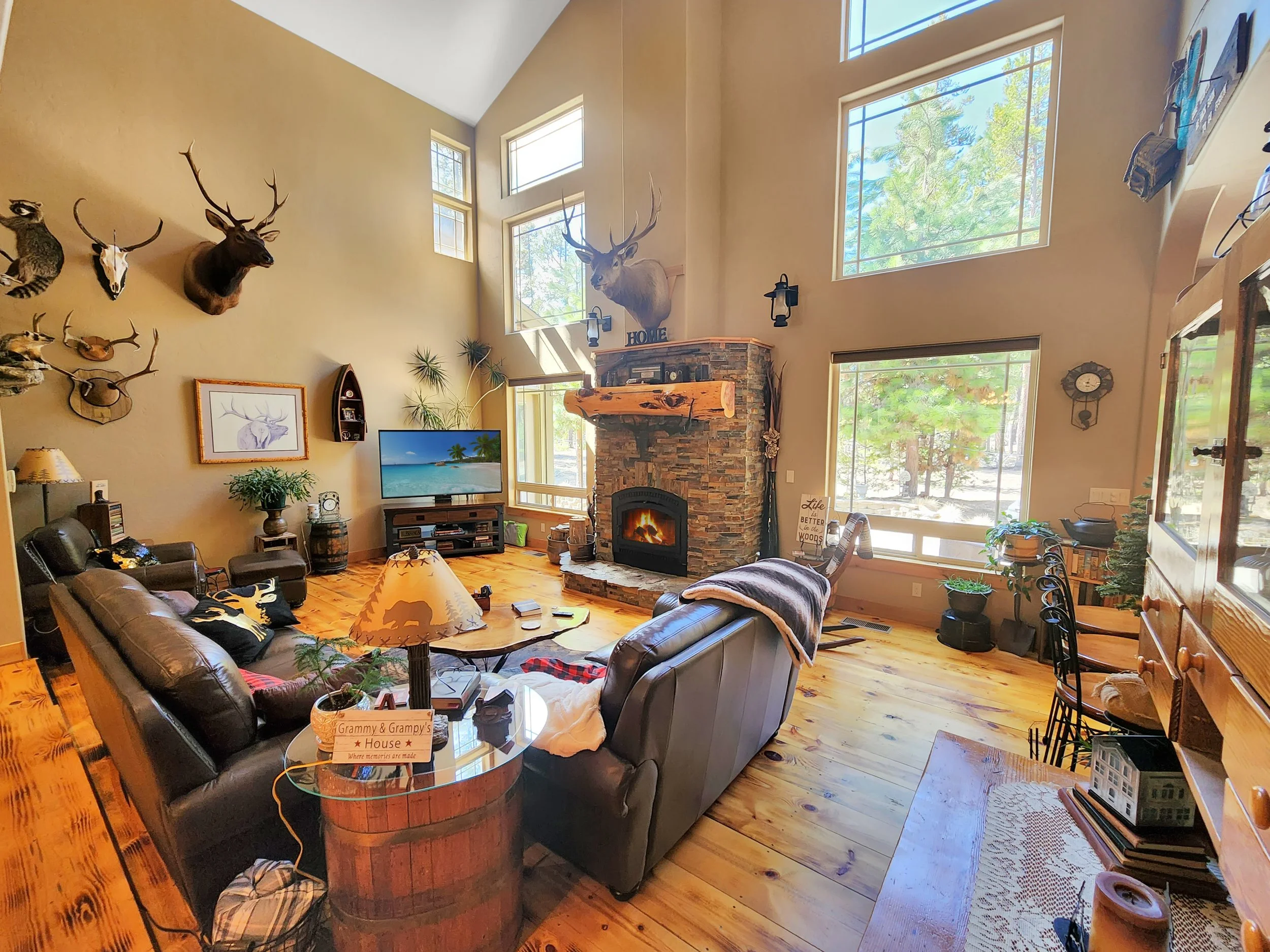
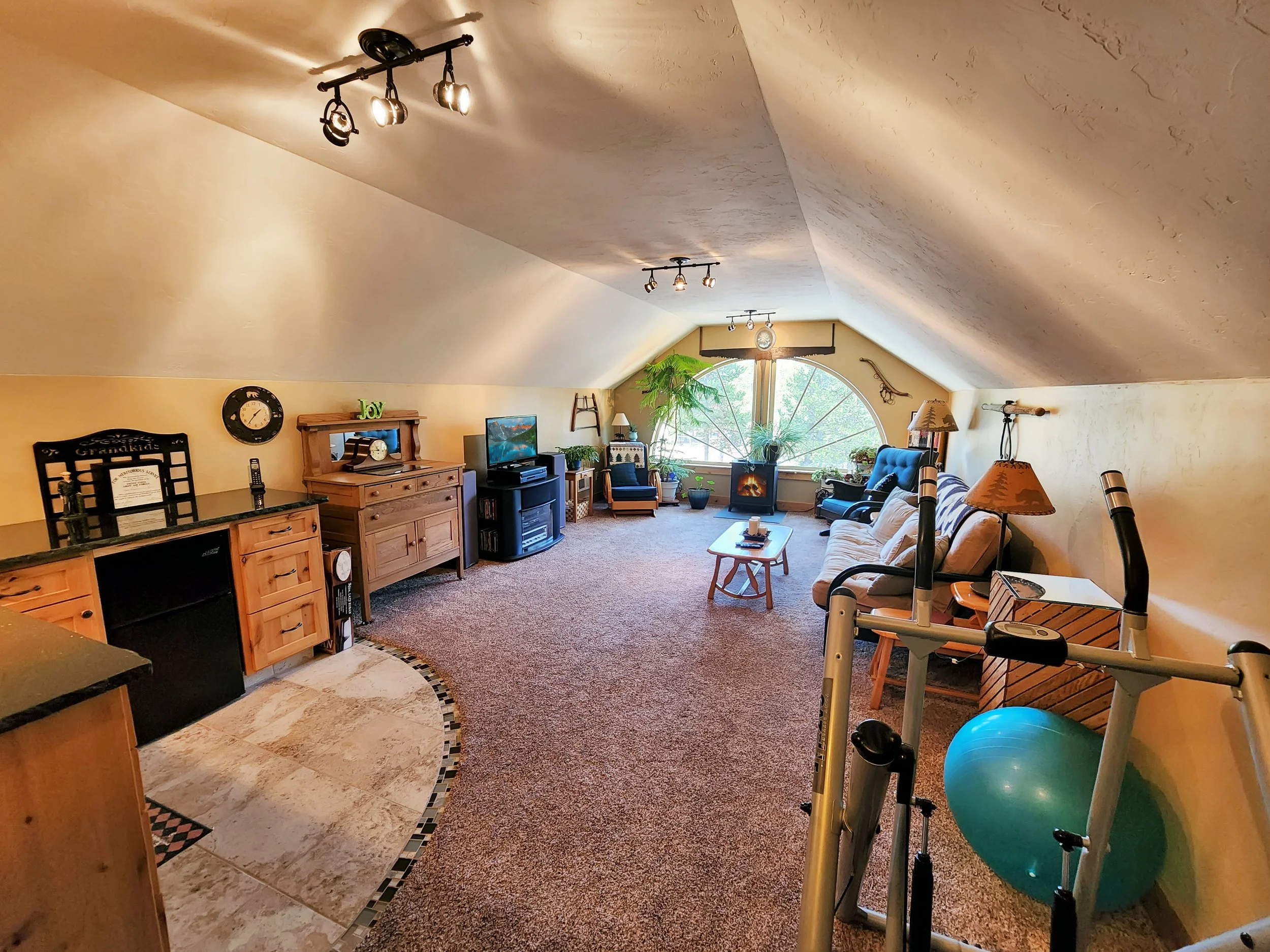
Just Listed: Custom Home with Deschutes National Forest Frontage


Come home to this amazing setting on a paved road that backs up to miles of National Forest Land.

Highly desired Sunrise Blvd home with over 500 feet of Deschutes National Forest frontage. This is more than a builders custom home, this home is a piece of art with timeless finishes hand tooled metal and wood found throughout the home. Primary bedroom suite is downstairs along with home office, laundry, formal dining and living room. Upstairs you find additional living space with a huge family room area with a kitchenette. and 2 additional bedrooms, one which is adjoined to the hall bath. 3 car attached garage with one double 6 foot door and one single 9 foot door. Easy care landscaping and Outdoor living is astounding with patio off the kitchen and eating area that looks out on to the forest where deer and elk are often present. 3 storage buildings resemble a western town, but are completely functional. Huge shop with insulated upstairs for storage.

Listed by Thesa Chambers for West + Main Homes. Please contact Thesa for current pricing + availability.


Have questions?
West + Main Homes
westandmain.co
hello@westandmainoregon.com

Presented by:
Thesa Chambers
(541) 771-7064
thesa@centraloregonbuzz.com


Search homes in Oregon
 

Just Listed: River Front Home on The Big Deshutes


River Front on the Big Deschutes! Short Term Rental Approved by HOA and Property is Eligible!

Ranch Style, Single Level Home, featuring 3 Bedrooms & 2 Bathrooms in River Meadows! Located in the Back Corner of the Community, this Park-Like Setting features Mature Trees & Landscaping, a Large Deck, Propane Fire Pit, Large Storage Shed & a Water Feature on a 0.35 Acre Lot. Great Room with Vaulted Ceiling, Hickory Flooring, Propane/Stone Fireplace with Log Mantel. Kitchen with Slate Floors, Alder Cabinets, Granite Counter Tops, Island & Stainless Steel Appliances. Huge Master Suite with River Views, Oversized/Open Shower, Double Vanity, Jetted Tub, & Radiant Heat Tile Floors. 3-Car Garage with Attic Storage, Laundry Room with Washer & Dryer, Tankless Water Heater, New Roof in 2017, Forced Air Heating & Cooling. The Community has Pool, Docks on River and Access, Tennis Courts, Fitness Center, Clubhouse, and Walking/Biking Trails.

Listed by Andrew Moore for West + Main Homes. Please contact Andrew for current pricing + availability.


Have questions?
West + Main Homes
westandmain.co
hello@westandmainoregon.com

Presented by:
Andrew Moore
(949) 307-1405
andrew@westandmainoregon.com


Search homes in Oregon
 

How Homeownership Can Help Shield You from Inflation

If you’re following along with the news today, you’ve likely heard about rising inflation.

You’re also likely feeling the impact in your day-to-day life as prices go up for gas, groceries, and more. These rising consumer costs can put a pinch on your wallet and make you re-evaluate any big purchases you have planned to ensure they’re still worthwhile.

If you’ve been thinking about purchasing a home this year, you’re probably wondering if you should continue down that path or if it makes more sense to wait. While the answer depends on your situation, here’s how homeownership can help you combat the rising costs that come with inflation.

Homeownership Offers Stability and Security

Investopedia explains that during a period of high inflation, prices rise across the board. That’s true for things like food, entertainment, and other goods and services, even housing. Both rental prices and home prices are on the rise. So, as a buyer, how can you protect yourself from increasing costs? The answer lies in homeownership.

Buying a home allows you to stabilize what’s typically your biggest monthly expense: your housing cost. If you get a fixed-rate mortgage on your home, you lock in your monthly payment for the duration of your loan, often 15 to 30 years. James Royal, Senior Wealth Management Reporter at Bankrate, says:

A fixed-rate mortgage allows you to maintain the biggest portion of housing expenses at the same payment. Sure, property taxes will rise and other expenses may creep up, but your monthly housing payment remains the same.” 

So even if other prices rise, your housing payment will be a reliable amount that can help keep your budget in check. If you rent, you don’t have that same benefit, and you won’t be protected from rising housing costs.

Use Home Price Appreciation to Your Benefit

While it’s true rising mortgage rates and home prices mean buying a house today costs more than it did a year ago, you still have an opportunity to set yourself up for a long-term win. Buying now lets you lock in at today’s rates and prices before both climb higher.

In inflationary times, it’s especially important to invest your money in an asset that traditionally holds or grows in value. The graph below shows how home price appreciation outperformed inflation in most decades going all the way back to the seventies – making homeownership a historically strong hedge against inflation (see graph below):

So, what does that mean for you? Today, experts say home prices will only go up from here thanks to the ongoing imbalance in supply and demand. Once you buy a house, any home price appreciation that does occur will be good for your equity and your net worth. And since homes are typically assets that grow in value (even in inflationary times), you have peace of mind that history shows your investment is a strong one.

Bottom Line

If you’re ready to buy a home, it may make sense to move forward with your plans despite rising inflation. If you want expert advice on your specific situation and how to time your purchase, a trusted real estate advisor can help.

Learn more on Keeping Current Matters.

Related Links

If there is a home that you would like more information about, if you are considering selling a property, or if you have questions about the housing market in your neighborhood, please reach out. We’re here to help.

Search Homes in Colorado

Search Homes in Oklahoma

Search Homes in Oregon

Is It Okay to Keep Moving Around Your Houseplants?

There are two types of people when it comes to home decorating: those who embellish a space and then consider it done, and those who love to switch things up. 

If you fall into the latter category and are constantly giving your rooms a refresh, you may be wondering if it’s okay to get your houseplants in on the action. The short answer, according to plant experts? Yep, you can. The longer answer? We’ve got some caveats and tips, so keep reading below. 

Let the Newbies Rest for a Bit 

If you’ve just brought home a new green addition, it can be super tempting to try out a bunch of different spots for it. But Agatha Isabel, Brooklyn-based owner of the online Plant Ma Shop, recommends first letting a new plant hang out in one location for two to three weeks so it can get used to your home. 

“Usually you just want to let it chill in an indirect bright light situation, even if over time it can acclimate to direct light, and then let it acclimate to your space,” she says. “Once it’s acclimated to your space, you can totally move it around.”

Realize that Some Plants Are More up for a Move Than Others

Substantial plants tend to be more resilient, so options like philodendronsmonsterassnake plants, and ZZ plants should be able to handle frequent moving. But with other types, you may need to be more careful. “You have species such as your fiddle leaf fig or your crotons that will lose leaves simply by moving and having to reacclimate,” says Barry Greene, owner and lead plant stylist at Shades of Moss Plant + Design Studio in Charlotte, North Carolina. “Once you get them where you like them, they pretty much like to remain there.”

Isabel adds that older plants in your collection that have gotten very used to their environment may also not want to be moved often, as they “might have a little bit more of a bounce back time.” 

When Relocating Your Plants, Stick with a Consistent Lighting Level 

“The biggest thing to keep in mind is the lighting in your space,” says Tylor Rogers, co-owner of Arium Botanicals plant shop in Portland, Oregon. So if you’re moving a plant and that plant is used to a certain amount of light, ensure that it can get that same level of sunshine in its new spot. 

“Let’s say you have your monstera that’s growing wonderfully right beside your western window, and you want to move it all the way across the room to a space that’s going to get very little light. You’re going to notice those changes,” Rogers explains. “It’s not going to be growing as vigorously. It’s going to be drying out a lot slower. You might see some stunted leaves and things like that.”

If it isn’t possible to give your plant the same dose of natural light in a new place, you always have the option of adding a grow light to the area. 

Don’t Make Big Temp Changes, Either 

For some plants, a move near extreme heat or cold won’t end well. Rogers mentions that placing greenery too close to air conditioning units, fireplaces, or vents could spell trouble. “Some plants are going to be a little more susceptible to having damaged leaves or crisping edges if they are moved near those sources,” he says. Rogers notes that ferns, calatheas, and prayer plants are some of the types most likely to be impacted in these cases, while heartier varieties like those aforementioned philodendrons and monsteras shouldn’t be affected as strongly. 

In a similar vein, Greene says to be mindful when placing plants near windows during the colder months. “Make sure there’s no draft, and that the foliage isn’t touching the actual window if it’s cold outdoors,” he says. “That will also bring damage to the foliage.” 

Remember to think about the humidity levels in your space, too, says Isabel. “If you’re moving something from the kitchen or the bathroom — which might tend to have more humidity because of the space that it’s in — and you don’t have, for example, a humidifier in your bedroom, that plant might react.” 

Oh, and Check for Pests Before Moving 

Prior to picking up that pothos, Rogers suggests making sure it isn’t home to any insects.

“If you set up this great little jungle corner and you bring in a plant that was otherwise isolated by itself and did have pests, and you brought that into the mix because you’re moving your plants around, you could spread those pests to your entire collection,” he says. “Giving them a quick look-down, or just making sure that they are pest-free or you don’t see any signs of pests before you start moving things around, is going to be a great thing to do beforehand.”

Read more like this on Apartment Therapy.

Related Links

If there is a home that you would like more information about, if you are considering selling a property, or if you have questions about the housing market in your neighborhood, please reach out. We’re here to help.

Search Homes in Colorado

Search Homes in Oklahoma

Search Homes in Oregon

Thinking of Relocating for a More Affordable Home? Ask Yourself These 5 Questions First

With home prices reaching record highs and mortgage rates soaring, you’re likely looking for ways to cut homebuying costs. Maybe you’re even thinking of relocating to find a more affordable home.

Nabbing a property that won’t break your budget is an excellent option in a challenging market. But remember that many more particulars go into relocating than just the home price.

“Relocating could be the best thing for some people to start over or get more in life,” says Shavahnna Hunt, a Guaranteed Rate vice president of mortgage lending in Flossmoor, IL. “Just know what you’re getting into and how much risk you’re willing to take.”

If you’re strongly considering making a move outside of where you currently live—but within your price range—here are five questions to ask yourself before making an offer and packing up.

1. Can you afford the moving costs?

Be sure to factor in the cost of moving houses before heading off to a far-flung area.

Professional movers cost about $1,633 for short-distance moves under 100 miles. But according to HomeAdvisor, that price jumps to between $2,200 and $5,700, depending on weight and distance.

“As a real estate specialist, the best and most essential advice I can give when moving to a house is to budget wisely,” says founder and CEO of Mortgage Relief Dan Belcher. “Make a list of all your moving costs, and try to budget them in order of priority. And set aside money for unanticipated costs, as relocation can be costly nowadays.”

To save money, sell items you no longer need, pack yourself, and get estimates from at least three movers.

2. What is the average cost of living in the new area?

The cost of living is how much money you’ll need to cover your basic expenses and includes food, local taxes, and health care, among other essentials.

“And consider the cost of utilities and managing the home,” says Lori Ballen, a real estate professional at Keller Williams Realty in Las Vegas.

Remember that the average cost of living can vary based on your family’s size and lifestyle. For example, those who commute to work by car will have a different transportation budget than those who bike.

Want to know the difference in the cost of living between your current city and a new city? Check out this cost of living calculator.

3. Will a new neighborhood accommodate your lifestyle goals?

“Buying a home is never rainbows and butterflies, but relocating to another area makes it that much harder,” says Jackie Konopka, a Montclair, NJ, Re/Max Central sales associate. “Take some time when you begin your home search and do what I call a ‘neighborhood boot camp.’ Go see the towns that interest you in person.”

And don’t forget to consider your lifestyle goals. These can include your career development and activities or hobbies you want to pursue.

“We all want to thrive and enjoy life,” says Estel Hilton of Estel Estates in West Hollywood, CA. “So write a list of the 10 most important things you are looking for in a new area. But have realistic expectations. Nothing is 100% perfect. I always say, if you get 80% of what you asked for, then the area will work.”

4. Is the area’s culture suitable for me?

Family might mean children to some and elder care to others. And to some pet owners, it includes their beloved pets.

“The most important thing you have to be aware of is the appropriate environment and culture for your family,” says Dino DiNenna, a broker at South Carolina’s Southern Lifestyle Properties. “If the city doesn’t match with the type of culture you prefer, you will not feel comfortable in the long run.”

So think about the kind of community that best suits your family. That could be a suburban, kid-friendly neighborhood or a nightlife-rich city of young professionals.

5. How flexible are you?

Many homes are more affordable due to where they’re located, and some are priced low because they might be lacking a few amenities. That could be a covered garage or finished basement. So be sure to drill down on what you are willing to live without.

“If your goal is to get an affordable house, my best advice is to be as flexible as you can on what you’re looking for,” says house flipper Phil Bryson, of Desert Pro Home Buyers in Phoenix. “The more detailed your list of requirements … the more likely you won’t find a home for a long time. You’ll miss out on properties that still hit many of your wants with which you’d be perfectly happy.”

Learn more on Realtor.com

Related Links

If there is a home that you would like more information about, if you are considering selling a property, or if you have questions about the housing market in your neighborhood, please reach out. We’re here to help.

Search Homes in Colorado

Search Homes in Oklahoma

Search Homes in Oregon