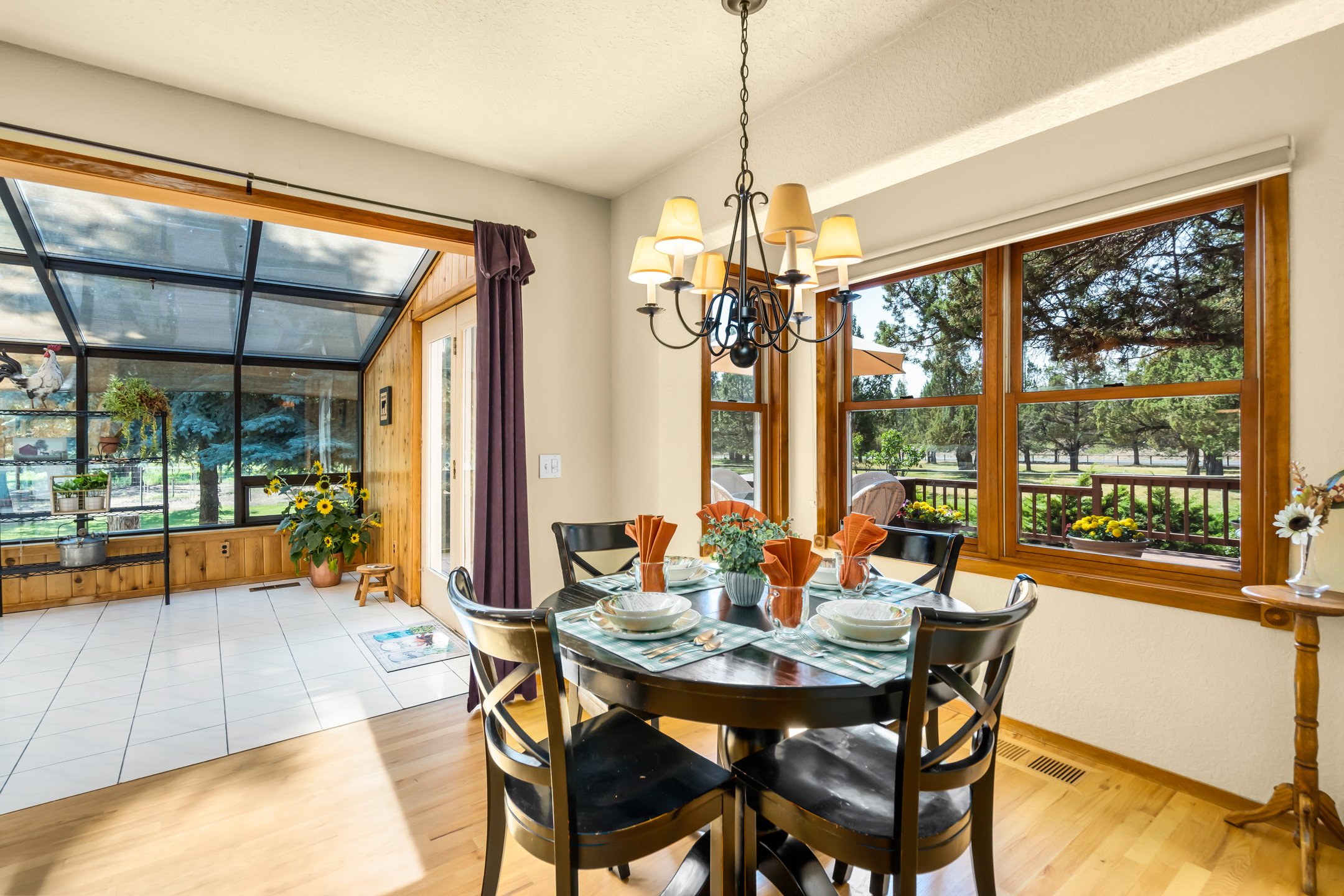
Just Listed: Beautiful Bend Acreage Property


This beautiful Bend acreage property features a large master suite with vaulted ceiling, stainless appliances, granite tile counter tops, hardwood floors and a south facing sun room.

4.52 acres with 3.5 acres of irrigation, fenced pastures, paved circular driveway and a 3 car garage. New parking structure for your RV or toys. Fenced garden and fruit trees. Your rural oasis awaits.

Listed by Jason Bradley for West + Main Homes. Please contact Jason for current pricing + availability.


Have questions?
West + Main Homes
westandmain.co
hello@westandmainoregon.com

Presented by:
Jason Bradley
(541) 647-4901
jason@westandmainoregon.com


Search homes in Oregon
 

More Joy, Less Waste: How To Reduce Holiday Waste


American household waste increases more than 23% during the holiday season – but we can change that. Check out some tips below for reducing waste this holiday season and beyond.

Green your gifts. Look for gifts you can buy locally, are gently used, have minimal packaging and are made to last. Better yet, give the gift of a local experience like event tickets, a class or membership.   

Wrap with reused materials. Get creative with recycled and reused gift wrap. 

  • Fabrics are a great way to wrap and re-wrap presents each year. Pick up some fabric at your favorite thrift store or estate sale, wrap your gifts, save the fabric for next year and ditch wrapping paper for good. For ideas on how to wrap using fabrics, check out the Japanese art of furoshiki, which uses a few simple folds and a knot.

  • Put paper bags to use as gift wrap. Add a design or drawing for an extra touch and recycle the paper bags later.

  • Save newspapers, old maps, calendars and magazine pages for gift wrap with some character and recycle afterwards.

  • Skip plastic bows and ribbon and choose natural decorations like small twigs and pinecones to top your gift. Save fabric ribbons or twine to use again.

Rethink your holiday cards. The type of paper a holiday card is printed on will determine if you can recycle it. For example, cards on photography paper or embellished with things like foil, glitter, or bows should not go in your recycle cart, while cards printed on plain paper can. Eliminate the recycling guess work for your loved ones and reduce waste entirely with an e-card instead.   

Entertain with reusables. Many resources go into creating disposable tableware that’s only used once. Skip the paper plates, plastic utensils and napkins by opting for reusable dinnerware. 

Borrow from nature. It’s tempting to buy new holiday decorations, but beautiful holiday décor can be found right outside. Try branches, leaves and twigs to add some cheer. Some tree lots even save trimmed branches and will let you take them for free. Trimmings can be used in all sorts of ways, including wrapping them around a metal hanger or wire to make a wreath.   

Stop junk mail before it starts. Catalogs and unsolicited mail really start to add up during the holidays.  Prevent this waste in the future by calling the 1-800 number listed on catalogs and ask to be removed from their mailing list. Learn how to stop junk mail before it starts. 

Choose glass. When you stock up on holiday baking ingredients, buy them in glass rather than plastic.  For example, look for vanilla, fluff, vegetable oil and sprinkles in glass bottles and jars.  

Shop with waste prevention and recycling in mind.  Follow our Zero Waste Grocery checklist for purchasing your holiday food staples in bulk or without packaging. If that’s not possible, look for packaging that can be recycled, such as cartons, steel cans and empty aluminum pie tins. Familiarize yourself with Denver’s recycling guidelines prior to shopping to know what can be recycled in your purple cart. And always bring your own reusable bags when you shop to reduce waste and avoid Denver’s fee on disposable bags

Try the Guestimator tool. Planning meals for large groups can be difficult and costly. Use this Guestimator tool to avoid too much food waste. 

Store food correctly. Don’t let those delicious holiday meal leftovers go bad before they’re eaten. Read up on proper and preferred food storage tips.  

Compost your food waste and napkins. The Denver Composts accepts food, leftovers, bones, dairy, vegetable scraps, paper napkins and paper towels, keeping these items out of the landfill and turning them into a useful soil amendment known as compost. Not a Denver Composts customer? Sign up today.  

Recycle right. Most holiday food packaging - such empty bottles, cans, cartons, and tubs - are recyclable. Plastic bags, wrapping paper, glittery cards, photo paper, bubble wrap, packing peanuts, old toys and tissue paper ARE NOT. These should be avoided, reused or placed in the trash. The holidays can also bring more recyclables to manage. Save room in your recycle cart by breaking down and flattening boxes. 

Participate in Seasonal Programs offered by Denver Recycles. Bring unwanted holiday lights to the Cherry Creek Recycle Drop Off as part of Recycle Your Holiday Lights, and participate in Treecycle after the holidays! 

Commit to make less holiday waste. Take our Holiday Pledge to commit to reducing your waste this holiday season.

Learn more.

Related Links

If there is a home that you would like more information about, if you are considering selling a property, or if you have questions about the housing market in your neighborhood, please reach out. We’re here to help.

Search Homes in Colorado

Search Homes in Oklahoma

Search Homes in Oregon

Are Short Term Rentals Effecting Housing Costs in Central Oregon?


Bend City Councilor Anthony Broadman requested that short term rental data that the City started collecting over the summer be paired with a conversation on policies that could be used if STRs are shown to exacerbate Central Oregon's housing crisis.

Broadman said he isn't advocating for a specific policy yet, and any decision would have to be data-driven, but that there's a lot of community feedback on STRs' impact on housing affordability and on the character of neighborhoods.

"What I want to see is analysis about the numbers of units that we currently have, growth, contraction, and really some analysis of the effect that STRs have on home affordability," Broadman told the Source. "This data is coming, but I thought it's also important to have narrowly tailored regulatory options that staff believes are appropriate or something that we should at least consider."

Bend had the fourth-most Airbnbs per capita in the United States in 2019, according to IPX1031, a financial service company. AirDNA, a website that tracks Airbnb and VRBO listings in real time, reports 1,163 active rentals in Bend's city limits.

"It does seem true that folks in our community think we have way too many of these things, and we should be doing more to limit the number of them," Bend City Councilor Barb Campbell told the Source.

The range of policy options available to the City includes a moratorium on permits, creating a cap on the number of STRs and changing zoning laws so STRs aren't a use-by-right in mixed-use and/or commercial areas. In 2015 the City required new STRs to be at least 250 feet from already-existing STRs and made permits expire with the sale of the property. In September the City Council approved changes to its development code to adhere to the newly passed HB 2001, and in the process fixed a loophole in those rules that allowed duplexes, triplexes and apartment complexes to circumvent the density requirement to be at least 250 feet from other STRs. Now only one unit in any multifamily housing may be an STR.

"I'm open to whatever is an efficient regulatory mechanism to make sure that this is the community we all want to live in," Broadman said.

Both councilors said there's no desire to revoke any existing STR permits, and that STRs are just one piece of the housing crisis, but that they need to maintain a standard of living for the residents of Bend.

"We are kind of a tourist town, but unlike Vail, unlike even maybe Tahoe, we were a working town before we became more of a tourist town. And we are still very much a community of folks who are working and living their lives," Campbell said.

The City Council will get STR data and hold a policy discussion on potential STR regulation at a work session in March.

Learn more on Source Weekly.

Related Links

If there is a home that you would like more information about, if you are considering selling a property, or if you have questions about the housing market in your neighborhood, please reach out. We’re here to help.

Search for Homes in Oregon

How to Protect Your Water Heater Against Winter Weather


As the weather cools, many of us are grateful for the break in the hot weather.

Depending on where you live, you might even get to enjoy some snow. However, colder weather should also remind you that you need to protect your home against common winter problems that could leave you without hot water. Here are some standard preparations you should make to ensure your water heater is prepared for the cold winter weather:

Insulation

One of the best methods of preserving your hot water heater is to insulate both the hot water tank and the pipes. As you may already know, there is always stand-by hot water in the pipes; however, when it gets frigid, the heat from those pipes dissipates, making your ready access to hot water not so ready. Also, the continued demand for the tank to offset the cold helps to drive up utility costs. You can get a fitted tank cover; newer models are designed with built-in insulation.

Check the Sacrificial Anode Rod

Much the same way the hulls of boats are fitted with the “least noble” metal called the anode to prevent galvanic corrosion, your tank is fitted with a sacrificial anode rod. An essential part of your water tank, it is there to be the metal that rusts away to help preserve the life of your tank. Located at the top of the tank, it should be checked annually. Although it should give you at least five years of service, if you notice that the rod is coated with calcium or has worn down to less than a quarter inch thickness, it must be replaced.

Check the Temperature Pressure Relief Valve

Another handy valve to keep an eye on is the temperature pressure relief valve, which is located either on the side or the top of your tank water heater. It's designed to automatically release water when either temperature or pressure in the tank gets too high. You can check this valve by simply lifting the lever and releasing it. If the valve is functioning properly, you should hear the sound of pressure escaping, as well as visible signs of water. If the valve does not seem to be operating properly, you should call a professional to check it.

Clean the Tank Out

Even when the anode rod is doing its job, there is still the inevitability of calcification occurring inside the tank. Sediment and calcium can coat both the inside of the tank and the element. To prolong the life of your hot water tank, drain it once or twice a year to clear this buildup.

This is a simple process that involves shutting off both the power and water supplies and then connecting a hose to the drain valve to allow everything inside the tank to flow out to an in-ground drain. You will need to open the drain valve, as well as the temperature-pressure regulator valve, to drain the tank. Then, you can flush that tank with water to make sure all the sediment comes out. If you are on a regular maintenance contract with your plumber, this could be one of those chores that are included. Check with your plumber to see if this is offered.

Adjust the Temperature Setting

While there is a handy temperature setting on your tank heating unit, it isn't always the best idea to simply crank it up when the weather gets cold. Yes, it's true that you are working against the cold air conditions that affect the tank, and it makes sense to turn the heat dial to a hotter setting. However, this brings hotter water directly to your taps, which can be scalding if you're not aware of the difference. Simply turn it up by five or 10 degrees; you shouldn’t need to raise it higher than 130 degrees Fahrenheit.

With the effort to clean and insulate your tank, as described above, you can maintain a setting that will neither drastically increase your energy consumption nor scald the home’s occupants. These are some of the routine measures you can take to prepare your tank heater for the winter weather. Your plumber can inspect and advise on other ways you can maintain your much-needed hot water year-round, as well as provide suggestions for any other steps you can take to keep expenses down and prolong the life of your water heater.

Get more tips like this on RISMedia.

Related Links

If there is a home that you would like more information about, if you are considering selling a property, or if you have questions about the housing market in your neighborhood, please reach out. We’re here to help.

Search Homes in Colorado

Search Homes in Oklahoma

Search Homes in Oregon

Luxury Homeownership: Sustainability a Key Building Factor, Covid Continues Impacting Trends


Demand for luxury home purchases has not dwindled even as the pandemic’s volatile nature continues to pose challenges in real estate.

According to a 2022 State of Luxury Real Estate (SOLRE) report, authored by Luxury Portfolio International® (LPI), home prices in the segment are expected to continue increasing as supply struggles to meet high demand.

While most luxury buyers (74%) are still reporting strong personal economic confidence, 75% say they are very concerned their discretionary spending power could soon be tested. However, LPI forecasts that the market could stabilize in the near future even as the fast-paced market is expected to continue through 2022.

“After a record-breaking year in luxury real estate, we anticipate that some balance will be restored to the market,” said Mickey Alam Khan, president of LPI, in the report. “It is important to view the luxury market over a trajectory of several years, noting that half of 2020 was in paralysis due to the pandemic. The red-hot market that began in the latter part of 2020 continued into 2021 and will continue a positive trajectory into 2022. The difference will be that there will be more luxury sellers in 2022 than in 2021, and while there will be fewer actual luxury buyers, it is still a seller’s market.”

“The pandemic madness that drove us to an over-heated market is being normalized,” added Alam Khan. “Demand will remain strong, and a healthy, new normal in luxury real estate will start to take hold in 2022.”

What are the trends driving this increasing demand for homes in the luxury price point? According to the report, sustainability is a major component, with 75% of those surveyed for the report stating they will choose their next home with sustainability in mind, and 90% saying they will be factoring sustainability in relation to a “Next Chapter in Life” home search. Sustainability is particularly important in legacy homes, where homeowners plan to pass on the property to their heirs.

Among the concerns luxury buyers say they face are fear of missing out on the latest trends (26%) and having a space that can accommodate remote work (27%), the latter of which was cited as last year’s top considerations during the home search.

On a global scale, this segment of homebuyers is interested in purchasing across all price points, even as prices increased 33% year-over-year. Over 14 million affluent households are interested in purchasing a new home (6.4 million of which are in the luxury category), while 1.2 million luxury homeowners are interested in selling in the next three years—a 32% increase over last year.

But where is this segment moving? While suburban migrations have been popular amid the pandemic, LPI reports that that over half of luxury buyers globally (55%) expect to purchase their next home in a city, while 77% just want to be within commuting distance.

Shared living spaces are fading away as single-family homes grow in popularity—a trend led by North America but catching up in Europe and the Middle East where 40% of buyers seek the additional space and privacy, as well as in Asian-Pacific countries where 29% look to do the same.

While demand for homes continues to increase across the wide range of buyers in the luxury space, there’s been a surge in real estate priced under $1 million, signaling that upper-middle class buyers who delayed purchasing due to COVID are making their way back to the markets.

Learn more on RISMedia.

Related Links

If there is a home that you would like more information about, if you are considering selling a property, or if you have questions about the housing market in your neighborhood, please reach out. We’re here to help.

Search Homes in Colorado

Search Homes in Oklahoma

Search Homes in Oregon