How to Prevent Overwatering Your Indoor Plants This Winter

All of that time spent indoors can lead to giving your plants too much attention!

Plant care can be tricky. Not only do you have to factor in the specific plant’s needs, but you have to consider external factors like seasonal changes—even if you keep your plants indoors. During the winter, there’s one unexpected mistake you might be making: overwatering your plants. 

“Overwatering is one of the most common causes of moldy soil in houseplants,” says Richard Cheshire, a plant doctor for the online plant store Patch Plants. “In wintertime, it is essential to change how often we water our plants as most of them stop growing and some even hibernate.”

While you might think the heat of the summer months would mean your plants are more prone to overwatering, winter is a big factor because people spend more time indoors—meaning they can end up giving their indoor plants too much attention. To avoid overwatering your plants, Cheshire has a few tips you can follow:

Do the finger dip test.

"Dip your finger up to your second knuckle; if your finger stays dry and clean, then it’s time to water," Cheshire explains. "Ideally, only water your plants when the top two inches of soil feel dry." If you're caring for cacti or succulents, he recommends only watering when the soil is completely dry. 

Avoid repotting plants directly into decorative pots.

It's best to keep your plant in a pot that has good drainage holes at the bottom. "Many decorative pots do not have proper drainage holes, making the plant more prone to overwatering," Cheshire points out. If you want to use a decorative pot, it's bets to get one that has enough room for a smaller pot with your plant in it.

Make sure excess water can drain off.

When watering your plants, make sure there's a way for the excess water to escape through the pot's drainage holes. Cheshire recommends watering your plant in a sink or bathtub to let the excess drain before putting it back in a decorative pot. You can also place the plant in a pot with a saucer to catch the excess.

Help air circulation at the roots.

"For this, simply poke holes in the soil with a pencil or a long stick to help air circulate, but be careful not to damage the roots," Cheshire says.

Use a moisture meter.

If you want to really go all in, try using a moisture meter to monitor the amount of water in the soil. "They are also great to remind you when to water if you are a forgetful person," Cheshire explains. "These can range from inexpensive ones that change color when the soil’s too wet or dry to fancy ones with digital displays."

Use water dispensers.

"Dispensers move the problem to the root (pun intended)," Cheshire adds. "Just fill the bulbs with water, and let your plant drink what it needs."

Follow House Beautiful on Instagram.


Related Links

If there is a home that you would like more information about, if you are considering selling a property, or if you have questions about the housing market in your neighborhood, please reach out. We’re here to help.

Search Homes in Colorado

Search Homes in Oklahoma

Search Homes in Oregon

Single-family rents soar in tight housing market

You could buy a top-of-the-line laptop and a new cell phone to match, or you could pay one month’s rent for a single-family home in Los Angeles.

It’s not much better for prospective single-family renters across California, a study by HouseCanary found. In Ventura or Carlsbad, median single-family rents are $4,250, and in Santa Clara and Berkeley, median single-family rents reached $4,225 and $4,200, respectively. That’s nearly as much as it costs to deliver a newborn, on average, even with employer-provided health insurance, and quite a bit more than the $3,900 the average woman earns each month.

As eviction moratoriums expire, HouseCanary predicts single-family rents will continue to increase.

Enforcement of the now-expired Centers for Disease Control eviction moratorium was inconsistent to begin with, and in some areas there have been few checks on tenant turnover and rent increases even during the pandemic.

Curbing court-ordered evictions also only addresses a portion of evictions — a recent Princeton University study estimated that informal evictions outnumber formal proceedings by more than five to one. Still, robust local restrictions in places like New York City helped keep rents more level, the HouseCanary report found.

In some areas, the HouseCanary study found, single-family rents skyrocketed. A median single-family rent in Cape Coral-Fort Myers, Florida stood at $1,800 in March 2020, but by October this year, had doubled to $3,600.

Florida, overall, experienced the largest rent hikes during the pandemic. The four largest increases in metropolitan areas from March 2020 to October 2021 were in Florida. Sarasota-area median single-family rent grew from $2,145 to $3,875, and single-family rents in Port St. Lucie rose to $1,895 from $2,725. The Daytona Beach area grew 39%, from $1,550 to $2,195.

“If workers are allowed to relocate, it’s hard to lose in a state where there’s 0 income tax, good weather year-round, and a lower cost of living than in New York or traditional financial centers,” said HouseCanary co-founder Chris Stroud, who leads the firm’s research efforts.

Some areas did not see such sharp increases in single-family rental prices. New York City, where the median single-family rent is $2,900, did not land on the list of top 10 most expensive cities. But of New York City’s 2.2 million rental households, just a sliver are single-family rentals, Stroud said. About a third of the nation’s rentals are single-family homes, according to the New York Times.

The HouseCanary study said a lack of supply is driving the surge in single-family rents. The supply woes have worsened during the pandemic, particularly in Baton Rouge, Louisiana, where the supply of properties for rent since the start of the pandemic decreased by 78%. In New Orleans, available rental properties decreased by 73%, and in the Winter Haven area in Florida, availability decreased by 67%.

Follow HousingWire.


Related Links

If there is a home that you would like more information about, if you are considering selling a property, or if you have questions about the housing market in your neighborhood, please reach out. We’re here to help.

Search Homes in Colorado

Search Homes in Oklahoma

Search Homes in Oregon

6 Ways to Make a Small Bathroom Look Bigger

Tiny bathrooms are a unique design challenge that can puzzle even the most experienced homeowner.

The goal is to make it feel stylish and comfortable rather than cramped or cluttered. The question is how to make a small bathroom look bigger without changing the dimensions of the room. Is there a way to maximize the space without compromising on your style?

Well, here are six tips to make your small bathroom look bigger while staying true to you!

1. Choose Light and Bright Paint

Colors that are light and bright make a room feel larger. A bright white bathroom will feel clean and timeless. However, if you want to stray away from neutral colors, consider staying on the lighter spectrum so the space feels airy.

If you had your heart set on a dark paint color, then be bold and go for it — just choose semi-gloss or high-gloss to reflect the light. Most homeowners utilize satin or semi-gloss paint in their bathroom, but a high-gloss finish will provide you with a shiny look that doesn’t suck out the light. 

2. Layer Your Lighting

When possible, emphasize the natural light in the room. Use windows and skylights to make the room feel bright and open. Natural lighting creates the illusion of a larger space, so be keep windows clear of obstructions. 

When adding artificial light to the bathroom, you should consider four types. Implement task lighting so your reflection remains shadow-free when putting on makeup or shaving. Ambient light bounces off the ceiling and is extremely flattering to your complexion. Some people may want this source of light to boost confidence, while others may find it unnecessary. Accent lighting gives dimension to a room, while decorative lighting is more for show. 

To make a small bathroom look bigger, find lighting that can be multifunctional in the room. For example, mirrors with backlights are one way to gain task lighting without taking up additional wall space. 

3. Focus Your Design

Your home should reflect your style, but how can you make a small bathroom look bigger without the design seeming too busy? The key is minimalism. Focus on one or two elements in the room and allow them to shine. If you try to cram too many details into a small space, the result looks overloaded.

To create a cohesive look, use the same materials throughout the bathroom. Look for similar colors to create an effortless feel. Consistency will help to make the space feel purposeful and well designed. Without a clear plan, your design could quickly be overrun in a small area.

Choose your materials with care and remain practical — a silver bathroom tray will tarnish from the moisture and air. Consider using bamboo or wicker accents that encourage positive airflow and have low heat retention. 

4. Get Crafty With Storage

Storage can completely change the flow of a small bathroom. Stands take up precious floor space and give the appearance of a smaller room. Utilize hooks, wall shelves and a medicine cabinet to gain storage without losing space on the floor.

If you have an abundance of products to fit, try using baskets, boxes or containers to reduce the clutter on shelves. Clutter is known to cause anxiety because it provides a constant distraction that can feel overwhelming. Keep the mess out of sight and out of mind so you don’t need to tidy up every time guests come around.

Look for dead spaces where you could squeeze in some extra storage. The back of the door, next to the toilet and under the sink are all potential storage opportunities.

5. Create a Layout That Flows

An odd configuration can make a bathroom feel cramped and awkward. Choose a layout that creates a natural flow in the room. If possible, start by aligning all of your appliances on one side of the room — this will help create a clear line of sight and provide the illusion of more space. It will also save you money since all of the plumbing will be on one wall.

Keep the large items farthest from the door for easy accessibility and a streamlined design. You should choose products that fit the space — bulky pieces will make the room feel smaller. If practical, choose a shower and tub combo maximize the space.  Install a glass enclosure to provide a sense of depth where a traditional curtain would have cut off the flow.

6. Utilize Mirrors

It’s essential to know how to update a space if you are on a small budget. Have you asked yourself how to make a bathroom look bigger without changing the paint colors, fixtures or appliances? Well, the answer is with mirrors!

Mirrors reflect light — making a room look larger and brighter. To amplify the space, choose large mirrors that will provide an elegant and unobstructed reflection. Consider making a wall of mirrors in your tiny bathroom to create the greatest effect. The idea is to make the mirrors look natural and blend into the environment.

Maximize Every Small Space

Most properties list a price per square footage, but what use is the extra space if you aren’t utilizing it? Consider applying these six tips to other areas of your home for the same appearance benefits. For additional assistance, talk to an interior designer for in-depth insight into your unique space.

Join the Renovated community!


Related Links

If there is a home that you would like more information about, if you are considering selling a property, or if you have questions about the housing market in your neighborhood, please reach out. We’re here to help.
Search Homes in Colorado

Search Homes in Oklahoma

Search Homes in Oregon

Low Temps, High Expectations: 65% of Prospective Sellers Plan to Enter the Market this Winter

Over one-third of today's sellers expect offers above asking price, but those looking to close quickly may be more willing to compromise than in the Spring

After sitting on the sidelines as low mortgage rates fueled homebuyer demand and listing price growth throughout the pandemic, the majority of prospective sellers1 are eager to enter the housing market within the next six months, according to a new Realtor.com® Survey. Although sellers' expectations for bidding wars and fast-paced sales have only gotten higher since the spring, the potential uptick in new listings offers holiday hope to buyers challenged by the shortage of for-sale homes.

"The pandemic has delayed plans for many Americans, and homeowners looking to move on to the next stage of life are no exception. Recent survey data suggests the majority of prospective sellers are actively preparing to enter the market this winter," said George Ratiu, Manager of Economic Research for Realtor.com®.

"Buyers should be ready for high asking prices and offer deadlines as seller expectations of the upcoming market are greater than in the spring, but an increase in new sellers could mean some relief from the inventory crunch. In addition, as more homes have entered the for-sale market, price growth has moderated from the spring's double-digit levels to a more approachable 8%-9% range. Seasonality will play a key role in seller activity levels as we approach the typically-slower holiday period, with new listings already slipping in recent weeks. As buyers race against the clock of rising mortgage rates, sellers who price their homes in line with today's market and stick to their plans will likely see their expectations met."

Survey findings:

The majority of prospective sellers plan to list before the end of the year or in early 2022.

  • Among homeowners who indicated they will enter the market in the next year, 65% expect to within six months, including 19% who have already listed their home.

  • Compared to the spring (76%), more of today's prospective sellers (93%) have already taken steps toward listing their home, including working with an agent (28%).

  • More than one-third of prospective sellers, at 36% each, have researched the value of their home and others in their neighborhood, as well as started making repairs or decluttering.

Consumers' top reasons for selling reflect the rising influence of more time spent at home during COVID.

  • Compared to the spring (15%), nearly two-times as many prospective sellers (33%) have realized they want different home features after spending more time at home.

  • With more sellers having children at home this winter (65%) than in the spring (43%), family considerations are a top reason behind homeowner decisions to enter the market: 37% of prospective sellers say their home no longer meets their family's needs and 32% want to move closer to friends and family.

  • The rise in remote work is also a key driver this winter: 23% of sellers are looking for a home office and 19% no longer need to live near their workplace, up from 6% in March.

Sellers have greater expectations of the current market this winter than in the spring.

  • Over one-third of today's prospective sellers are eager to take advantage of the current market and think they can make a profit (35%), up from the spring (24%).

  • When asked how the current market impacts the terms they will ask for, top responses included asking for above what they think their home is currently worth (42%) and asking for a quick close (29%).

  • Compared to the spring, more of today's prospective sellers anticipate that buyers will compete in bidding wars, offer above asking, forgo contingencies like inspections and appraisals and more. (See table 1 below.)

Today's prospective sellers plan to list in relatively affordable price ranges and are potentially more willing to compromise if their expectations aren't met.

  • Sellers with homes at the core of the market ($351,000-$750,000) remained the same over March (29%). However, more sellers plan to list in the $500,001-$750,000 price range, which overlaps with recent median listing prices in increasingly popular first-time buyer cities like Riverside, Calif. ($540,000), Austin ($546,000) and Denver ($600,000).

  • More than three-quarters (77%) of prospective sellers would be willing to accept a lower offer to close quickly versus just over half in March (54%).

  • Compared to Spring sellers, a higher number of today's prospective sellers plan to take alternative routes like moving in with family (19%), as well as temporarily renting their home back from the buyer (29%).

    Keep reading on Realtor.com


Related Links

If there is a home that you would like more information about, if you are considering selling a property, or if you have questions about the housing market in your neighborhood, please reach out. We’re here to help.

Search Homes in Colorado

Search Homes in Oklahoma

Search Homes in Oregon

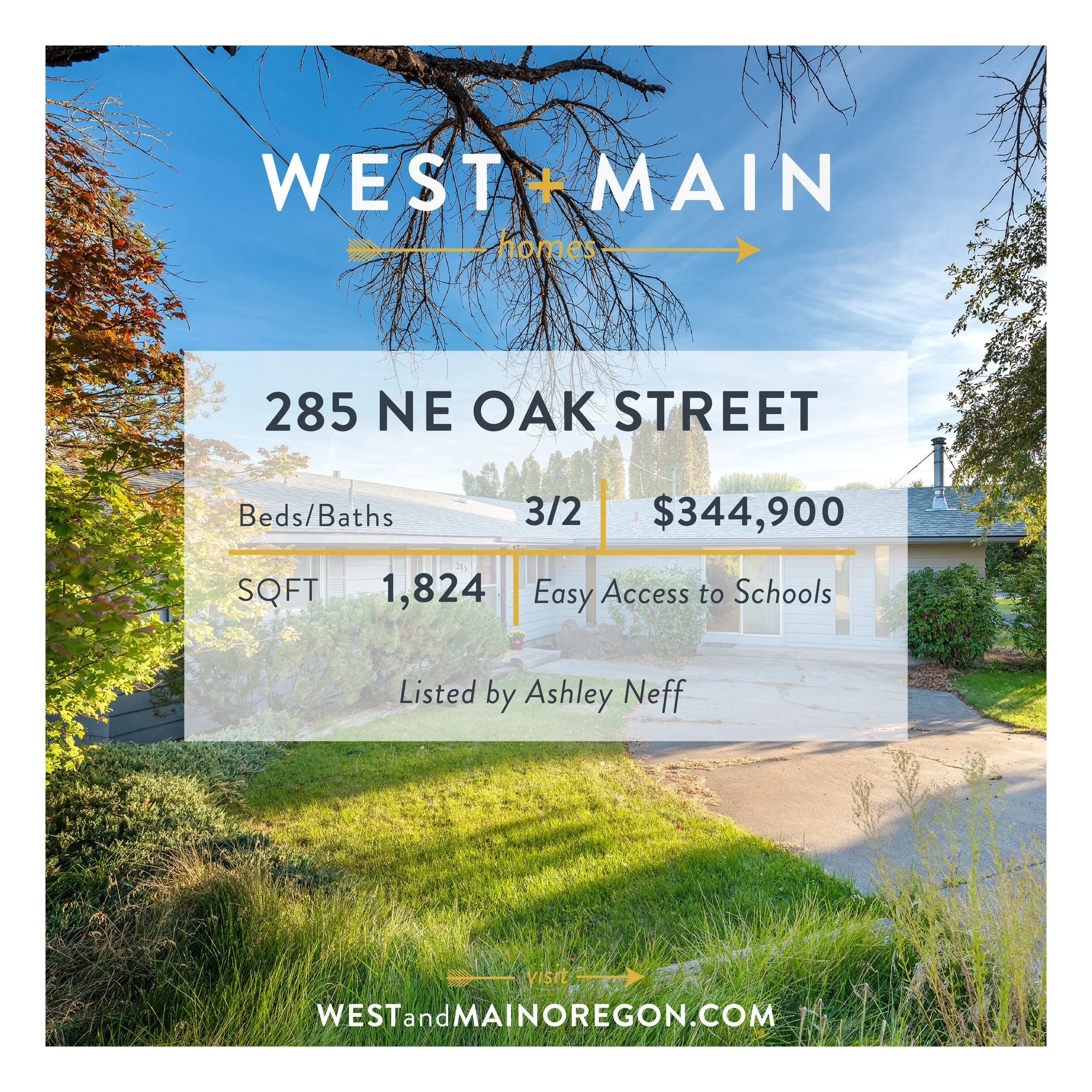
Just Listed: Madras Home with Great Access to Schools


Looking for an older home with character, on a great piece of property, to make your own?

Come check out this 1,824 square foot home on over a quarter of an acre! This home features 3 bedrooms, 2 bathrooms, a large living room & laundry room and a huge bonus room. Outside you’ll find a 6 person hot tub, mature trees and landscaping, plenty of parking under two separate carports, one on each side of the 900 square foot shop with 240 volt power, and plenty of room to park an RV, turn into more outdoor entertaining space or anything you can dream up. Located near schools, the hospital and multiple parks, this home is in the center of it all.

Listed by Ashley Neff for West + Main Homes. Please contact Ashley for current pricing + availability.


Have questions?
West + Main Homes
westandmain.co
hello@westandmainoregon.com

Presented by:
Ashley Neff
(541) 788-3195
ashley@westandmainoregon.com


Search homes in Oregon