The Main Reason Mortgage Rates Are So High


Today’s mortgage rates are top-of-mind for many homebuyers right now.

As a result, if you’re thinking about buying for the first time or selling your current house to move into a home that better fits your needs, you may be asking yourself these two questions:

  1. Why Are Mortgage Rates So High?

  2. When Will Rates Go Back Down?

Here’s context you need to help answer those questions.

1. Why Are Mortgage Rates So High?

The 30-year fixed-rate mortgage is largely influenced by the supply and demand for mortgage-backed securities (MBS). According to Investopedia:

“Mortgage-backed securities (MBS) are investment products similar to bonds. Each MBS consists of a bundle of home loans and other real estate debt bought from the banks that issued them . . . The investor who buys a mortgage-backed security is essentially lending money to home buyers.”

Demand for MBS helps determine the spread between the 10-Year Treasury Yield and the 30-year fixed mortgage rate. Historically, the average spread between the two is 1.72 (see chart below):
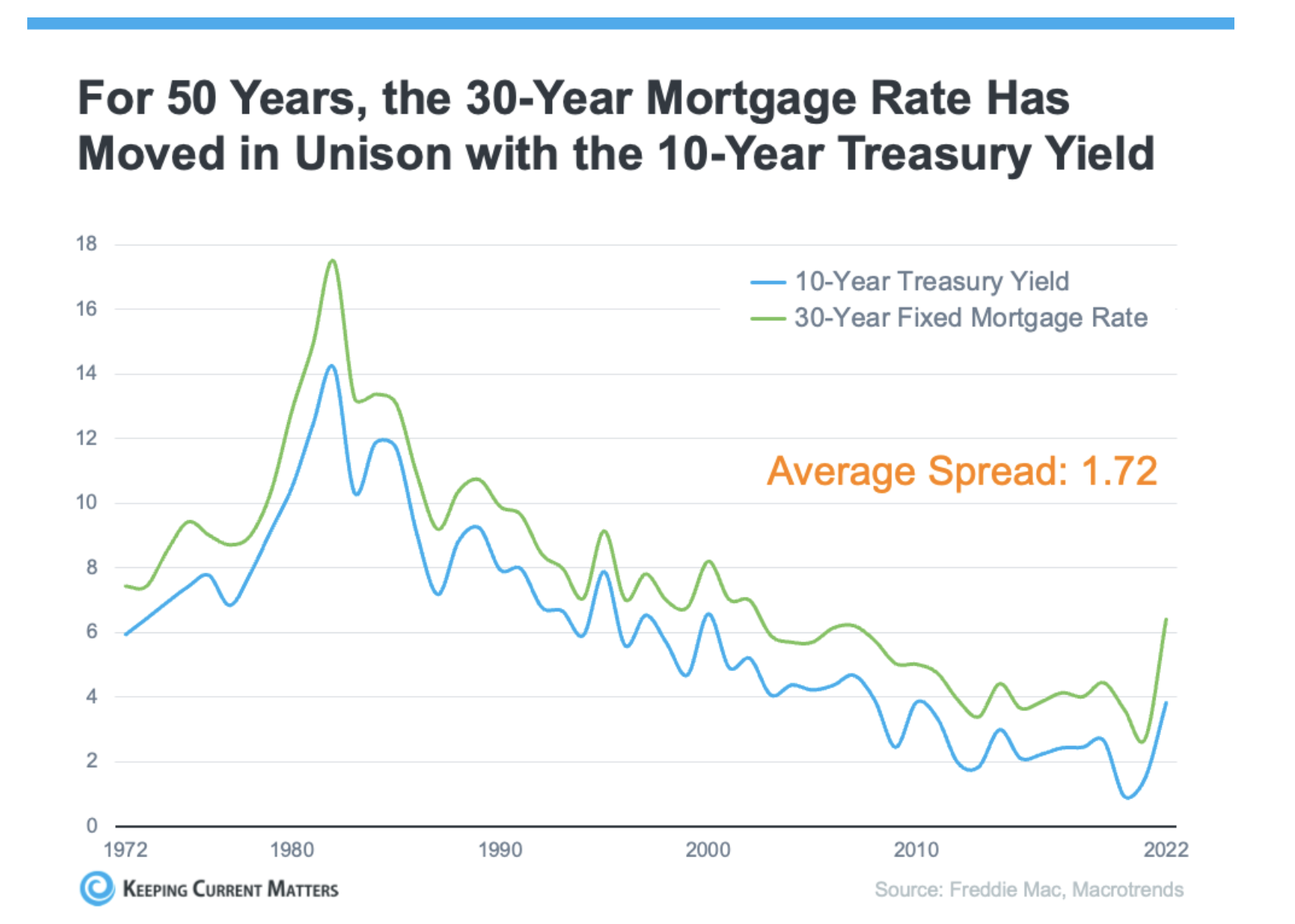


Last Friday morning, the mortgage rate was 6.85%. That means the spread was 3.2%, which is almost 1.5% over the norm. If the spread was at its historical average, mortgage rates would be 5.37% (3.65% 10-Year Treasury Yield + 1.72 spread).


This large spread is very unusual. As George Ratiu, Chief Economist at Keeping Current Matters (KCM), explains:

“The only times the spread approached or exceeded 300 basis points were during periods of high inflation or economic volatility, like those seen in the early 1980s or the Great Financial Crisis of 2008-09.”

The graph below uses historical data to help illustrate this point by showing the few times the spread has increased to 300 basis points or more:


The graph shows how the spread has come down after each peak. The good news is, that means there’s room for mortgage rates to improve today.

So, what’s causing the larger spread and making mortgage rates so high today?

The demand for MBS is heavily influenced by the risks associated with investing in them. Today, that risk is impacted by broader market conditions like inflation and fear of a potential recession, the Fed’s interest rate hikes to try to bring down inflation, headlines that create unnecessarily negative narratives about home prices, and more.

Simply put: when there’s less risk, demand for MBS is high, so mortgage rates will be lower. On the other hand, if there’s more risk with MBS, demand for MBS will be low, and we’ll see higher mortgage rates as a result. Currently, demand for MBS is low, so mortgage rates are high.

Get more like this on Keeping Current Matters.

Related Links

If there is a home that you would like more information about, if you are considering selling a property, or if you have questions about the housing market in your neighborhood, please reach out. We’re here to help.

Search Homes in Colorado

Search Homes in Oklahoma

Search Homes in Oregon

Search homes in Minnesota

Everyone’s Talking About Home Equity: Here’s What Yours Means in Today’s Market


Homeownership has long been tied to building wealth—and for good reason. Instead of throwing rent money out the window each month, owning a home allows you to build home equity.

And over time, equity can turn your mortgage debt into a sizeable asset. You can use it to get a line of credit, a home equity loan, or a refinance. Alternatively, if you’re considering selling your house, that equity you create can be used toward purchasing your next home.

But before you can put that nest egg to use, you should understand precisely what equity is in light of today’s record-high home prices. Here’s what the experts have to say on home equity.

What is home equity?

When you initially get a mortgage, most of the equity in your home belongs to the bank. That could be 80% to 95%, depending on how much down payment you made. Every time you make a mortgage payment, the home equity portion (the amount you own outright) increases—minus any outstanding mortgage or other liens.

“Simply put, equity is the difference between the current market value of the property you own and the amount still owed on the mortgage,” says Adie Kriegstein, a real estate agent and founder of the NYC Experience Team at Compass.

Every mortgage payment you make increases your equity. However, your equity can decrease if you decide to use your equity for a line of credit or home equity loan.

Building your equity egg takes time. And depending on the market conditions, your equity can rise sharply or take a nosedive. Today, many homeowners are sitting on record-high amounts of equity because of the decade-long boom of low interest rates, up until 2022.

“As home prices increase, and so long as your debt remains constant, the equity value in your home will increase,” says Jill Fopiano, CEO of O’Brien Wealth Partners.

Home equity can be a seller’s most valuable asset

When you sell your home, the equity you built can be used to pay off the remaining mortgage balance and other debts, potentially leaving you with a profit.

Or you might decide to use the equity as a down payment on your next house—or finance other investments or expenses. And if you have a hefty equity amount, you can plop down a more significant down payment, which should qualify you for a lower interest rate.

It sounds like a win-win if you’re thinking about selling your home. But before you start counting your cash, you should determine how much equity you have and if putting your home on the market makes sense.

“By knowing their home equity, sellers can set a realistic asking price for their property and avoid overpricing or underpricing,” says Kriegstein.

How much home equity do you have?

Whether you’re putting your home on the market or staying put, knowing how your home equity and home value measure up is essential.

“This can help homeowners make informed decisions about potential home improvements or financial decisions, such as taking out a home equity loan,” says Kriegstein.

In a nutshell: Home value affects your equity and can increase when property values go up or decrease when property values fall.

Typically, homes appreciate 3% per year. So if you’ve owned your home for a while, you’ve likely built up some equity and might not even realize how much you’re sitting on until you do a little homework.

“While the best valuation is the price a buyer is willing to pay, more viable alternatives include researching the value of your home through online sites, looking at comparable sales in your area, or ordering an appraisal,” says Fopiano.

Once you determine the value of your home, subtract any debt related to the house, such as first or second mortgage balances and home equity loans. The remainder is your equity.

So let’s say you bought your house for $200,000 and after a few years, your loan balance is $160,000. And in that time, your house value jumped to $250,000. With this simplified example, your equity is now $90,000.

How much equity you should have before selling your home

It’s vital to consider a few critical financial factors if you want to use home equity to your advantage. One is whether you have enough equity to sell your home. There isn’t a one-size-fits-all amount, but there are some general guidelines.

“One common rule of thumb is that you should have at least 20% equity in your home before you consider selling,” says Kriegstein. “If you have less than 20%, you may be required to pay private mortgage insurance, which can add significantly to your monthly mortgage payments.”

Another variable is the current market conditions.

“If the housing market is strong and demand for your home is high, you may be able to sell your home with less equity than if the market is weak and there are fewer buyers,” adds Kriegstein.

Even with these guidelines, it’s wise to speak with a trusted real estate agent and a financial planner to get a clear picture of your options—and determine whether to sell or stay put.

Keep reading on Realtor.com

Related Links

If there is a home that you would like more information about, if you are considering selling a property, or if you have questions about the housing market in your neighborhood, please reach out. We’re here to help.

Search Homes in Colorado

Search Homes in Oklahoma

Search Homes in Oregon

Search homes in Minnesota

Summer Events on The Crystal Coast


The Crystal Coast is home and host to a variety of events throughout the year.

From fishing tournaments to seasonal festivals; from children’s celebrations to athletic events, each month holds something different to delight everyone in your family. Find out what’s going on during your stay, or learn when to plan your next vacation!

Some Featured Events in June:

June 3: Kayak for the Warriors Kayak/Paddleboard Race - 122 Oakleaf Drive

June 9: 65th Annual Big Rock Blue Marlin Tournament - Big Rock Landing

June 10: 26th Annual Keli Wagner Lady Angler Fishing Tournament - Big Rock Landing

June 10: 62nd Annual Old Homes Tour Kickoff Party and Bartender’s Challenge - Beaufort Historic Site

June 17: The Dust Parade - Snapperz Grill + Steam Bar

June 29: Bryan Mayer at The Trading Post - The Trading Post

Find more events + learn more.

Related Links

If there is a home that you would like more information about, if you are considering selling a property, or if you have questions about the housing market in your neighborhood, please reach out. We’re here to help.

Search Homes in Colorado

Search Homes in Oklahoma

Search Homes in Oregon

Search homes in Minnesota

The Benefits of Selling Now, According to Experts


If you’re trying to decide if now’s the time to sell your house, here’s what you should know.

The limited number of homes available right now gives you a big advantage. That’s because there are more buyers out there than there are homes for sale. And, with so few homes on the market, buyers will have fewer options, so you set yourself up to get the most eyes possible on your house.

Here’s what industry experts are saying about why selling now has its benefits:

Lawrence Yun, Chief Economist at the National Association of Realtors (NAR):

“Inventory levels are still at historic lows. Consequently, multiple offers are returning on a good number of properties.”

Selma Hepp, Chief Economist at CoreLogic:

“We have not seen the traditional uptick in new listings from existing homeowners, so undersupply of housing will continue to heighten market competition and put pressure on prices in most regions. Some markets are already heating up considerably, but price premiums that we saw last spring and summer are unlikely.”

Clare Trapasso, Executive News Editor at Realtor.com:

“Well-priced, move-in ready homes with curb appeal in desirable areas are still receiving multiple offers and selling for over the asking price in many parts of the country . . .”

Jeff Tucker, Senior Economist at Zillow:

“. . . sellers who price and market their home competitively shouldn’t have a problem finding a buyer.”

Bottom Line

If you’re thinking about selling your house, connect with a real estate advisor who can share the expert insights you need to make the best possible move today.

Learn more on Keeping Current Matters.

Related Links

If there is a home that you would like more information about, if you are considering selling a property, or if you have questions about the housing market in your neighborhood, please reach out. We’re here to help.

Search Homes in Colorado

Search Homes in Oklahoma

Search Homes in Oregon

Search homes in Minnesota

Today’s Real Estate Market: The ‘Unicorns’ Have Galloped Off


Comparing real estate metrics from one year to another can be challenging in a normal housing market.

That’s due to possible variability in the market making the comparison less meaningful or accurate. Unpredictable events can have a significant impact on the circumstances and outcomes being compared.

Comparing this year’s numbers to the two ‘unicorn’ years we just experienced is almost worthless. By ‘unicorn,’ this is the less common definition of the word:

“Something that is greatly desired but difficult or impossible to find.”

The pandemic profoundly changed real estate over the last few years. The demand for a home of our own skyrocketed, and people needed a home office and big backyard.

  • Waves of first-time and second-home buyers entered the market.

  • Already low mortgage rates were driven to historic lows.

  • The forbearance plan all but eliminated foreclosures.

  • Home values reached appreciation levels never seen before.

It was a market that forever had been “greatly desired but difficult or impossible to find.” A ‘unicorn’ year.

Now, things are getting back to normal. The ‘unicorns’ have galloped off.

Comparing today’s market to those years makes no sense. Here are three examples:

Buyer Demand

If you look at the headlines, you’d think there aren’t any buyers out there. We still sell over 10,000 houses a day in the United States. Of course, buyer demand is down from the two ‘unicorn’ years. But, according to ShowingTime, if we compare it to normal years (2017-2019), we can see that buyer activity is still strong (see graph below):


Home Prices

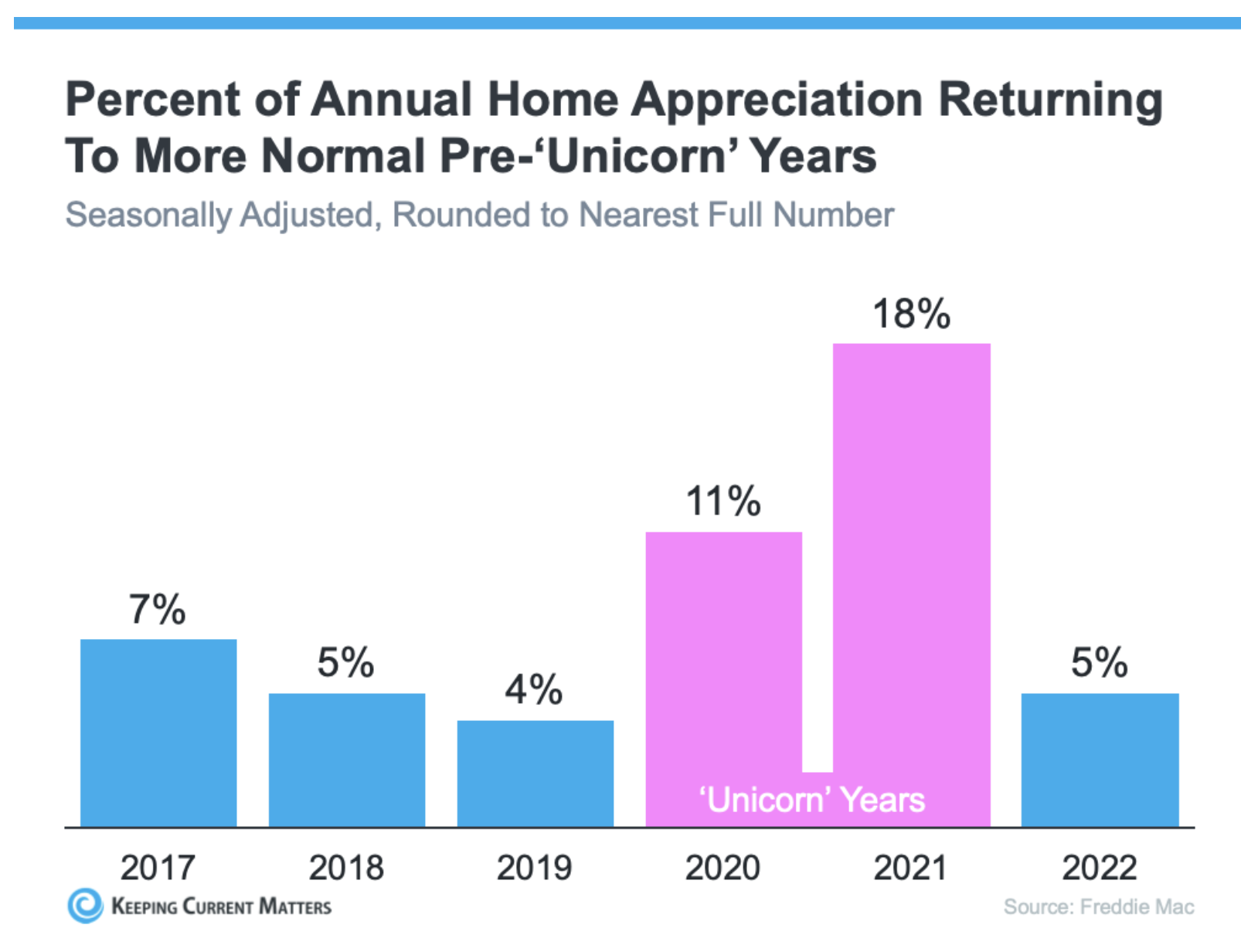
We can’t compare today’s home price increases to the last couple of years. According to Freddie Mac, 2020 and 2021 each had historic appreciation numbers. Here’s a graph also showing the more normal years (2017-2019):


We can see that we’re returning to more normal home value increases. There were several months of minimal depreciation in the second half of 2022. However, according to Fannie Mae, the market has returned to more normal appreciation in the first quarter of this year.

Foreclosures

There have already been some startling headlines about the percentage increases in foreclosure filings. Of course, the percentages will be up. They are increases over historically low foreclosure rates. Here’s a graph with information from ATTOM, a property data provider:


There will be an increase over the numbers of the last three years now that the moratorium on foreclosures has ended. There are homeowners who lose their home to foreclosure every year, and it’s heartbreaking for those families. But, if we put the current numbers into perspective, we’ll realize that we’re actually going back to the normal filings from 2017-2019.

Bottom Line

There will be very unsettling headlines around the housing market this year. Most will come from inappropriate comparisons to the ‘unicorn’ years. A real estate professional is a great resource to help you keep everything in proper perspective.

Get more on Keeping Current Matters.

Related Links

If there is a home that you would like more information about, if you are considering selling a property, or if you have questions about the housing market in your neighborhood, please reach out. We’re here to help.
Search Homes in Colorado

Search Homes in Oklahoma

Search Homes in Oregon

Search homes in Minnesota