
Is Down Payment Assistance Available to First-Time Homebuyers?


Q: What kind of down payment assistance programs are available to first-time homebuyers?

Who doesn’t love free money—especially when it can help you to afford your first home?

Saving up for a down payment on your first home isn’t fun. About a quarter of first-time buyers rated coming up with that money as one of the most difficult steps of the homebuying process, according to the National Association of Realtors®. And it’s not getting any easier. Inflation and rising rents are whittling away at paychecks, student loan and car payments keep coming due, and there always seems to be some sort of emergency you have to throw money at.

That’s where down payment assistance programs can help.

There are at least 2,000 federal, state, regional, and local programs available across the nation. Some employers even offer them. Many of these are little-known programs typically offered by government agencies, nonprofit organizations, and private lenders and can put anywhere from a few hundred to tens of thousands of dollars into the hands of homebuyers.

That kind of cash can help turn someone’s dream of homeownership into reality.

Some buyers can qualify for these programs based solely on their income. Others might be able to secure assistance depending on their professions, military service, racial backgrounds, disabilities, and where they hope to purchase their homes, among other factors.

Homebuyers can search for down payment assistance programs on Realtor.com®. They can also check out their state’s Department of Housing website to see what sort of help is available.

The assistance can come in the form of grants, which are fully forgiven when you close on your home; forgivable loans, where you can keep the money unless you break the terms of the loan; and deferred-payment loans, which you repay at the end of your loan or if you violate the stipulations of your loan. There are also loans that you pay back every month, some with interest rates as low as 0%.

However, there is no such thing as a free lunch—or a no-strings-attached down payment in this case.

Some of the more common stipulations are that the buyers will undergo housing counseling or other education program in order to receive the funds. Many require recipients to make these properties their primary residences, sometimes for a set period of time—or they may have to pay back a portion of the assistance they received.

So don’t skip reading the fine print on the down payment applications.

Also, buyers who receive assistance still need to qualify for a mortgage. Lenders want to see steady incomes, strong credit scores, and relatively low debt.

First-time buyers might also want to consider low or even no-down-payment mortgages. Many folks believe that they must put down at least 20%, but that’s a myth. If you put down that much, you can avoid paying private mortgage insurance every month, which is great. But 20% of the median-priced home of $400,000 in December was $80,000. That’s a lot of money. And it doesn’t include closing costs, which can set buyers back an additional 2% to 6% of their loan amounts, plus repairs, furniture, and an emergency fund.

This is why the typical first-time buyer kicked in much less—just 6% of the purchase price of their home last year, according to NAR data.

Active military personnel and veterans as well as those purchasing homes in more rural areas might be eligible for 0% down loans through the U.S. Department of Veterans Affairs or the USDA Rural Home Loan Program.

Fannie Mae and Freddie Mac offer several programs to lower-income homebuyers that can require as little as 3% down. The Federal Housing Administration offers loans for first-time buyers with down payments as low as 3.5%.

With fewer buyers in the market, sellers are more likely to accept offers from buyers with lower down payments. (At the height of the COVID-19 pandemic, all-cash offers and sizable down payments often won out as many sellers assumed, sometimes erroneously, that buyers who had more cash to put down were on better financial footing.)

There are risks associated with these loans, though. The housing market has been cooling rapidly as higher mortgage interest rates have limited how much buyers can pay for homes. If borrowers get a 3% down loan and home prices in their market fall by 5%, they might find themselves underwater on their mortgage, owing more than their home is worth.

That’s usually not a big problem if you plan to stay in your home for a while as long as you can continue to make your mortgage payments. Home prices typically rise over time even if they fall in the short term. But if you need to sell before the housing market bounces back, you could wind up losing money.

So if you’re dreaming of homeownership but having a hard time saving up for a down payment, it doesn’t hurt to see what sort of assistance might be available to you.

Learn more on Realtor.com

Related Links

If there is a home that you would like more information about, if you are considering selling a property, or if you have questions about the housing market in your neighborhood, please reach out. We’re here to help.

Search Homes in Colorado

Search Homes in Oklahoma

Search Homes in Oregon

Lessons Every Homeowner Can Learn This Winter to Prepare for the Next


This winter has been a tough one, with temperatures lower than expected in some regions and more precipitation than usual.

But it's also been a learning experience, and homeowners can take some lessons from it as they prepare for next winter. Here are some of the things we've learned this winter.

Don't Take Your Home for Granted 
Give it the TLC it needs to weather any storm

In a winter full of unexpected weather, it's easy to let your home needs go unnoticed. But lessons learned this season have taught us that now is the time to give your home some TLC to ensure your place of refuge is in peak condition--whether it be fixing that pesky draft or replacement of worn out windows and pipes. Don't take your home for granted; proper maintenance and care can help you weather any storm life throws at you.

Be Prepared for Anything 
Have a plan and supplies on hand in case of an emergency

We all know that winter weather can be unpredictable, but this past season has been a special reminder of how ready we should always be. When the temperatures plummeted and snowfall exceeded expectations, it was hard to know what to expect. That's why it's important to plan ahead and have a strategy in place - with necessary items on hand, just in case of an emergency. It might take some extra effort and planning, but having peace of mind is invaluable. Being prepared for anything will help ensure that any inconveniences that come along with unexpected weather don't turn into disasters. 

Stay Warm and Comfortable 
Make sure your home is well-insulated

This winter brought a series of surprises with unpleasant weather and more snow than expected. To stay warm and comfortable it is essential to make sure your home is well-insulated. It's important to take the time to check for drafts, detect poor insulation in walls, ceilings, and floors, and seal any openings that let in cold air or moisture; all of these steps can help keep your living space at a pleasant temperature. As well, the exterior of your house might need some focus, whether it's your windows that are not up to the task of keeping the heat in or your roof that leaks in inconvenient places. Consulting a company like Liberty Exteriors LLC can give you an idea of whether or not your roof is properly doing its job. Investing a bit of effort into the upkeep of your home during this winter can ensure that you’ll be able to rest easier, even during unpredictable weather conditions.

Keep Things Clean and Tidy
Avoid slip-ups and accidents

Keeping things clean and tidy is an effective way of avoiding slip-ups, accidents, and other preventable issues. We have a responsibility to do whatever we can to prevent hazardous conditions. By taking the necessary time to focus on tidiness such as clearing away snow and ice or sweeping up wet leaves, we can guarantee that our yards and driveways remain safe. As well, making sure to keep our indoors organized can be beneficial. Instead of leaving blankets out to get worn and stepped on, make sure to keep things tidy to care for the things you own. A little bit of extra care goes a long way, especially during the wintertime!

Check In on Your Neighbors
…Especially if they're elderly or live alone

Although the unusually cold, wet winter weather might be wrapping up where you live, it's important to remember the lessons we learned. Especially when it comes to looking out for our neighbors. We should all do our part in checking in on those who are particularly vulnerable - especially the elderly and those that live alone. Even if you're not able to provide any resources, a little bit of kindness goes a long way and can help give people a little extra peace of mind during difficult times. So let's continue to keep our friends and neighbors safe by taking care of each other.

Winter may soon start winding down (hopefully), but that doesn't mean we should let our guard down. These past few months have been a great reminder of the importance of taking care of our homes and being prepared for anything. By following these simple tips, we can make sure that we're ready for whatever mother nature throws our way. So as you start to pack away your winter gear, keep these lessons in mind and you'll be all set for whatever comes next.

Keep reading.

Related Links

If there is a home that you would like more information about, if you are considering selling a property, or if you have questions about the housing market in your neighborhood, please reach out. We’re here to help.
Search Homes in Colorado

Search Homes in Oklahoma

Search Homes in Oregon

Already Pending! Traditional Brick Ranch on an Oversized Corner Lot in Mitchell Village


Traditional brick ranch on an oversized corner lot in the popular Mitchell Village neighborhood.

3 bedrooms, 2 bathrooms with tons of charm throughout, including hardwood floors, a fireplace with gas logs, original tile, an eat- in kitchen, and sunroom. The huge yard is ideal for entertaining with space for a fire pit area or even a pool (plans attached). This home has been well maintained with an updated roof, windows and utilities. Mitchell Village neighborhood park is just blocks away with swings, a playground, picnic benches, grills, a beach and beautiful views of Bogue Sound. Close to shops, restaurants and schools.

Listed by Gray Blount Busch for West + Main Homes. Please contact Gray for current pricing + availability.


Have questions?
West + Main Homes
westandmain.co
hello@westandmainnorthcarolina.com

Presented by:
Gray Blount Busch
(252) 723-2974
gray@westandmainnc.com


Carteret County Real Estate Market Report from January 2023


Buyers are back in the market with bidding wars being reported again, much to the delight of sellers.

In fact, buyers were so keen to jump back into the market that pending sales jumped up 28 percent this month. Sellers who held off listing their homes over the holidays were eager to get their homes listed to kick off the New Year right, with new single family detached listings increasing from 43 in December to 77 in January.

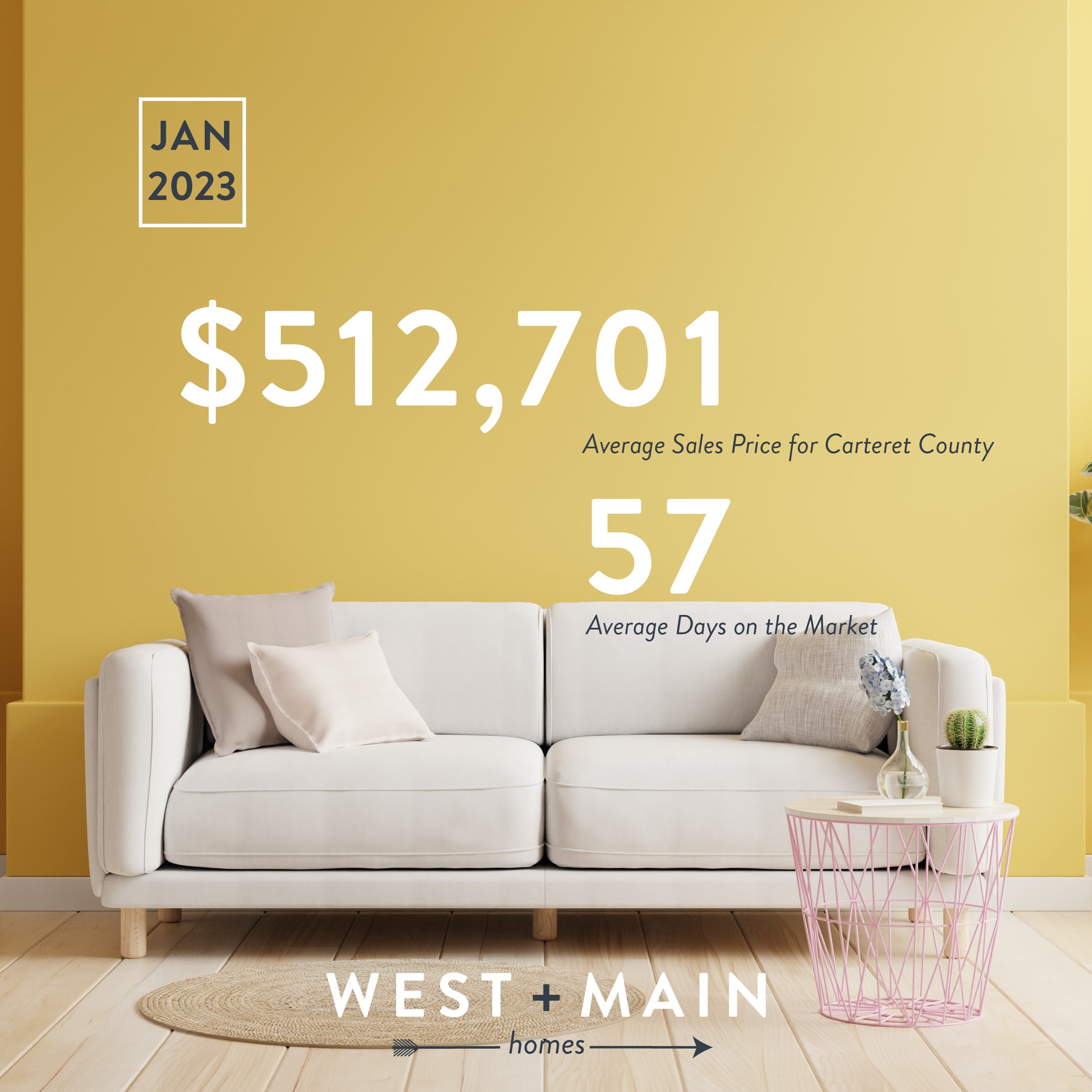
While activity picked up from the holiday market, average days in MLS also decreased to 57 days. While homes are not flying off the market within a weekend, buyers are still in the market. They have wrapped their heads around higher interest rates, have factored in rate buydowns into their purchase costs and are simply taking their time to find the right home.

Although homes are selling a bit slower, the average close price dipped slightly by 8.6 percent to $512,701 for single family detached homes.

The stats continue to showcase Carteret County’s stability, as prices have not varied even though affordability for buyers has been greatly impacted by rising interest rates.

Buyers are actively looking and the majority of the market still favors sellers. Homes may not sell in the first week-end, or even the first 30 days, but they are selling and prices are staying strong. As we enter Carteret County’s spring market, which traditionally starts next month, there is still much to love about the 2023 real estate market.

Related Links


If there is a home that you would like more information about, if you are considering selling a property, or if you have questions about the housing market in your neighborhood, please reach out. We’re here to help.

2023’s Housing Market Is Looking Up: 3 Things That Should Give Homebuyers Real Hope


After suffering all-time lows during the COVID-19 pandemic, the supply of homes for sale has rebounded with a bang.

January marked a whopping 65% more real estate listings than this same month a year earlier, according to a recent inventory report from Realtor.com®.

And while home prices are still up year over year, they’ve declined from the pandemic peak. January’s median home list price clocked in at $400,000—holding steady since December but much lower than June’s record high of $449,000.

In addition to this deluge of homes for sale at more reasonable prices, mortgage rates are also down from their 20-year high, which broke 7% in November. For the week ending Jan. 26, Freddie Mac found that rates for a 30-year fixed-rate loan averaged a mere 6.13%.

These three things—lower mortgage rates, stabilizing home prices, and a glut of listings—spell a long overdue opportunity for homebuyers to jump into the market and snag a deal.

“The fact that mortgage rates are down from their November highs means that today’s homebuyers aren’t paying quite as much as they did before,” says Danielle Hale, chief economist of Realtor.com.

Plus, mortgage rates might dip lower still.

“Further declines in inflation are expected at this point, but if they register faster than expected, that could mean a further drop in mortgage rates,” Hale predicts. “This would bring back purchasing power for buyers and help close the current gap between what many sellers hope to sell for and what buyers are willing to pay.”

‘An interesting year’ for real estate?

Yet the unpredictability of what interest rates might do next has many buyers and sellers nervous about forging ahead.

“January data tells us that it’s going to be an interesting year,” says Hale. “Both sellers and buyers are feeling their way out of this market stalemate with a keen eye on the broader economy and interest rates.”

While steadily climbing inventory means buyers can enjoy plenty of homes to shop and a more balanced negotiation with sellers, their affordability challenges persist. Despite the recent dip in interest rates, median mortgage payments are still about $750 higher each month than they were just one year earlier.

Additionally, many potential buyers are facing financial crunches in many aspects of their lives due to stubborn inflation. The net result? Many bottom-line-minded buyers are unable or unwilling to make offers on homes as aggressively as they were a few months ago, if at all.

As a result, many homes are simply sitting on the market an average of 75 days—way longer than the June rush, when listings lingered a mere 32 days before being snapped up.

That’s why inventory is so much higher: It’s not that more homes are going up for sale; rather, the ones that are on the market already aren’t selling as fast.

Why home sellers are hibernating

Meanwhile, many potential sellers are remaining in their homes rather than listing for one simple reason: They’re locked into mortgages with low interest rates they aren’t willing to give up. Sellers might also be hesitant to list properties that will simply sit there growing stale with nary an offer in sight.

And so the increase in listings—which breaks down to 248,000 more homes on any given January day—hides an important caveat: In January, new listings were down 2.8% on a year-over-year basis, following a much steeper year-over-year drop of 21% in December.

Why does this decline in fresh homes for sale matter? Because new listings help drum up demand and attract buyers, many of whom have already checked out (and passed over) listings that have been lingering on the market for months.

“Fresh listings are a new opportunity for buyers because they might mean they will better fit the needs and budget of potential buyers,” says Hale. However, she urges buyers to give those long-in-the-tooth listings another look, since this is where sellers might be desperate enough to lower their price.

“One benefit to buyers of looking at older listings is that their sellers may be more willing to negotiate,” Hale explains. “Sellers of new listings are typically going to want to see how many offers they can attract in a week or more before they consider negotiating with a buyer.”

Where inventory is soaring

Regions in the South and West have taken a beating in the market downturn, with supply far outweighing demand, sometimes by staggering numbers.

Take Nashville, TN, a pandemic darling. Once red-hot Nashville saw its inventory grow by a whopping 304.2 % on a year-over-year basis in January, according to Realtor.com data.

“In December 2021, we had just over 3,600 units available on the market,” says local real estate agent Brian Copeland, of Tennessee’s Doorbell Real Estate. “At the end of December 2022, we had just over 8,200 units.”

Copeland explains that there are several factors at play in the rise in inventory. One is pricing, with some sellers still putting homes on the market for $25,000 over comparable properties.

“Sellers aren’t being as realistic with pricing straight out of the gate,” says Copeland. “When you couple that with higher interest rates, it causes a slowdown.”

Hale agrees with this on-the-ground assessment: “What we see in the data is that while home sellers are more likely than a year ago to reduce their asking price, the majority of home sellers are still not making reductions,” she says.

What will happen to housing in the year ahead?

To get the market moving again, perhaps both buyers and sellers need to budge and make some concessions so they can meet in the middle.

“With macroeconomic conditions continuing to shift and adjust, it’s more important than ever to focus what you can control and on your individual goals,” Hale says. “As a seller, you can’t create more buyers, but you can price appropriately for the buyers that are in the market.”

As for buyers? Don’t forget your negotiating power as the new year gears up rather than letting high listings prices push them past what they can afford.

“As a buyer, you can’t set the market price, but you can determine what you’re comfortable paying, and make the best offer you can on a home that fits your needs and falls within your budget range,” Hale says.

Get more insight on Realtor.com

Related Links

If there is a home that you would like more information about, if you are considering selling a property, or if you have questions about the housing market in your neighborhood, please reach out. We’re here to help.

Search Homes in Colorado

Search Homes in Oklahoma

Search Homes in Oregon