Affordable Homeownership Strategies for Gen Z


The idea of owning a home has always been a big part of the American Dream.

It’s a symbol of stability, independence, and having a place to truly call your own. But for Gen Z, the “Zoomers” born between 1997 and 2012, making that dream a reality can feel like quite the challenge today with higher mortgage rates and rising home prices.

But achieving that goal of owning your first home can still be attainable, even today, with some strategic planning and resourcefulness.

Explore Down Payment Assistance Options

With prices rising all around you, it can be hard to save up for a home. If you’ve been struggling to stash away enough cash for that down payment, it’s worth it to look into the various down payment assistance programs available. These programs can really help you save big on the upfront costs of buying a home.

There are a lot more options out there than you may realize. According to Down Payment Resource, there are over 2,000 programs designed to help hopeful homebuyers with down payments and closing costs.

If you qualify for one of these programs, you may not need to save up as much money for your down payment. A local real estate agent can help you explore these programs in your area, making it much easier to turn your homeownership dream into a reality.

Consider Living with Relatives To Save

If you still need a bit more time to save, even with the down payment assistance programs out there, there are ways you can make that happen. Many savvy Zoomers have made a strategic choice to live with relatives so they can get to their savings goals even faster.

According to the National Association of Realtors (NAR), around 30% of Gen Z homebuyers transition directly from their relative’s home to a home of their own.

By sharing living costs, such as mortgage payments, utility bills, and even grocery expenses, you can substantially reduce your monthly expenses. This frees up more of your income to tackle any outstanding debt, boost your credit score, and reach your down payment target in less time. And, all of this can bring homeownership one step closer to becoming a reality. Clare Trapasso, Executive News Editor at Realtor.com, explains:

“Faced with ongoing housing affordability issues . . . we’re seeing parents and children becoming roommates again in later years as the ‘kids’ save up to purchase their own place . . .”

The Road to Homeownership

When you’re on the path to becoming a homeowner, it’s a good idea to get some help along the way. And one of your best resources on this journey as a young homebuyer is a trusted real estate agent. They’ll steer you through the process of buying a home and help you find one you can afford. 

Bottom Line

For Gen Z, the path to homeownership may not be straightforward, but it's still within reach. With the right strategies, you can turn your dream of owning a home into a reality.  

Learn more at Keepingcurrentmatters.com

Related Links

If there is a home that you would like more information about, if you are considering selling a property, or if you have questions about the housing market in your neighborhood, please reach out. We’re here to help.

Search Homes in Colorado

Search Homes in North Carolina

Search Homes in Oklahoma

Search Homes in Oregon

Search homes in Minnesota

How To Find the Right Buyer’s Agent for Your Home Purchase


Purchasing a new home is an exciting and often overwhelming process.

From finding the right neighborhood to determining your budget, there are plenty of tasks to keep you busy. One of the most important tasks is selecting the right buyer's agent. This professional will help guide you through the entire process, from searching for the ideal property to negotiating the cost. However, finding the right buyer's agent can be tricky, so in this blog, we’ll go over some helpful tips to find the best agent for you.

Get Referrals From Trusted Sources
Looking for referrals from friends, family members, and other trusted sources is one of the easiest ways to find a reputable buyer's agent. By seeking referrals from people you trust, you can get feedback on how they worked with their agents and also ask about their home-buying experience. This will help you glean insights into the agent's communication style, work ethic, and professionalism.

Research Their Credentials
Check if the agent has a license to practice in your state, certifications, and any awards they may have received. You can also look for reviews and testimonials from other clients they worked with previously. This will give you an idea of their specialties and qualifications. Finding an agent with experience and accolades in your desired neighborhood and property type can be of great help.

Interview Potential Agents
It is essential to interview at least three agents before making a final decision. In this way, you can understand their work style, personality, response time to messages, and overall thoughts on the home buying process. Ensure the agent is approachable, professional, and aligns with your wishes. You can also ask the agent to provide references and contact them to confirm if they're worth considering.

Gauge Their Knowledge of the Property Market
Your agent should possess a solid understanding of the property market and the intricacies of the buying procedure. Ask potential agents questions on costs, market trends, and home value. Their answers should make sense and meet your expectations. Experienced agents can offer insights on the property's future value, potential resale value, and local tax laws.

Review Their Fees and Pricing Structure
Before hiring an agent, be sure to review their fees and pricing policies to avoid misunderstandings over payment procedures. Discuss any limits on their services or exclusive agreements they might require and ensure they're acceptable to you. Once you understand their policies, you will feel more comfortable with moving ahead.

Choosing the right buyer's agent sets the tone for a smooth and stress-free buying experience. Referrals, research, interviews, market knowledge, and fees are just some factors to consider when choosing an agent. Remember, the right buyer’s agent will set you up for success. Join our newsletter for more buying and selling tips and insights! Come to work with us, and let's help you find that dream home.

Learn more at Rismedia.com

Related Links

If there is a home that you would like more information about, if you are considering selling a property, or if you have questions about the housing market in your neighborhood, please reach out. We’re here to help.

Search Homes in Colorado

Search Homes in North Carolina

Search Homes in Oklahoma

Search Homes in Oregon

Search homes in Minnesota

2 Ways to Avoid Getting Spammed While Shopping for Mortgage Rates Online


Picture this: You were recently shopping around for mortgage rates — or you applied for a home loan online — and now your phone is figuratively ringing off the hook. The emails are flooding in, too, with lenders hounding you.

You just wanted to know how much your interest rate would be on that cute bungalow! But now you’re getting spammed. And even if you are a serious buyer and you applied for a mortgage, how did so many dang companies get your contact information?

One likely scenario: Your data was sold by a credit bureau, says Fred Winchar, co-founder and CEO of MaxCash, a financial broker that connects users with lenders.

When you apply for a loan with a mortgage company, the company pulls your credit record to determine your credit score, Winchar explains. The credit bureau now has the credit inquiry record, which they sell to other mortgage companies as leads. 

“This lets the other mortgage companies know you are shopping for a mortgage, so they get in touch with you to attempt to make a sale,” Winchar says. 

In case you were wondering, yep, credit bureaus can sell information about you to lenders and insurers, who can then send you unsolicited offers of credit or insurance through “prescreening offers.” You can opt out of these offers, though according to the Federal Trade Commission’s consumer advice. Here’s how to do so. 

The other likely scenario? When you apply for a mortgage, your application gets logged in various databases or within networks that are affiliated with the initial company, explains financial planner Jeff Rose, CFP, and the founder of GoodFinancialCents.com

“Some companies might also sell or share lead information with other lenders, especially if they can’t service your loan, leading to multiple companies reaching out to you,” he says.

In June, a California resident filed a class-action lawsuit against Rocket Mortgage LLC, alleging the company made unsolicited phone calls and sent text messages to those who are registered on the National Do Not Call Registry.

So, how do you shop for mortgage rates without getting inundated with unsolicited calls?

Consider using a separate email address and phone number (perhaps a Google Voice number) when shopping around to keep your primary contacts spam-free, Rose says. 

You can also explore online platforms that aggregate mortgage rates from various lenders, he suggests, allowing you to compare without directly providing your information to a slew of companies. 

To put a stop to the influx of calls and emails, consider registering your number with the National Do Not Call Registry, Rose suggests. 

It’s free to register your home or cell phone number, and it should show up on the registry the next day, he says. However, it can take up to a month for sales calls to stop. 

If you’re still getting a lot of unwanted calls, they might be from scammers, as the registry only stops sales calls from real companies, Rose explains. Charities, political groups, debt collectors, and survey takers can still reach you, too.

Another strategy is once you’ve identified potential mortgage deals and you’re ready to engage with lenders, reach out to them directly via their websites or phone numbers, suggests financial expert Young Pham, an editor with Biz Report.

The takeaway: If you’re hoping to shop around for a mortgage rate (and you should — you could save $84,000 over the life of your loan by doing comparisons, according to LendingTree), but you don’t want to be spammed with calls, consider opting out of prescreened offers and be sure you’re on the Do Not Call registry. 

Learn more at Apartmenttherapy.com

Related Links

If there is a home that you would like more information about, if you are considering selling a property, or if you have questions about the housing market in your neighborhood, please reach out. We’re here to help.
Search Homes in Colorado

Search Homes in North Carolina

Search Homes in Oklahoma

Search Homes in Oregon

Search homes in Minnesota

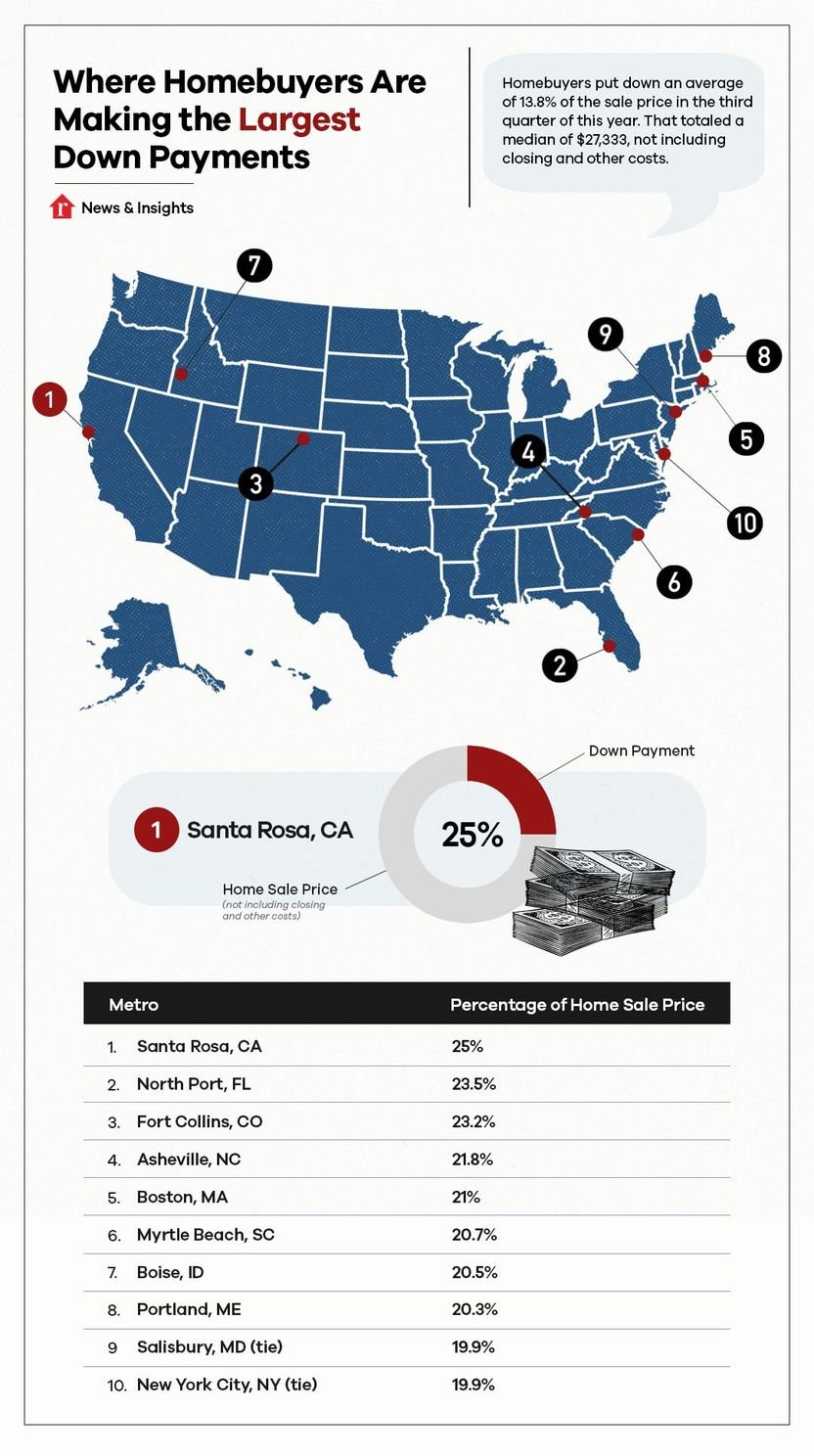
Winning the Bid: The Cities Where Homebuyers Are Making the Largest—and Smallest—Down Payments


A cluster of homebuying dictums has cropped up in recent years and become entrenched as canon.

Move fast. Be decisive. Be ready to make a bid by being pre-approved for a mortgage. Expand your horizons and remain flexible to find an affordable dream home. Roll with the punches.

And the one that seemed to tower over the rest: Put as much money as you can for a down payment.

In the most competitive markets, buyers need to plunk down quite a bit of cash (and maybe say a prayer or three) to make their offers more appealing to sellers, compete with all-cash buyers, and ultimately win a bidding war. However, not all markets have such a high barrier to entry, especially during this real estate slowdown. In some markets, buyers don’t need to come up with much cash, if any, to snag prime real estate.

Realtor.com® set out to find the real estate markets where buyers are making the largest down payments for a home—and where they’re putting down the smallest (as a percentage of the home sale price).

The general rule of thumb is buyers should aim to kick in least 20%, which allows them to avoid paying private mortgage insurance each month. In September, that totaled $85,900 on the median-priced home of $429,500, according to Realtor.com data. (This doesn’t include closing and other costs.)

“When prices are rising so much faster than incomes, it’s hard to save more” for a down payment, says Sean Moss, executive vice president of product and operations at Down Payment Resource. “The goal post is always moving.”

Buyers generally need to put down more in the pricier, more competitive markets and in vacation and retirement destinations. Retirees can often sell their existing residences and use the money they earn to pay for their forever homes. And with mortgage rates hovering around 8%, many folks would rather put down more cash so they don’t have to pay interest on a larger loan.

Conversely, down payments were much lower in areas near military installations. That’s because active service members and veterans can use 0% down mortgages offered through the U.S. Department of Veterans Affairs. On top of that, mortgage rates for these loans are typically lower than for 30-year fixed-rate loans.

The good news for buyers: Down payments have fallen over the past year as the housing market has become less competitive. Buyers put an average of 13.8% of the sale price down in the third quarter of this year, down from 14.7% last year, according to a Realtor.com analysis of data from real estate data firm Optimal Blue.

What many buyers don’t realize is how many low and no down payment loans and financial assistance are available, says Moss.

Like VA loans, U.S. Department of Agriculture loans also require no down payment. Then there are Federal Housing Administration loans, which require a minimum of 3.5% down. There is also down payment assistance available for those having a hard time coming up with those funds.

In 2022, about 53.5% of mortgages made in the 10 largest metropolitan areas were eligible for assistance, according to Down Payment Resource. These borrowers were eligible for about $18,144 in down payment funds. In many cases, this money could also be used to help cover closing costs and even buy down mortgage rates.

To come up with the places with the highest and lowest down payments, we dove into data from Optimal Blue. We looked at the average down payments as a percentage of the home sale price in the 150 largest metropolitan areas in the third quarter. (Metros include the main city and surrounding towns, suburbs, and smaller urban areas.) We included just one per state to ensure geographic diversity.

Where homebuyers are making the largest down payments:


1. Santa Rosa, CA

Average down payment as a percentage of the home sale price: 25%
Median down payment: $147,550
Median home list price in September: $1,070,990

About an hour north of San Francisco in the heart of Sonoma County’s wine country lies Santa Rosa. It’s the most expensive metro on our list, by a lot. And if we hadn’t limited our analysis to just one metro per state, high-priced California housing markets would have taken six of the top 10 slots.

Many of the buyers in the area are nearing retirement or seeking a vacation home, says local real estate broker associate Daphne Peterson, of Keller Williams Realty. Some are relocating to the area and using the proceeds from the sale of their previous homes to fund their new purchases. This allows them to avoid taking out a more expensive loan at today’s higher mortgage rates.

“Prices are expensive, but they’re not as expensive as many surrounding counties,” says Peterson. “It is attracting a lot of people from higher-priced areas who may be cashing out the equity of their home and deciding to retire here.”

2. North Port, FL

Average down payment (percentage): 23.5%
Median down payment: $81,853
Median home list price: $525,000

The metro, which includes Sarasota, is located on the southwestern coast of Florida along the Gulf of Mexico. Like Santa Rosa, it’s also popular with retirees and vacationers looking to pick up an extra home, making it competitive when there are only a limited number of homes available.

Nearly all of relocation specialist Linda Starcher‘s sales have been cash deals over the past year.

“Our market is mostly retirees and pre-retirees moving here for the majority of the year as their permanent home,” says Starcher, of Re/Max Alliance Group.

These older buyers often have a home they can sell, giving them the cash they need to purchase a new home without taking out a mortgage.

“Our sellers can afford to wait for a strong buyer … all cash or those with a very strong down payment,” says Starcher.

3. Fort Collins, CO 

Average down payment (percentage): 23.2%
Median down payment: $105,533
Median home list price: $625,000

Over the past few years, Fort Collins has emerged as a slightly more affordable alternative to Denver, about an hour south. (The median home price in the Denver metro was $649,000 in September.) Founded as a military fort in 1864, Fort Collins has evolved into an outdoorsy community with plenty of museums and art galleries.

However, the housing market isn’t as competitive as it was during the COVID-19 pandemic. There were about 21% more homes on the market in September than there were a year earlier. The number of sellers cutting prices has also risen.

The majority of homes for sale in the city are single-family houses, although there are plenty of condos on the market as well. Buyers can check out this four-bathroom, 3.5-bathroom house with a recently remodeled kitchen, which is listed for $550,000.

4. Asheville, NC 

Average down payment (percentage): 21.8%
Median down payment: $63,733
Median home list price: $600,000

The small, funky city in the Blue Ridge Mountains, known for its outdoorsy lifestyle and craft beer scene, has long attracted artists, vacationers, and retirees. About two hours from Knoxville, TN, to the west and Charlotte, NC, to the east, the area is now drawing wealthier buyers to its growing luxury real estate market.

Home list prices have soared over the past few years as a result of that demand. Prices rose 50% from September 2019 to September 2023. However, the number of homes for sale over the same period dropped about 56%.

That competition, plus buyers who are able to sell homes and use the money they make to buy new ones, has resulted in higher down payments.

5. Boston, MA

Average down payment (percentage): 21%
Median down payment: $108,654
Median home list price: $849,000

Beantown buyers are making large down payments for one simple reason: That’s often what they need to do to win bidding wars.

The problem is there aren’t enough homes to go around in this high-demand city. The number of properties for sale in the metro was down 16.6% year over year in September. Meanwhile, prices were up 14.1% over the same period as buyers battled it out over real estate.

“Here, it’s standard to put at least 20% down,” says Compass agent Amy Goldberg, who works primarily in downtown Boston. “Because the rates are higher now, if you put more down, it makes your monthly payments more comfortable.”

This two-bedroom, 1.5-bathroom, upper-level duplex in a brownstone with a shared yard is on the market for $709,000. Buyers looking for a single-family house can view this four-bedroom, two-bathroom Colonial-style home with an outdoor patio for $599,900.

Rounding out the top 10 is Myrtle Beach, SC, where buyers put down an average of 20.7% of the home sale price. It was followed by Boise, ID, at 20.5% and Portland, ME, at 20.3%. Salisbury, MD, and New York City tied for the No. 9 and No. 10 spots with buyers putting down an average of 19.9%.

Where homebuyers are making the smallest down payments:


1. Killeen, TX

Average down payment (percentage): 5.3%
Median down payment: $2,182
Median home list price: $325,000

It’s not a surprise that Killeen made our list. The city, about an hour north of Austin and an hour southwest of Waco, is an Army town, home to Fort Cavazos, formerly called Fort Hood. It’s the largest military base in Texas with more than 53,000 soldiers and their families based here.

Many of the area’s buyers are either active service members or veterans and have access to popular VA loans that don’t require a down payment. Those loans pushed down the average down payment in the local housing market.

The market also doesn’t appear to be as competitive as other places on our list. The number of homes for sale was up 37.3% in September compared with a year earlier, according to the most recent Realtor.com data. Homes are also staying on the market for 34% longer, at a median of 56 days.

Most of the homes for sale in Killeen are single-family houses. Buyers can still find plenty of brick ranches for less than $200,000, including this 1,300-square-foot, three-bedroom, two-bathroom home priced at $170,000. There is also new construction, including this four-bedroom, three-bathroom house for about $450,000.

2. Fayetteville, NC 

Average down payment (percentage): 5.9%
Median down payment: $2,779
Median home list price: $330,000

Fayetteville is another military town with more than 50,000 soldiers stationed at Fort Liberty, formerly known as Fort Bragg.

The fort “is responsible for a disproportionate number of sales,” says real estate broker Bernard Fleming, of Fleming Real Estate. “We know that every year a number of soldiers are going to be coming to be stationed here and a number are going to be moving out.”

The loan of choice for these military buyers is VA mortgages. However, the market has become so competitive due to the lack of homes for sale that even VA buyers might now be making small down payments and offering over the list price to spur sellers to choose their offers.

“People are still waiting in line to get homes,” says Fleming.

3. Shreveport, LA

Average down payment (percentage): 6.7%
Median down payment: $4,587
Median home list price: $245,000

The city in northwest Louisiana, known for its riverboat casinos, is also popular with military buyers.

The area is home to the Barksdale Air Force Base, which has a population of about 15,000 active-duty personnel, reservists, and civilians. The city also has the Overton Brooks VA Medical Center.

Buyers can find this three-bedroom, two-bathroom home on the market for $250,000. Those looking for some space to stretch out in can check out this three-bedroom, 1.5-bathroom cottage with a deck on an acre of land. It’s priced at $269,000.

4. Huntington, WV 

Average down payment (percentage): 8.2%
Median down payment: $4,802
Median home list price: $179,900

The second-largest city in West Virginia, the former manufacturing hub is home to Marshall University and Camden Park, one of the nation’s oldest amusement parks.

However, the area has been hurt by the decline in manufacturing. Many residents left the metro in the second half of the 20th century. Then the opioid crisis struck. Today, nearly a third of the residents of the city proper lived in poverty in 2022, according to the U.S. Census Bureau.

The troubles that have plagued the area have resulted in some of the lowest home prices on our list—about 58% less than the national median list price.

This two-bedroom, two-bathroom Cape Cod, spanning about 2,500 square feet, is on the market for $179,900 after a $5,000 price cut.

5. Augusta, GA

Average down payment (percentage): 8.3%
Median down payment: $5,586
Median home list price: $302,430

Augusta is yet another military hub where homebuyers are making low—or no—down payments. Fort Eisenhower, formerly known as Fort Gordon, is located just southwest of the city. It was designated as the U.S. Army Cyber Center of Excellence in 2014.

“You got a lot of VA buyers,” says Frank Mears, senior vice president of Meybohm Real Estate in Augusta. “You have first-time buyers who are using FHA loans.”

Buyers who use FHA loans can often put down as little as 3.5%.

But there’s a shortage of homes here. Even when military personnel leave the fort, they often keep the home they own and use it as a rental property, says Mears. Many plan to return to the fort in the future or anticipate retiring in the area.

Sellers generally prefer buyers who can put some money down. In some areas where there aren’t many homes for sale, buyers might still have to waive home inspections and appraisals to compete with multiple offers.

“If there’s no inventory, the only way you’re going to get a house in that neighborhood is if you have no contingencies,” says Mears.

The rest of the top 10 metros with the lowest down payments were Mobile, AL, with buyers putting down an average of 8.5% of the home sale price; Virginia Beach, VA, at 8.7%; Gulfport, MS, at 8.9%; Lakeland, FL, at 9.4%; and Peoria, IL, at 10%.

Learn more at Realtor.com

Related Links

If there is a home that you would like more information about, if you are considering selling a property, or if you have questions about the housing market in your neighborhood, please reach out. We’re here to help.

Search Homes in Colorado

Search Homes in North Carolina

Search Homes in Oklahoma

Search Homes in Oregon

Search homes in Minnesota

Areas of Your Home You Probably Never Think About Cleaning


Cleaning your home is a tedious task that most people are reluctant to do.

While you might have a cleaning routine that covers the floors, countertops and bathroom, there are certain areas of your house that you might forget to clean. These areas are usually overlooked, but they can harbor germs and make your home look unappealing. In this blog, we will discuss the areas in your home that you might forget to clean and offer tips on how to keep them sparkling.

Light Fixtures and Ceiling Fans
As you go about your household cleaning, it can be easy to overlook the fixtures that illuminate and cool your home - your light fixtures and ceiling fans. Did you know that these fixtures accumulate a significant amount of dust and grime, even though they're easily seen in our day-to-day lives? It's vitally important to take the time to give them a wipe-down, not only for aesthetic purposes but also to maintain their functionality. To clean them, consider using a microfiber cloth or duster to gently remove dirt. If your fixtures have glass or plastic parts, using warm, soapy water can help break up any stuck-on grime. By giving these often-neglected fixtures a little attention, you can help keep your home cleaner and more pleasant to be in.

Baseboards
When cleaning your home, it's important not to overlook the baseboards. Despite their often-neglected status, they are surprisingly susceptible to dirt and dust build-up, which can quickly accumulate and detract from the overall appearance of your space. Fortunately, cleaning them is an effortless task that won't take up much of your time. Simply grab a damp sponge or cloth and your preferred cleaning solution. With a bit of elbow grease, you can go along the baseboards, clearing out the gunk at the bottom of your walls. Taking care of the baseboards is a small but vital aspect of maintaining a clean and tidy home.

Air Vents and Filters
Maintaining high-quality air in your home is vital to your health and well-being no matter the time of year. Your home's air vents control the airflow and keep your home cool or warm, depending on the weather outside. They also act as a filter, collecting dust and other particles in the air that could cause allergies and other respiratory issues. Proper care of your air vents is crucial to ensure that your home's air quality remains clean and fresh. Regular cleaning and changing out your filters every three months can help keep your HVAC system running smoothly and your home free of dust and debris. However, if you encounter a problem when trying to change the air filter or feel that a more thorough cleaning is in order, it might be a good idea to call in a professional to do some air conditioning repair. By taking these simple steps, you can breathe easier and enjoy a healthier home environment for you and your loved ones.

Kitchen Appliances
In a busy household, kitchen appliances such as your refrigerator, oven and dishwasher are essential components of your daily life. But with all the use they get, it’s easy to forget that they, too, need regular TLC to function properly. Take your fridge, for example. The build-up of bacteria and germs on the often-overlooked fridge interior can become a breeding ground for potential health hazards. Prevent this by making it a habit to clean up spills and stains with mild soap and water. Your dishwasher and oven also require special attention to keep them running well. By running your dishwasher on a hot cycle and cleaning your oven with natural solutions like baking soda and vinegar, you can keep them in tip-top condition. Make it a priority to keep these appliances as clean as possible, and you’ll enjoy fresh, healthy and hygienic food for years to come.

Outdoor Areas
When it comes to maintaining your home, it’s important to remember that the outdoor areas are just as important as the interior. Whether it's your patio, deck, or gutters, having these areas clean and well-kept can make a huge difference in the overall look and feel of your property. Not only does regular upkeep improve the aesthetic value of your home, but it also helps prevent potential structural damage caused by neglect. Plus, if you’re planning on selling your home in the future or hosting guests for an outdoor gathering, a pristine outdoor area can be a major selling point. So, take some time to give these areas the attention they deserve and enjoy a beautiful and functional outdoor space.

While it may be easy to overlook certain areas of your home when cleaning, taking the time to clean these often-neglected spots regularly can make a significant difference in the overall look and feel of your living space. From light fixtures and baseboards to kitchen appliances and outdoor areas, giving these spaces some TLC can help maintain a healthier and more aesthetic home for you and your loved ones. So next time you're cleaning, don't forget to add these areas to your checklist and enjoy a sparkling clean living environment.

Learn more at Rismedia.com

Related Links

If there is a home that you would like more information about, if you are considering selling a property, or if you have questions about the housing market in your neighborhood, please reach out. We’re here to help.

Search Homes in Colorado

Search Homes in North Carolina

Search Homes in Oklahoma

Search Homes in Oregon

Search homes in Minnesota