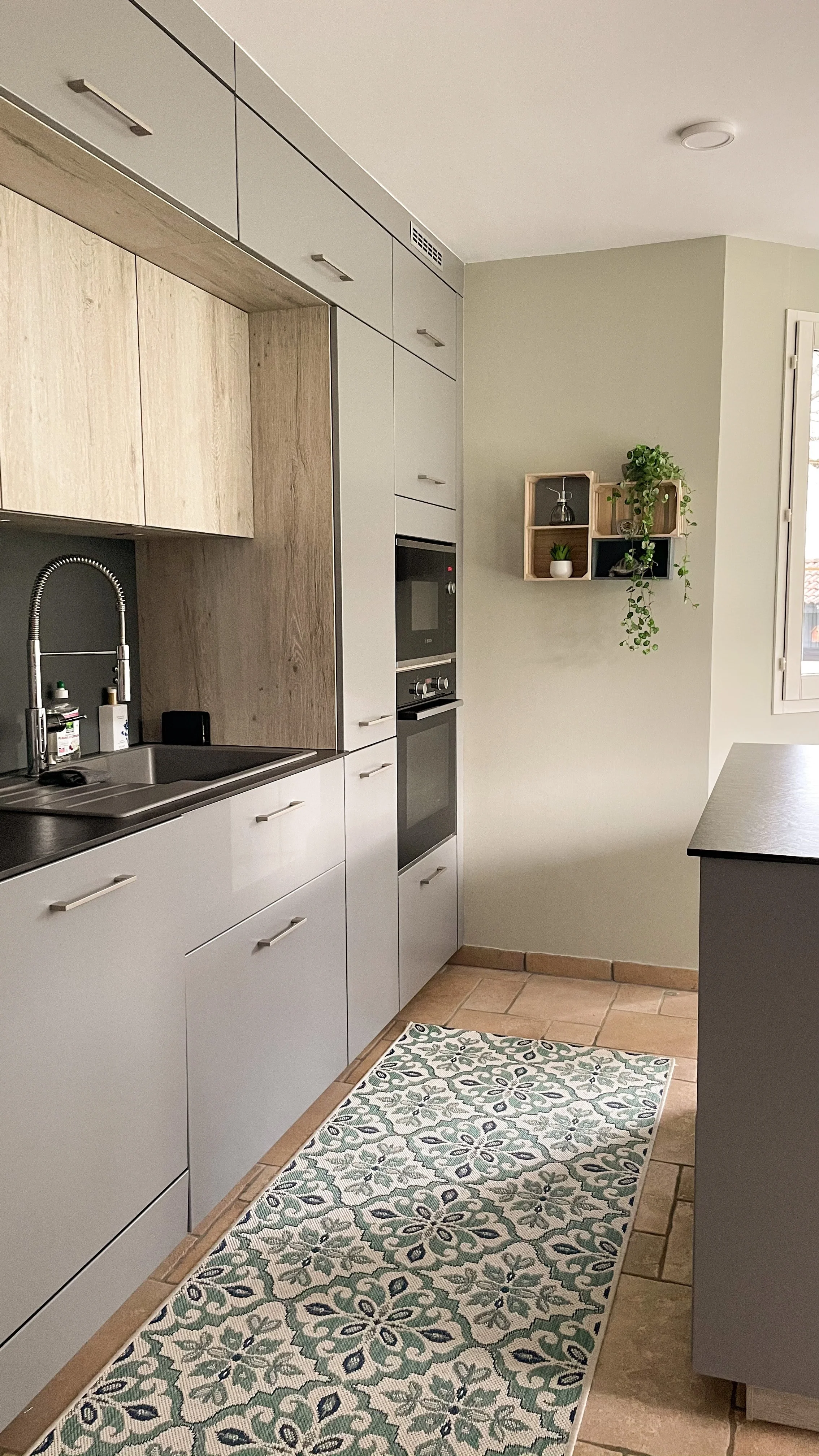
As Featured in West + Main Home Magazine: Pantry Re-Imagined


West + Main agents Steph Christianson and Sam Messmer teamed up and got an organizational wave of inspiration after scouring HGTV, Magnolia, Pinterest, and all-things-interior-design.

When it came time to actually begin on the pantry project, homeowner Steph credits renovation genius Sam for being detail-oriented and able to pick out specific design points to make a space even more eye- catching.

“Sam (gently) forced me to use all the scary tools that I never thought I’d have the courage to use,” Steph said. “She is a real pro and insists on safety every step of the way. We also spent a crazy amount of time (and girl muscles) to get the baseboards off during the demo. I remember Sam saying this is going to be the 'easiest' part of this project. Nope. That was not the case at all. Someone definitely attached those puppies with some crazy adhesive many years ago!”

Below: Before + After of Pantry

And the hard work did indeed pay off. Not only is the pantry practical, but a beautiful part of the home.

"Sometimes I open the pantry door just to gaze at how beautifully it turned out,” Steph said. “I knew I’d be giving up some storage space but the trade-off was totally worth it for me. It’s a work of art in my opinion, and I am in awe that two badass ladies did this!”

Pantry Details


If there is a home that you would like more information about, if you are considering selling a property, or if you have questions about the housing market in your neighborhood, please reach out. We’re here to help.

Search Homes in Colorado

Search Homes in Oklahoma

Search Homes in Oregon

How to Properly Maintain a Rural Property


Living in the country is at the core of many people's dreams.

Fresh air, gardens and wild animals are a big part of the draw. If you're considering a move to the country, there are some things you should know about maintaining a rural property. Here are a few tips to help you keep your rural home in top shape.

Water Well
Most rural properties rely on water wells for their water supply. This means that you'll need to have your well regularly inspected and serviced to ensure that it is functioning properly. You'll also need to be sure to know how your pump and tank work and how to troubleshoot and fix minor issues they may have. You'll also want to have the proper equipment on hand in case of a power outage or other emergency or install a generator to power the pump in the absence of electricity.

Septic System
Another thing to be aware of if you're moving to the country is that most rural properties rely on septic systems for their wastewater. This means that you'll need to have your septic system inspected and pumped every few years to keep it working properly. You'll also want to be careful about what you put down your drains and toilets as some things can clog and damage your system. When buying a property, it's a good idea to have local experts, like those at Rob's Septic Tanks Inc, come out and do an inspection on the system to assess its age, size,and condition to determine whether it is adequate for your family's needs.

Foliage
One of the most attractive features of rural properties is the usually larger property sizes. Even if a property doesn't have acreage, the lot sizes tend to be much bigger than city lots. If you've ever mowed your lawn and a few days later the grass was shin-high already, imagine how much effort it will take to tend a large yard. If you end up buying a rural property, this is a great time to consider a riding mower. They are versatile and can pull utility trailers, or even small garden plows. You'll also need a variety of trimming devices for trees and bushes. In the country where "growing like a weed" manifests into reality, you'll need to round up all the gardener's power tools you can get!

Security
There is a common notion that living in the country is automatically safer than living in the city. While this may be true in some cases, there are also certain dangers that come with rural living. Because properties are often more spread out, it can take law enforcement longer to respond to an incident. This is why it's important to have a good security system in place as well as a few well-trained guard dogs. You should also be aware of your surroundings and know who your neighbors are and how to get in touch with them in case of an emergency.

With a little bit of preparation, country living can indeed be the stuff of dreams. Just be sure to do your research and be proactive with maintenance to manage the challenges that come with rural property.

Get more tips like this on RISMedia.

Related Links

If there is a home that you would like more information about, if you are considering selling a property, or if you have questions about the housing market in your neighborhood, please reach out. We’re here to help.

Search Homes in Colorado

Search Homes in Oklahoma

Search Homes in Oregon

Should You Buy a Home with Inflation This High?


While the Federal Reserve is working hard to bring down inflation, the latest data shows the inflation rate is still going up.

You no doubt are feeling the pinch on your wallet at the gas pump or the grocery store, but that news may also leave you wondering: should I still buy a home right now?

Greg McBride, Chief Financial Analyst at Bankrate, explains how inflation is affecting the housing market:

Inflation will have a strong influence on where mortgage rates go in the months ahead. . . . Whenever inflation finally starts to ease, so will mortgage rates — but even then, home prices are still subject to demand and very tight supply.”

No one knows how long it’ll take to bring down inflation, and that means the future trajectory of mortgage rates is also unclear. While that uncertainty isn’t comfortable, here’s why both inflation and mortgage rates are important for you and your homeownership plans.

When you buy a home, the mortgage rate and the price of the home matter. Higher mortgage rates impact how much you’ll pay for your monthly mortgage payment – and that directly affects how much you can comfortably afford. And while there’s no denying it’s more expensive to buy and finance a home this year than it was last year, it doesn’t mean you should pause your search. Here’s why.

Homeownership Is Historically a Great Hedge Against Inflation

In an inflationary economy, prices rise across the board. Historically, homeownership is a great hedge against those rising costs because you can lock in what’s likely your largest monthly payment (your mortgage) for the duration of your loan. That helps stabilize some of your monthly expenses. Not to mention, as home prices continue to appreciate, your home’s value will too. That’s why Mark Cussen, Financial Writer at Investopedia, says: 

Real estate is one of the time-honored inflation hedges. It’s a tangible asset, and those tend to hold their value when inflation reigns, unlike paper assets. More specifically, as prices rise, so do property values.”

Also, no one is calling for homes to lose value. As Selma Hepp, Deputy Chief Economist at CoreLogic, says:

“The current home price growth rate is unsustainable, and higher mortgage rates coupled with more inventory will lead to slower home price growth but unlikely declines in home prices.”

In a nutshell, your home search doesn’t have to go on hold because of rising inflation or higher mortgage rates. There’s more to consider when it comes to why you want to buy a home. In addition to shielding yourself from the impact of inflation and growing your wealth through ongoing price appreciation, there are other reasons to buy a home right now like addressing your changing needs and so much more.

Bottom Line

Homeownership is one of the best decisions you can make in an inflationary economy. You get the benefit of the added security of owning your home in a time when experts are forecasting prices to continue to rise.

Get more advice like this on Keeping Current Matters.

Related Links

If there is a home that you would like more information about, if you are considering selling a property, or if you have questions about the housing market in your neighborhood, please reach out. We’re here to help.

Search Homes in Colorado

Search Homes in Oklahoma

Search Homes in Oregon

4 Questions To Ask Your Partner Before Buying a House Together


If you’re hoping to buy a house with your significant other, it can be easy to get caught up in the fun stuff, like deciding the style of home you’d love (Victorian, midcentury modern, Cape Cod?) and finding the perfect neighborhood (downtown or middle of the woods?).

Still, don’t be fooled: The home-buying process is riddled with pitfalls, particularly if you haven’t vetted how prepared your partner is for such a financial leap of faith. Jump in blindly, and you might see your dreams of a sweet beach bungalow crumble because your sweetheart’s hiding a sketchy credit score behind that cute smile.

It’s a cliche among successful couples that communication is key, and that’s especially true if you’re planning to buy a house together. So before you get too serious and start poring through real estate listings, pop these four questions first.

1. How much debt do you have?

If you haven’t done so already, now is the time for each of you to come clean about any debt you may have, since that can make or break your ability to get approved for a mortgage.

One of the things mortgage lenders look at when you apply for a home loan is your debt-to-income ratio. The DTI ratio is your combined monthly debt payments (from obligations like credit cards, student loans, car loans, installment loans, and personal debts), divided by your combined monthly income.

Lenders use the DTI ratio to gauge a borrower’s financial responsibility, since evidence from studies of mortgage loans shows that borrowers with a higher DTI ratio are more likely to run into trouble making monthly payments, says the Consumer Financial Protection Bureau.

So let’s say together, as a couple, you’re paying $1,000 to debts and pulling in $6,000 in gross (meaning pretax) income per month. Divide $1,000 by $6,000, and you’ve got a DTI ratio of 0.166, or roughly 16%. However, that’s your DTI ratio without a monthly mortgage payment. If you factor in a monthly mortgage payment of, say, $1,000, your DTI ratio would increase to about 33%.

As a general rule, to qualify for a mortgage, your DTI ratio cannot exceed 36%, says David Feldberg, broker and owner of Coastal Real Estate Group in Newport Beach, CA. A higher DTI ratio could mean a higher interest rate, or you could be denied a loan altogether.

2. How much house can we afford?

Though your DTI ratio determines your ability to qualify for a mortgage, only you and your partner can decide how much you feel comfortable spending on a home. If you stretch yourselves too thin, making your mortgage payments can be difficult.

Too often, dreams and reality collide: You’re yearning for a four-bedroom Colonial, but given your income and debt owed to credit cards and beyond, the best monthly loan payment you can manage is for a two-bedroom condo that needs some fixing up.

You also have to consider your down payment. Ideally, to get the best mortgage rates and terms, you’ll want a down payment amounting to 20% of the price of the house—but if you don’t have that much cash to shell out, there are ways that you can put down less and still obtain a mortgage. Federal Housing Administration loans, for instance, require a down payment of only 3.5%, while Veterans Affairs loans are available with 0% down. However, you’ll need to meet certain income and credit requirements—FHA loans call for a minimum credit score of 500, and VA loans require a minimum score of 620—to qualify.

Don’t qualify for a VA or FHA loan? If you have good credit and can put at least 10% down, you can still qualify for a conventional mortgage. The catch is you’ll need to pay private mortgage insurance, a premium that protects the lender in case you default on the loan. PMI ranges from about 0.3% to 1.15% of your home loan.

You and your partner may also be able to qualify for one of the more than 2,500 down payment assistance programs offered by state and local housing finance agencies, according to a recent estimate by DownPaymentResource.com and Freddie Mac. We’re not talking chump change! One study found that buyers who use down payment assistance programs save an average of $17,766. Just knowing down payment programs exist gives you an edge over other home buyers.

3. Where do we want to live and for how long?

Buying a home makes financial sense only if you’re going to stay in it long enough to recoup your purchasing costs. (Financial experts call this a “break-even point.”) Therefore, have a talk with your partner about your long-term plans.

Do you see yourselves starting a family in this house? Are you both happy in your current jobs, or do you foresee a job search in the future that could make for a longer commute?

Life throws curveballs, of course, but discussing these things ahead of time will help you decide whether you’re really ready to buy a house together based on your future goals.

Moreover, be prepared to do a little digging to determine where you want to live. One of the worst mistakes you can make is moving into a bad area, or a neighborhood that doesn’t fit your needs.

Watch out for red flags. For instance, if you see a sea of “For Sale” signs in a neighborhood, look elsewhere, advises Alison Bernstein, the founder of Suburban Jungle, a company that helps families find their ideal suburb.

“This points to illiquidity in the market and pricing pressure, which is a risk for buyers,” Bernstein says,

Pro tip: As a couple, consider rating, on a scale of 1 to 10 (with 10 being “must have it” and 1 being “seriously, this is what you’re obsessing about?”), what aspects of a neighborhood are most important to you. Doing so will help you align your values and make a smarter home-buying decision.

4. What happens if we break up?

Though this is a happy time in your relationship, you need to consider all possible outcomes for your relationship, and create a plan—ideally a formal contract—of how you’d divide your assets if you split up.

However, before drawing up an agreement, it’s important both of you understand there are a couple of types of homeownership options to choose from when purchasing property with your partner. The most common is joint tenancy, where each person holds equal interest in the property. Its distinguishing factor is that in the event one person dies, that person’s interest in the property automatically conveys to the surviving partner (also known as “right of survivorship”).

Meanwhile, under tenancy in common, each person has a distinct, separately transferable interest in the property. This might be a sensible form of ownership if one person makes a higher percentage of the down payment or monthly mortgage payments and wants to guard his or her investment in the event of a separation. The caveat?

“At any time, any owner can sell their share of the property or give it to someone else without requiring the consent of the other owners,” says Michele Lerner, author of “Homebuying: Tough Times, First Time, Any Time.” “This may result in you owning a house—and perhaps living there—with someone that you don’t know or don’t like.”

Whatever plans are drawn up, Lerner advises couples seek independent counsel from an attorney and a tax professional to walk them through both the legal process and the tax ramifications of purchasing a shared property.

The bottom line: Buying a house is a huge commitment. Some would say it’s an even bigger commitment than getting engaged! After all, you can return a ring—but not a house. So take the time to sit down with your partner and have a frank conversation about these topics before you decide to purchase a home together.

Get more like this on Realtor.com

Related Links

If there is a home that you would like more information about, if you are considering selling a property, or if you have questions about the housing market in your neighborhood, please reach out. We’re here to help.

Search Homes in Colorado

Search Homes in Oklahoma

Search Homes in Oregon
Millennials would give up TikTok and alcohol for a dream home


Millennials are willing to give up alcohol, social media and vacations for the chance at homeownership

Millennials now make up 43% of home buyers, which is the most of any generation, and an increase from 37% last year. Even as they delay marriage, kids, and reject their parents’ version of adulting, Millennials still desperately want a place to call their own.

In fact, over half of millennials say their urgency to own a home has increased in the past year, driven by wanting to raise a family, hope for better living conditions, and —understandably — being tired of paying rent to a landlord.

Yet amidst low inventory, high competition, and rising costs and interest rates, many millennials have lost hope that they’ll ever achieve the American Dream. At Opendoor, we decided to dive deeper into the members of this generation who have never owned a home. We call them ‘unmortgaged millennials.’

What is an unmortgaged millennial?

Those Millennials who have not yet checked the “homeowner” box are eager to make the transition — and many would make some big sacrifices to be homeowners. In fact, most would give up TikTok and Instagram in order to own their dream home (73%), and even more (78%) would give up alcohol.

Furthermore, nearly half (47%) say they would delay vacations for five years if it meant they could buy a home, and 41% would even delay a wedding for five years!

For these unmortgaged millennials, the reward of owning a home outweighs any sacrifices. So how can agents help these aspiring homeowners fulfill their dreams? Here are three takeaways from our research.

Affordability is the top barrier to home ownership

Our research revealed that rising home prices are the most commonly reported challenge to homeownership (45%), and compounded with low income (42%), nearly half of respondents aren’t sure they’ll ever be a homeowner (49%).

However, this group still ranks a down payment as the number one most important financial milestone, even when compared to saving money for a new car (21%), travel (22%), and paying off student loans (29%).

Complicating matters is that only 20% of those polled have saved enough for a down payment, and only 12% say they can actually afford to buy a home right now. More than half (56%) have less than $25,000 in total savings, and 51% say they’ll need at least $25,000 more to make a down payment where they live.

Agents should educate their customers about low down payment options for homes, and help them understand if these programs are right for their financial situation. Additionally, agents should help their buyers be fully prepared to make their offer as soon as they find a home they love — with all their paperwork prepared and any outstanding financial issues resolved, so that they can make the deal exactly when needed.

Finding a dream home takes priority over finding a partner

Forget Hinge and Tinder. Unmortgaged millennials value their real estate apps ahead of dating apps, travel apps, and sports betting apps. And speaking of romantic prospects, unpartnered and unmortgaged Millennials see no issue in buying solo, as one-third say they’d buy a home on their own.

As further support for single homebuyers, NAR’s latest Homebuyer and Seller Generational Report found that 19% of recent buyers were single females and 9% were single males, with Millennials making up a growing percentage of this group. Single buyers have unique needs from married buyers, and agents should arm themselves with the knowledge needed to serve this demographic — whether it’s addressing specific financing questions, or the home and neighborhood features that are most important to them.

Digital tools are here to stay

NAR’s Generational Report revealed that almost two out of three younger Millennials found the home they ultimately purchased on the internet. While real estate scrolling is a popular pastime for all generations, a recent study we conducted found Millennials outpace other cohorts, with 72% browsing for real estate actively.

They’re turning to less traditional sources, too: 26% of millennials regularly use TikTok, while even more use Instagram (33%) and Facebook (36%) at least a few times per week. There’s a big opportunity for agents to reach and engage this audience on social media platforms through creative and educational videos and short-form content.

We also found that this generation is more comfortable with buying and selling digitally than older generations — more than 70% of millennials. Agents should continue to market to potential clients through less traditional sources, and also give their clients more digital tools to help them beat out the competition. For example, there are more options now to work with companies that help buyers make an all-cash offer on a home—which can be more attractive to sellers in this hot market.

Millennials’ desire to own a home remains strong, even in a challenging housing market. Agents can engage this aspiring group of homeowners by educating them about all of the options they have on the table, such as innovative ways of buying and financing the home, or low down payment options.

By providing education and resources, agents can help make home ownership more affordable and more attainable for millennials across all their unique stages in life, whether they’re starting a family or buying solo.

Keep reading on Real Trends.

Related Links

If there is a home that you would like more information about, if you are considering selling a property, or if you have questions about the housing market in your neighborhood, please reach out. We’re here to help.

Search Homes in Colorado

Search Homes in Oklahoma

Search Homes in Oregon