Could Identity Theft Keep You From Buying a House?

 
unsplash-image-n8Qb1ZAkK88.jpg
 

Imagine you’ve finally found your dream home and have put in an offer, and you’re declined—not due to anything you’ve done wrong, but because someone’s stolen your identity.

Sound far-fetched? Ever year, approximately 14.4 million adults are victims of identity theft, and many don’t even realize it until the financial scrutiny of homebuying brings the crime to light.

“Identity theft is on the rise, and if you don’t pay attention, you could have a harsh awakening when applying for a mortgage to purchase a home,” warns cybersecurity expert Sandra Estok, author of the “Happily Ever Cyber!” book series.

Typically, identity thieves steal personal information such as your Social Security number (usually by hacking into your email account, sometimes even from your trash) and then use it to open credit cards or loans in your name. The result?

“False charges on your account can deplete your funds and ruin your credit score,” Estok says.

Identity theft can also present problems with your debt-to-income ratio and with getting title insurance, since any outstanding debts in your name could make you flat-out uninsurable.

Due to this new threat, part of prepping for a house hunt today should be to take steps to safeguard your financial reputation preemptively, and to repair damage if it’s already been done. Here’s what homebuyers need to know.

How homebuyers can prevent identity theft

“One proactive step to take before putting in an offer, or even before you consider looking at homes, is to review your credit report at annualcreditreport.com or directly with all three major bureaus—Equifax, Experian, and TransUnion,” says Estok. “Each of these companies maintains a separate report that can give you clues if something doesn’t add up.”

What you want to pay attention to are the sections that have to do with your payment history and open lines of credit, so you can spot any errors or suspicious activity.

Estok also suggests that you set a regular schedule to check your credit reports and bank statements.

“There is a 60-day window to report suspicious activities in your account during which financial institutions may restore the illegal spending. After this period, you may be liable for the full amount stolen,” says Estok. If you are regularly monitoring your financial accounts, you are more likely to catch anomalies.

Many credit cards also offer enrollment in fraud detection programs, which enable you to be alerted to any atypical spending. You could also enable alerts for all financial transactions.

“The easiest way to catch if something is happening in your financial accounts is to activate text or email messages every time a transaction is done, or someone logs in to your account,” says Estok. “You can either visit your bank website to activate these alerts, or contact your bank representative directly for further assistance.”

Another important step is to visit the site haveibeenpwned.com to check if your email or phone has been involved in a data breach. If your email has been affected, Estok suggests replacing any passwords you used with passphrases—which are short sentences that are simple to remember, but not easy to guess. An example of a good passphrase would be “IfeelHappy@tmyNEWh0me” because it also replaces letters with numbers and special characters to make it even harder to crack.

What to do if you’re a victim of identity theft

“Some people may find out that they are victims of identity theft before placing a bid on a house, when the underwriters for their mortgage evaluate their credit application and pull their credit score,” says Estok. “Others may find out after the offer is placed. Whatever the timing, the sooner the victim takes action to report and repair their identity, the higher the possibility they can continue the process of buying a home.”

One thing to know is that there are different types of identity theft.

“The ones that directly impact the purchase of a home include tax identity theft, Social Security identity theft, financial identity theft, and medical identity theft,” says Estok. “Each of these types will affect your credit score because this cybercrime will result in unpaid bills, debt from loans, and balances due on credit lines, even though they are not legitimately yours.”

Recovering from identity theft is a lengthy process, and the time to recover will depend on the severity and type of fraud. But overall, the quicker you react, the better.

One of the first things you should do the minute you confirm identity theft is freeze your credit with all three credit bureaus, as this will help you prevent further damage.

Estok, who was a victim of identity theft, actually keeps her credit permanently frozen. Then, you can unfreeze it when you need to (like when a lender needs to access your information to help you qualify for a home loan) and then refreeze it once you’re done.

“It is an additional step, but I like that I have control of when I allow access to my credit while also protecting myself from cybercriminals affecting my credit score,” says Estok.

In almost all cases, it’s wise to file an identity theft report with your local police and file a report with the Federal Trade Commission. There are also guided steps you can follow for how to report identity theft on USA.gov.

Finally, gather evidence—like past-due bills you don’t recognize, collection entries in your credit history, unauthorized charges on your bank accounts, or even social media impersonations—to prove you are a victim of identity theft. You will likely need to submit these to your financial institutions and also your credit lenders as you work to repair your record.

How to recover after identity theft

While fully recovering from identity theft can take years, this does not mean that your homebuying dreams have to stay on hold the whole time. First, keep checking your credit reports to see if your fixes have gone through and are reflected in a higher credit score. Once that happens, you should be ready to resume your house hunt and apply for a mortgage, although there are still some added precautions you’ll want to take.

For instance? While routine mortgage applications often undergo an automated underwriting process, problems with identity theft may remain on your credit report for years (even if your credit score has improved). As such, it behooves identity theft victims to ask lenders for manual underwriting, which would give you a chance to explain to a professional what’s happened in your credit history so any crime-related issues can be taken into account.

Plus, even with lenders, it’s important to stay alert to any potential security issues.

“When selecting a lender, the security and privacy of your information is as important as getting the best interest rate,” says Estok. “Ask them how they will protect your information. After you purchase the house, will they securely store your files, or would they shred documents that aren’t needed? Would they share your sensitive data with a third party?”

It is equally important to validate with your real estate agent, mortgage lender, and any other party involved in your home purchase how your financial documents will be shared. While transferring paperwork in email attachments might seem safe, it is far better if you add another layer of security such as encryption.

“Request a secure option to manage the transfer of your sensitive documents, or do it in person if possible,” says Estok. When sending your information electronically, it is best to use a Wi-Fi network you trust like from home (rather than at work or a coffee shop).

Also consider creating a dedicated email account to use for your home purchase.

“This will help you respond to inquiries promptly and reduce fake emails,” says Estok.

If you are unable to purchase a home as a result of identity fraud, there are places you can go for help, which you’re entitled to under the Fair Credit Reporting Act.

“Consider consulting a consumer protection attorney at the National Association of Consumer Advocates or your state attorney general’s office,” suggests Estok.

Learn more on Realtor.com

Related Links

If there is a home that you would like more information about, if you are considering selling a property, or if you have questions about the housing market in your neighborhood, please reach out. We’re here to help.

Search Homes in Colorado

Search Homes in Oklahoma

7 Signs You May Be Falling Victim to a Home Improvement Scam

 
theme-photos-Cl-OpYWFFm0-unsplash.jpg
 

Worried your contractor might not be legit? Here are the tactics scammers use to cheat unsuspecting homeowners out of their money.

We all want to live in beautiful surroundings that evoke feelings of peace and serenity. After so much time stuck in our houses and apartments, many of us have never been more aware of the things we need (and want) to transform and renovate our personal spaces. 

While there are thousands of honest and professional contractors willing to take our nests to the next level, there are also people ready to rip us off. Unfortunately, countless homeowners fall victim to scammers every year, notes the Better Business Bureau’s 2020 Scam Tracker Risk Report, which ranks home repair scams in its top five most reported rip-offs in the U.S. and Canada.

It’s important to recognize the signs of a home improvement scam before demo day wrecks your bathroom and budget, says Danny Lipford, host of the nationally-syndicated Today’s Homeowner TV and radio shows. How can you tell the difference between a trustworthy contractor and a sneaky scammer? Lipford and others say to watch for these red flags:

THEY SHOW UP AT YOUR DOOR UNINVITED SAYING THEY WERE “IN THE AREA”

Typically, contractors with good track records don’t make cold calls. They don’t need to. If someone shows up at your door, especially in the days after severe weather damaged dozens of homes in your neighborhood, be very suspicious. Take their card, if they have one, and let them know you will check their references before getting back to them. 

THEY TRY TO PRESSURE YOU TO MAKE A DECISION ON THE SPOT

Most good contractors are so busy they are not able to start right away, and encourage you to take your time to make a decision on the scope of work to be performed. Steer clear of someone who tries to pressure you to give them an immediate answer.

THEY DEMAND PAYMENT UP FRONT, OR ONLY ACCEPT CASH

You should never pay the full amount for a project before the work is done. In fact, some states limit the amount of money a contractor can ask for as a down payment. Contact your state or local consumer agency to find out the law in your area. You should also never make the final payment until the work is done to your satisfaction.

THEY USE SHODDY MATERIALS NOT IN YOUR ORIGINAL AGREEMENT 

Some shady contractors will try to slip subpar materials into a project that were not called for in the contract, says Lipford, noting that scam artists may use 3/8-inch plywood where the contract calls for 5/8-inch, or a 2-inch layer of gravel instead of the specified 4-inch layer. Then, they pocket the savings gained from using the cheaper materials.

THEY WANT TO USE MATERIALS ‘LEFT OVER’ FROM OTHER JOBS

This questionable practice should raise red flags immediately. You don’t want to go near materials that “fell off a truck,” meaning they were stolen or purchased by less than reputable means. Using such materials also means you won’t have a warranty or any recourse if the products don’t hold up to normal wear and tear.   

THEY CAN’T PRODUCE PROOF OF A LICENSE OR INSURANCE

No matter how hard it might be to get a contractor to show up and perform work at your home, you absolutely don’t want someone who isn’t licensed and bonded. If the contractor can’t show you his license or proof of insurance, show them the door.

THEY OFFER AN ESTIMATE FAR LOWER THAN THE REST

Be wary when a bid comes in far below several others. For example, when you get three bids and two of them are in the $5,000 range and the other is $3,200, Lipford says, the low-bidding contractor either is clueless or never intends to finish the work. Another scam is to bid low and then charge a homeowner extra for materials that should have been in the original contract.

HOW TO MAKE SURE YOUR CONTRACTOR IS ON THE UP-AND-UP

Word of mouth is a great way to get a contractor who’s trustworthy. Ask your friends for references and check with your local home builders association for any complaints against your potential contractor. Always get multiple estimates before making a final decision. Ask for newer and older references from contractors, suggests the Federal Trade Commission, so you can find out if work a contractor did a few years back is still holding up. And even if your state doesn’t require a written agreement for the work to be performed, ask for one anyway. 

Another way to protect yourself during a home renovation, says Lipford, is to keep daily notes outlining progress and problems. It’s also a good idea to take pictures of the job at various stages. That way, when the walls are closed up, there’s no confusion about whether insulation was added or the wiring was updated to meet new construction codes. If you have fallen victim to a scammer, file a report with the Better Business Bureau, your local building inspector and the state attorney general’s office where you live.

Read more like this on Her Money.

Related Links

If there is a home that you would like more information about, if you are considering selling a property, or if you have questions about the housing market in your neighborhood, please reach out. We’re here to help.
Search Homes in Colorado

Search Homes in Oklahoma

7 Home Office Trends That Are Outdated, According to Designers

 
collov-home-design-UUsQk_9bdR8-unsplash (1).jpg
 

Before the pandemic, home offices were often approached as extra spaces or afterthoughts. But as remote work became the norm, offices have evolved into central features of the home.

In turn, there's been a collective push toward creating more intentional workspaces that promote productivity and focus. People are also ditching outdated home office trends and giving their spaces much-needed makeovers.

Sound familiar? Ahead, learn about the workspace trends that are behind the times, according to interior designers.

1. Executive Desks

An executive desk is a large, wide desk typically seen in traditional office settings. And according to Sharon Falcher and Sherica Maynard, designers and founders of Interior Design by S&S, the piece is on its way out. "[The executive desk] was very much a thing in the '90s and early 2000s," Falcher and Maynard tell Hunker. "[But nowadays], less people are seeking the big three-sided executive look. Our clients are seeking more writing desks, which have a smaller profile."

2. Traditional Corkboards

Like executive desks, organizational corkboards were common in the '90s and early 2000s. "These are great organizational tools, but people are going more digital," Falcher and Maynard tell Hunker. "No need to have a board stacked with to-do lists or reminders." Still want to display a corkboard? Consider using it as more of a decorative piece, like our wavy corkboard project.

3. Physical Filing Systems

Storage systems like file cabinets (or piles of folders) have seen better days. "Thanks to cloud storage, we no longer need [a lot] of physical file storage for endless stacks of paperwork and documents," says Mary Maloney, interior designer and owner of Bee's Knees Interior Design. "By eliminating unattractive file cabinets, we now have more room and freedom to get creative."

4. Typography Art

According to Kara Thomas, interior designer and founder of Studio KT, typography art (which is abundant on platforms like Etsy and Pinterest) is outdated. "I'm sure most of us appreciate words of encouragement to keep us motivated throughout our workday, but the look is dead," Thomas tells Hunker. "Try photography or abstract art instead."

5. Generic, Business-Like Spaces

Long gone are the days of basic, generic home offices. "Artwork, plants, and decor are [being] incorporated into the home office more," shares Linda Hayslett, designer and founder of LH.Designs. "People don't want to just have have their office supplies to look at; they want to see [interesting] items, inspirational pieces of art, and [lit] candles to get them motivated and productive in their workflow." The uptick in video calls has also contributed to the trend, she adds, as people's home and work environments are now visible to their peers.

6. Separated Home Offices

With remote work on the rise, people are shifting away from the idea that a home office needs to be a separate area. "The home office used to have its own room or space away from everything in the home," Hayslett says. But today, people are incorporating it into existing spaces. Case in point: "I've put built-in desks in the family room and cute office spaces in primary bedrooms," shares Hayslett.

7. Non-Ergonomic Desk Chairs

"With the work-from-home order, I think many of us learned that [an attractive] dining chair looks great but is extremely uncomfortable after sitting down for long periods of time," says Thomas. This has prompted folks to invest in more ergonomically friendly chairs for a healthier, less painful work environment.

Read more on Hunker.

Related Links

6 Emerging Real Estate Trends in 2021

 
ionut-vlad-idXQEOxhmvU-unsplash (1).jpg
 

Real estate, like nearly every aspect of our lives, took plenty of blows during the pandemic.

People fled big cities and, freed up by working remotely, clamored for homes in the suburbs. Locked-down families craved more space, landlords fretted over collecting rent from tenants struggling with unemployment, and commercial storefronts and office space sat empty.

Now as we look ahead, real estate is considered a bellwether for the future of an economic recovery, population migrations, consumer demand, and more.

Roofstock selected 10 emerging real estate trends in 2021, using data from the Emerging Trends in Real Estate 2021 report compiled by PwC and the Urban Land Institute. The trends cover topics such as investment prospects, notable real estate markets, population migration, and the effects of COVID-19 on residential and commercial real estate. The trends in this report are based on interviews and surveys of more than 1,600 people who work in real estate advisory, investing, lending, or real estate development.

Trends in real estate are intertwined. Construction costs are high as commodities are expensive, and supply chains are disrupted. Consumers' shopping habits have altered demand for brick-and-mortar shops, warehouse space, and online goods distribution centers. Rents are soaring, and houses in some places are sold within days, well over the asking prices. Keep reading to see how these elements are influencing emerging trends in real estate this year.

As jobs come back across the U.S., people who were renting may find themselves able to take out home loans, adding more buyers to an already competitive market. Some experts have predicted the housing shortage will continue for years before self-correcting.

While building slowed during the pandemic, construction costs—both labor and materials—soared. Many of the price rises were a result of worker shortages and disruptions in supply chains for commodities and raw materials. The price of lumber, as one example, rose by more than a third. Costs continue to be high, compounded by a shortage of skilled labor.

COVID-19 accelerated the development of public open spaces, decline of storefront retail

A 2020 survey from Ernst & Young Global Limited found 33% of consumers anticipated shifting more to online shopping; in 2021, nearly 40% said they are still shopping at physical stores less than before the pandemic started. Consumers are showing less tolerance for service disruptions linked to the coronavirus. Just one in five of those surveyed said they are forgiving retailers for such disruption.

COVID-19 has also elevated the discussion around how critical open public spaces are and the disproportionate access different demographics have to them. Roughly 100 million Americans do not live within 10 minutes of a park—a statistic that came into sharp focus in 2020. Restaurants setting up outside seating, along with surges in discussions around and demand for more open spaces, are driving infrastructure projects that will answer that need from coast to coast.

Suburban migration is growing and will likely increase

City residents started heading for the suburbs to work remotely when the pandemic hit, and they are continuing to do so. Many in this demographic are largely moving to suburbs close to cities—such as New Yorkers moving to New Jersey or Connecticut—leaving the option to return to the office part-time. A suburb close to the city also offers access to urban amenities. Experts say demand will continue to grow for single-family suburban houses.

Government-sponsored enterprises bring the capital for real estate institutions

Government stimulus for coronavirus-related economic recovery is helping boost the real estate sector and real estate investment trusts. Funding helps tenants stay current with rent, allowing landlords to pay their mortgages, property taxes, and other expenses. Other government funding has gone directly to landlords and to small businesses, also benefiting real estate investments.

Effects of COVID-19 are exacerbating the affordable housing crisis

With housing prices rising, affordability has become a worsening crisis. Across the country, rents have gone up more than 7 percent in 2021, and they are expected to continue to rise. By definition, affordable housing means the property costs 30 percent or less of a household's income. It's estimated that nationwide, there is a shortage of some 6.8 million rental units for tenants with extremely low incomes.

Raleigh/Durham and Austin are two real estate markets to watch

In Raleigh, one of the hottest real estate markets in the nation, houses listed for sale are on the market an average for a mere four days as of July 2021. Demand for housing is fueled in the area in part because a high number of buyers have good credit scores and are prepared with healthy down payments. In Austin, median home prices have been hitting record highs month after month. Housing prices are up some 42 percent from where they were a year ago, according to local realtors there.

Investment prospects are highest for industrial/distribution and single-family housing

Industrial and distribution properties are strong commercial real estate investments since e-commerce grew so dramatically amid the pandemic. With more e-commerce and less business at traditional brick-and-mortar stores, warehouse space is needed for goods. According to one estimate, 330 million square feet of warehouse space will be needed to house online orders by 2025. Additionally, companies doing sales online need distribution centers as they seek to improve their delivery systems.

For more Real Estate trends, visit Newsweek.

Related Links

If there is a home that you would like more information about, if you are considering selling a property, or if you have questions about the housing market in your neighborhood, please reach out. We’re here to help.

Search Homes in Colorado

Search Homes in Oklahoma

So Many People Moved for Their Pets in the Past Year - Would You?

unsplash-image-2xgy8YVVXpA.jpg

Here’s how to re-create it in whatever home you buy.

When you’re shopping around for a new home, you don’t just have to take your own likes and dislikes into consideration—your pet’s interests matter, too. We want our four-legged friends to be able to get around the house (or yard) with total ease, which can narrow down the optionsAccording to a survey of 1,600 homeowners from Homes.com, 68 percent of people who weren’t already living in a pet-friendly place said they have moved for the sole purpose of accommodating their furry pals in the past year. And more than half of the respondents admitted they’ve dropped plans to purchase a property because it wasn’t a good fit for their companions. 

So what if you stumble across your dream house—top-notch range, walk-in closet, tiled shower—but it’s not necessarily 100 percent compatible with your dog or cat? Before you walk away in search of more square footage, hardwood floors, or a mudroom, remember that these small renovations can make everyone feel a little more at home.

The Discreet Doggie Door

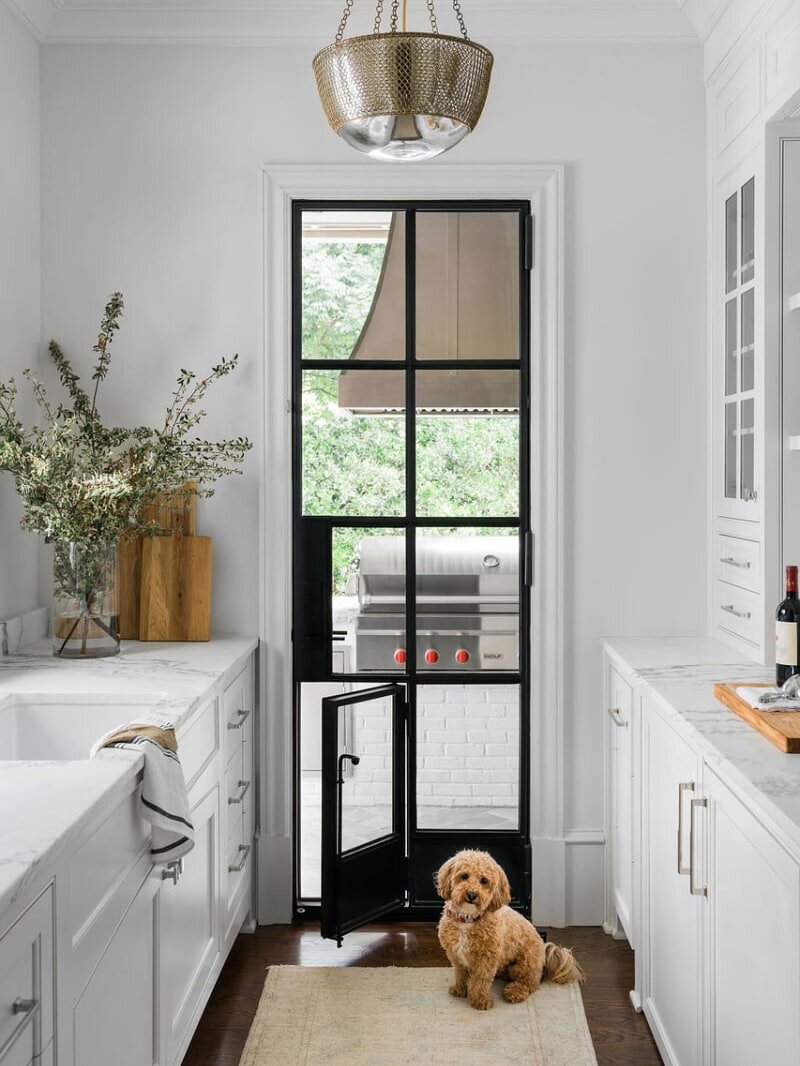
Swap the usual plastic flap for a hand-welded steel door with one operable panel at the bottom. Designer Sherry Hart created this stylish option that features surface bolts that allow the owners to lock or unlock the door and leave it open so their pets can exit the wet bar–slash–laundry room and run out to the pool when they please.  

The Claw-Friendly Climbing Wall

In an effort to accommodate their Bengal cat Miss Cleo’s adventurous nature and love of heights, Caitlin Mociun and Tammer Hijazi constructed a system in their living room made from IKEA Lack shelves and sheepskin throws. Bonus: If she ever tires of climbing down the road, the platforms can be used for books.  

The Low-Maintenance Yard

You don’t need a palatial grass-covered backyard in order for your pups to enjoy being outdoors. Leave the greenery to the walls like Whitney Leigh Morris did at her tiny bungalow and embrace easy-to-hose-down gravel that’s urine-proof instead. Her lower-energy pooches spend their days lounging on the stain-resistant couch anyway.

Subscribe to Domino Magazine. Photos courtesy of Domino.


If there is a home that you would like more information about, if you are considering selling a property, or if you have questions about the housing market in your neighborhood, please reach out. We’re here to help.

Search Homes in Colorado

Search Homes in Oklahoma