Millennials Are Ready to Take Over the Real Estate Market

 
stella-dimitrova-ZL9Qba8L6_Q-unsplash.jpg
 

Over the last several years, millennials have rented to stay nimble and keep work opportunities open. Now, they're ready to buy.

Why it matters: About 4.8 million millennials are turning 30 in 2021, and many are expected to enter the home-buying game if they haven't already.

  • This wave of new buyers will have the opportunity to build and pass on wealth, and shape the market for years to come.

Flashback: Leading up to the financial crisis of 2008, many people bought homes they couldn't afford, allowing developers to gobble up foreclosures, David Kennedy, president of Charlotte-based Canopy MLS, tells Axios.

  • We're still feeling the impacts of that, but it allowed first-time millennial buyers to head into the market with the knowledge their first home may not be their dream home.

  • They're more open to multi-family options like condos and quadraplexes, so they can start building wealth despite today's low inventory of single-family homes.

The big picture: Millennials are getting older and entering a new stage of life, casting off their long-held moniker as the "renter generation," Realtor.com senior economist George Rati says.

  • The oldest millennials are turning 40 this year, and they want more space for their growing families.

  • First-time buyers are also ready to build equity, have more space, and take advantage of low relatively mortgage rates.

The state of play: Homebuyers are entering a competitive market, with inventory down and home prices surging across the board. Low mortgage rates give buyers more power, but there has to be a home to buy to take advantage of current deals.

By the numbers, per a Realtor.com study:

  • 43% of first-time millennial homebuyers have been looking for more than a year.

  • 44% say they still need more money for a down payment and other closing costs.

  • 34% say they can't find a house in their budget.

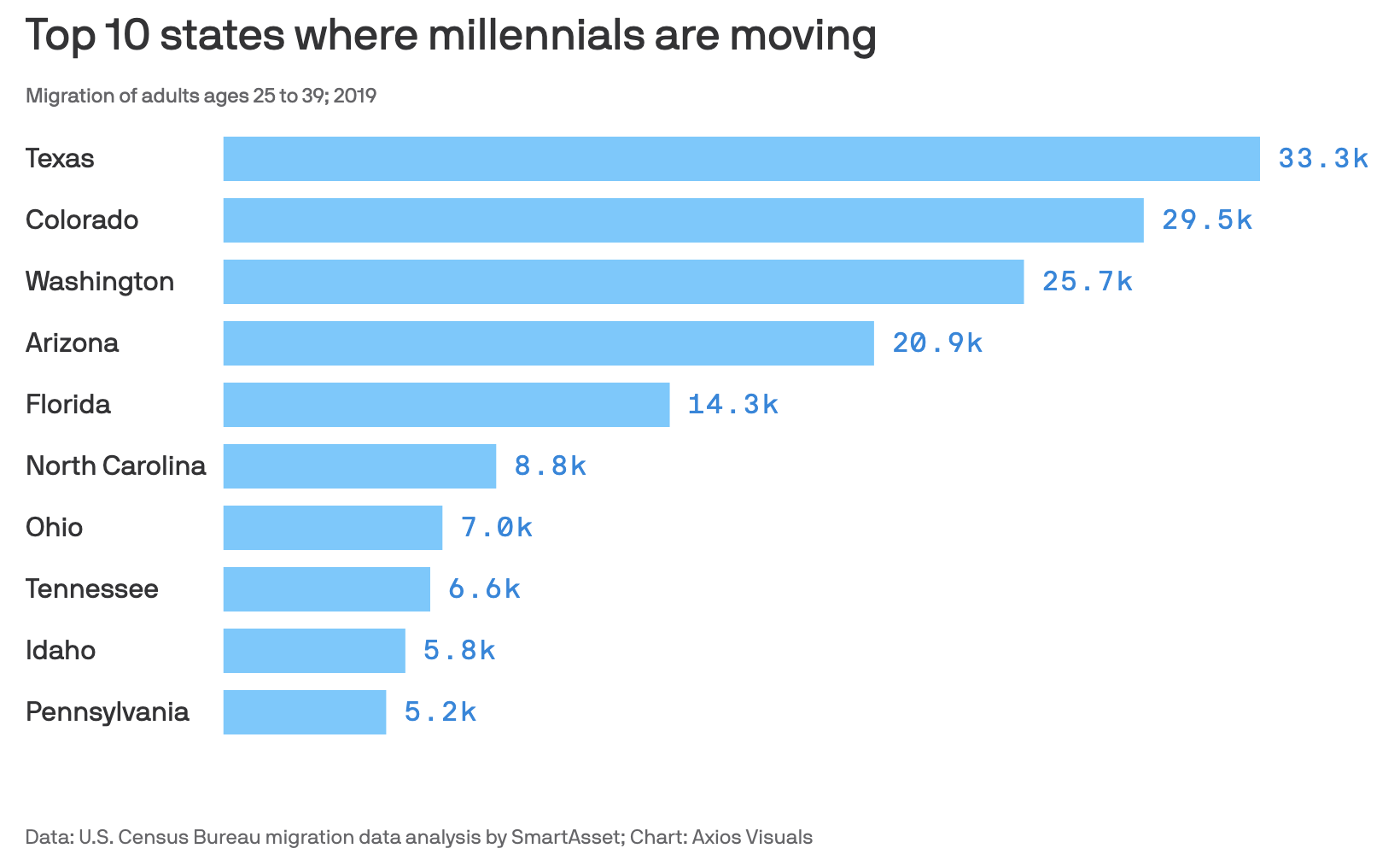
Where they're going: Millennials are leaving larger cities like New York and heading west or south. Migration patterns, according to SmartAsset, show five of the 10 most popular states among millennials have no income tax.


What millennials want: Rati says the average millennial buyer wants a house with a nice backyard in a desirable, quiet location.

  • A garage, updated kitchens and bathrooms, good schools, and attractions nearby are also common wishlist items.

  • Millennials with money want to spend it. Grandfather Homes president Matt Ewers, who builds $1M+ custom homes, says he's noticed millennial buyers "are willing to spend it as they make it," adding amenities like $150,000 pools during the building process.

  • "They're not all investment bankers either," he says. Millennials who are able to afford the bonus luxuries are involved in anything from sales to multiple side hustles.

The bottom line: "Looking ahead," Rati says, "millennials will continue to be dominant participants in housing markets."

Keep reading at Axios.

Related Links

If there is a home that you would like more information about, if you are considering selling a property, or if you have questions about the housing market in your neighborhood, please reach out. We’re here to help.

Search Homes in Colorado
Search Homes in Oklahoma

One Thing You Should Never Do to Your Yard Before Selling Your House

 
shaun-montero-ZxDX8D9HHNM-unsplash.jpg
 

There’s a lot of preparation involved in putting your home on the market.

Cleaning, tidying, decluttering, and de-personalizing are just a few of the ways sellers get their houses in tip-top selling shape. A home’s curb appeal is another supremely important consideration — how people feel when they pull into your driveway sets the tone for the rest of their tour.

But rather than go crazy sprucing up your yard in the name of curb appeal, one horticulturist says you should avoid new projects. In other words, don’t bother adding anything to your landscape, explains John Clements, horticulture manager at the San Diego Botanic Garden.

“Cleaning up the garden is the single most important thing one can do to prepare a home for sale,” he says. “If money is tight, trim and clean, but there’s no need to add anything to your garden. A new tree or bed of flowers is moot if the garden itself looks messy.”

Projects around the yard can also get expensive, which is another reason to avoid them ahead of a sale. New plants and trees cost a pretty penny, and it’s very possible that a buyer is going to end up re-doing the entire landscape anyway. 

“Paying to re-do your landscape to sell is counterproductive,” Clements says. “If your fence or deck is falling apart, fix those things rather than addressing the landscaping.”

Even those small projects can add up — according to Clements, repairing a deck or fence could easily be a four-figure job. His advice is to listen to your real estate agent and consider any of their suggestions before going full-force and hiring a landscape architect. 

And once you feel ready to start cleaning up the garden, Clements recommends starting with an outdoor version of decluttering.

“Gardens look awful with junk strewn about. I suggest getting rid of old tools, piles of pots, and dead plants. If you’re a person with lots of random plants in mismatched pots all over your deck or front entry, get rid of them.”

According to Clements, too many plants outside can read as dollar signs to potential buyers. “New buyers likely won’t share your same taste in plants. You may love your plants, but to potential buyers, it looks like work.”

“Remove all the weeds and trim and cut back messy and out of control plants,” the landscaping expert says. “You don’t want your garden to look like the jungle has reclaimed it.” 

Clements also suggests mulching. New mulch looks nice and fresh, and can often be obtained for free from your town or city. If you can’t figure out where to get mulch nearby, try calling a local landscaper. They may have some mulch laying around for purchase, or will be able to point you in the right direction. 

Read more on Apartment Therapy.

Related Links

If there is a home that you would like more information about, if you are considering selling a property, or if you have questions about the housing market in your neighborhood, please reach out. We’re here to help.

Search Homes in Colorado
Search Homes in Oklahoma

What it Means to Be In a Seller's Market

 
nathalia-segato-c168jRbeIEM-unsplash.jpg
 

If you’ve given even a casual thought to selling your house in the near future, this is the time to really think seriously about making a move.

Here’s why this season is the ultimate sellers’ market and the optimal time to make sure your house is available for buyers who are looking for homes to purchase.

The latest Existing Home Sales Report from The National Association of Realtors (NAR) shows the inventory of houses for sale is still astonishingly low, sitting at just a 2-month supply at the current sales pace.

Historically, a 6-month supply is necessary for a ‘normal’ or ‘neutral’ market in which there are enough homes available for active buyers.

When the supply of houses for sale is as low as it is right now, it’s much harder for buyers to find homes to purchase. As a result, competition among purchasers rises and more bidding wars take place, making it essential for buyers to submit very attractive offers.

As this happens, home prices rise and sellers are in the best position to negotiate deals that meet their ideal terms. If you put your house on the market while so few homes are available to buy, it will likely get a lot of attention from hopeful buyers.

Today, there are many buyers who are ready, willing, and able to purchase a home. Low mortgage rates and a year filled with unique changes have prompted buyers to think differently about where they live – and they’re taking action. The supply of homes for sale is not keeping up with this high demand, making now the optimal time to sell your house.

Bottom Line

Home prices are appreciating in today’s sellers’ market. Making your home available over the coming weeks will give you the most exposure to buyers who will actively compete against each other to purchase it.

Keep reading here.

Related Links

If there is a home that you would like more information about, if you are considering selling a property, or if you have questions about the housing market in your neighborhood, please reach out. We’re here to help.

Search Homes in Colorado
Search Homes in Oklahoma

As Featured in West + Main Home Magazine: Online Estate Sale Finds

 
online-estate-sale-blog.jpg
 

"We passionately serve those who have and want uncommon things, living at the center of a community that celebrates the rare, historical, weird and wonderful."

-EVERYTHING BUT THE HOUSE

Forget eBay! There's a whole new way to shop for vintage furniture, art, decor, jewelry and more. We've scoured the web for the best companies and some great finds for your home. 

 
Screen Shot 2021-04-13 at 9.23.37 PM.png
 

WHO WE LIKE

Companies like Everything But the House (EBTH.com) sell online direct to consumers starting at $1 from estate sales where they will help you clear out entire houses. You can also sell directly to them instead of having a whole estate sale. Another favorite is Live Auctioneers (liveauctioneers.com) who partner with over 5,000+ auction houses worldwide. With 63,059,211 items and counting you're bound to find something unique, cool or downright swoon-worthy. 

PRO TIPS

Feeling overwhelmed? It's ok, let's talk this through! If you want to find a good deal or that one of a kind piece you're been looking for you're going to want to follow a few basic tips.

1. Narrow it Down  One at a time. Start with a category + go from there.

2. Like + Follow  Both sites have the ability to heart and follow items – that way you can keep of track of when key auctions are ending.

3. Don't Get Caught Up in the Hype Decide beforehand how much you're willing to pay for an item, set your max, and forget about it until it's over.

4. Consider Shipping  Cool so you won an amazing huge antique sofa? Now how do you get it home? Estimate the charges and factor that into your max bid.

5. Think About Gifts  Have a hard friend or family member to shop for? This is your chance to really wow them and give new life to an old item.

Shop the Estate Sale

When EBTH clears out an estate for sale you can shop the entire house. This is a great way to find multiple items that already play well together. For example, the items from the next page range from a first edition book set to an abstract painting to a late 20th Century Chippendale Style Leather Settee. We love seeing the character in the  houses and watch them find new life through the auction. Evereything starts at $1 and there's deals to be had if you keep an eye  on your favorites and check regularly.

 
Screen Shot 2021-04-13 at 9.19.09 PM.png
 

Modern Treasure Hunting

Rather than pulling from estate sales, Live Auctioneers is a one-stop hub for auction and antique houses all over the world. By hosting thousands of auctions in real time via the Internet, the site allows unprecedented access to remote sales, and savvy bidders can often land desired items at very desirable prices. Leave an absentee bid, or fully engage in the live-auction action—it's up to you. From first editions of Harry Potter to Piccaso straight from Versailles Art Gallery, you will find the unexpected here.

 
Screen Shot 2021-04-13 at 9.19.18 PM.png
 
 
Screen Shot 2021-04-13 at 9.19.25 PM.png


For more remodel inspiration, visit the first edition of the West + Main Home Magazine.

Why Affordability Improved Amid Soaring House Prices

martin-pechy-fqPrGe0O7wA-unsplash.jpg

Soaring nominal house prices dominate recent headlines and for good reason.

It is true that nominal house prices are the highest they have ever been, over 22 percent higher than the housing boom peak in 2006, according to the First American Data & Analytics House Price Index.

The acceleration in the pace of annual house price growth began in the summer months of 2020, as potential home buyers emerged from lockdowns armed with record low mortgage rates and were met by historically low housing supply – a perfect storm for rapid nominal house price appreciation.

“Nominal house prices increased over 13 percent on a year-over-year basis, but house-buying power has grown even faster, increasing by an amazing 19 percent year-over year.”

By conventional measures of affordability, especially in an environment of modestly rising (in some markets declining) household income, a surge in nominal house prices implies significantly reduced affordability. Yet, nominal house price fluctuations alone, or even the relationship between nominal house price growth and income growth, can be a misleading indicator of affordability, and overlooks what matters more to potential buyers – house-buying power – how much home one can buy based on changes in income and interest rates.

For example, let’s assume you earn $100,000 a year, have a 33 percent debt-to-income ratio, and put down 5 percent on a home. With a 4 percent mortgage rate, your house-buying power is $606,000. But, if rates fell to 3 percent, your house-buying power increases by $80,000. Our Real House Price Index (RHPI) adjusts nominal house prices for purchasing power by considering how income levels and interest rates influence the amount one can borrow. The ability of low or declining interest rates to boost house-buying power makes it possible for a housing market to have high or even rising nominal house prices yet remain highly affordable (as measured by the RHPI)* and vice versa. Indeed, a walk down house price memory lane shows us that nominal house prices alone are not always a good measure of affordability.

Screen Shot 2021-04-10 at 4.45.31 PM.png

The 90s Recovery: Low House Prices, Low affordability

In the chart above, nationwide nominal house prices, real house prices, and house-buying power are all indexed to January 1990. From October 1993 through December 1994, a period when the U.S. economy was recovering from the early 1990s recession, housing was considered relatively unaffordable, even though nominal house prices were barely rising (1.0 percent). Despite relatively flat nominal house prices, the RHPI increased over 20 percent during this time period because house-buying power fell by 16 percent due to rising mortgage rates. Even though nominal house price growth was low, that was not enough to call the market “affordable” since it was accompanied by declining house-buying power and declining affordability.

The Housing Boom Era: High House Prices, Low Affordability

Nominal house prices surged in 2005 and peaked in 2006. From January 2005 through March 2006, nominal house prices jumped nearly 13 percent, while mortgage rates remained relatively steady.

During this time, the RHPI also increased dramatically by nearly 15 percent, indicating significantly reduced affordability. The reason? Nominal house price appreciation far outpaced house-buying power. During the housing boom era, rising nominal house prices did signal falling affordability, but only because house-buying power did not keep up.

The Pandemic Era: High House Prices, High Affordability

In the most recent RHPI report reflecting January 2021 data, nominal house prices increased over 13 percent on a year-over-year basis, but house-buying power has grown even faster, increasing by an amazing 19 percent year over year. The result? Despite rapidly rising nominal house prices, affordability actually improved, with the RHPI falling nearly 5 percent during the same time period. In fact, while nominal house prices are now more than 22 percent above the housing boom peak in 2006, real, house-buying power-adjusted, prices are 48 percent below their 2006 housing boom peak. The lesson? In housing, you can’t judge a housing market “book” by its nominal house price “cover.” Affordability is dependent on house-buying power.

Will Rising Mortgage Rates Signal the End of an Affordable Era?

Recently, mortgages rates have increased modestly. Does this spell the end of an affordable era? Not quite. As rates rise, affordability may become an issue for some buyers on the margin. As these buyers pull back from the market and sellers adjust their expectations, house price appreciation will adjust. But, the improving economic conditions and the ongoing shortage of supply relative to demand continue to support house price growth. The underlying fundamental housing market conditions support a moderation of house price appreciation which, alongside a healthier labor market and still historically low mortgage rates, should keep housing affordable.


If there is a home that you would like more information about, if you are considering selling a property, or if you have questions about the housing market in your neighborhood, please reach out. We’re here to help.

Search Homes in Colorado

Search Homes in Oklahoma