The Most Popular Design Style in Every State, According to a New Report

 
collov-home-design-H-1j_s0dhCw-unsplash.jpg
 

It’s no secret that the ongoing coronavirus pandemic has culminated in a rise of home renovation and design projects in quarantine. With cottagecorecabincore, and grandmillennial now in the vernacular of design enthusiasts everywhere, Joybird recently looked into some of the top interior design styles across the country. More specifically, the home decor brand looked into the most popular interior design styles by state to get a sense of how different regions have been sprucing up their homes. Additionally, Joybird also determined the top five styles that dominated the U.S.

The results? Modern farmhouse came out as the top interior design style in the U.S., followed closely by industrial, cottagecore, French country, and mid-century modern. To determine the findings, Joybird analyzed Google Trends data over the past twelve months using the search volume for over 20 of the biggest design styles in each state. Other recurrent design styles that made the list include Scandinavian, Japanese zen, bohemian, art deco, and shabby chic.

 
Screen Shot 2021-02-17 at 10.14.19 AM.png
 

According to Joybird’s findings, the modern farmhouse trend came in big in western and heartland states, such as South Dakota, Arkansas, Montana, and Idaho. Industrial, on the other hand, emerged as a winner in states like Alabama, Iowa, Mississippi, Kentucky, and Nevada. In terms of Cottagecore, Hawaii, Alaska, Vermont, and North Dakota showed an affinity for that countryside aesthetic, while French country reigned supreme in New Jersey, Ohio, Tennessee, Texas, and Virginia. Elsewhere, mid-century modern emerged as a favorite in Delaware, Michigan, Nebraska, and Utah.

Some less recurrent but noteworthy design styles that also made the list include Hollywood Regency (California), minimalist (New York), Moroccan (Massachusetts), and coastal (South Carolina). Check out a more comprehensive breakdown of the design style preferences with Joybird’s trusty design map above.

For more fun stats, visit Apartment Therapy.

Related Links

search homes in colorado
search homes in oklahoma

Should Your First Home Be a Condo?

 
jarek-ceborski-jn7uVeCdf6U-unsplash (1).jpg
 

A condo can make a great starter home, but weigh the pros and cons of buying a condo vs. a house to decide whether it's right for you.

Whether you're having trouble finding an affordable single-family home or you're simply fed up with renting, a condominium can be a way to wade into homeownership rather than diving into the deep end.

Condos tend to come with lower price tags than single-family homes. They offer significantly greater independence than renting, but you aren't on your own when it comes to maintenance and repairs. Plus, owning a condo gives you the chance to build equity you can use toward a down payment on your next home.

Those factors can make a condo a great starter home, though the condo lifestyle isn't for everyone. If you're looking to become a homeowner and are curious about buying a condo versus a house, here are some points to consider.

Pros of a condo vs. a house

More choices. Condos may be a relatively small slice of the overall U.S. housing market, but in certain areas, including densely populated, high-cost cities and vacation destinations, condos can be a significant proportion of for-sale listings. According to the National Association of Realtors, more than 5 million single-family homes changed hands last year, while condos and co-ops accounted for only 577,000 sales.

And condos are often priced lower than single-family homes, a difference that can be even more stark in costly areas. According to NAR data, in December 2020 the median price for existing, detached single-family homes was $314,300, while it was $272,200 for condos. 

Less effort to maintain. With a condo, you aren't responsible for exterior maintenance like mowing, snow removal or gutter cleaning. Maintenance of some mechanical systems like HVAC, electrical and plumbing may also be coordinated by the homeowner association. (You will, of course, help pay for this maintenance with your monthly HOA fee.)

"Even if they don't have on-site maintenance, they probably have a slew of people who they work with all the time," says Jan Stern, a real estate agent with Century 21 Beggins Enterprises near St. Petersburg, Florida. That can save you the time of vetting tradespeople. Also, the regular crew will already know the buildings and units.

Fancier amenities. Depending on the development, access to amenities you might not otherwise be able to afford or want to maintain (like an on-site gym, a pool or a heated parking garage) may be included. These are also wrapped into monthly HOA fees, so Stern recommends focusing on complexes that have extras you'll actually use.

Potentially cheaper insurance. Condo insurance costs may be lower than homeowners insurance, since you're mainly insuring your possessions. It's important to check over the HOA's insurance policy to make sure your own policy takes care of any coverage gaps.

Cons of a condo vs. a house

Rules and regulations. You won't have as much autonomy as you would in a house. HOA rules may limit what you can do both inside and outside your home, like whether you can have pets and when you can access common areas.

Lack of privacy. Condos generally have less privacy than a detached house, with shared walls and common areas. Not only are your neighbors close by, but if an adjoining unit is being used as a short-term rental, you might not be able to rely on having steady neighbors.

When it comes to subletting, "find out how many times per year and how many days at a time" a unit can be rented out, Stern suggests. A long-term rental may be fine — it might even be something you'll want to do one day if you move out but retain the condo as an investment property. But constant turnover from short-stay renters, or annual spikes of big partiers, can be much less desirable.

HOA fees. HOA fees will increase your monthly costs above your mortgage payment, though it's important to consider how these compare with owning a single-family home in your area. For example, if your HOA fees include utilities like water and services like trash pickup, those are bills you would have paid in a house, too.

But if you'd be paying for costly amenities you would never use or exterior upgrades that are subpar, you might be better off in a house — or at least in a different condo complex.

Resale issues. If you know your condo will be a starter home for you, it doesn't hurt to think about resale when you're buying — especially since condos can be harder to sell. If the HOA isn't well managed, buyers may have a harder time financing a condo because lenders are reluctant to get involved. A complex that consistently has a number of units for sale at once can be a red flag for buyers, and can also mean you'll be sitting on an unsold condo for longer.

To be better prepared to sell, Stern recommends buying a two-bedroom unit if you can afford it. Even if you only want one bedroom, "when it comes time to sell, a one-bedroom has a smaller market of buyers than a two-bedroom."

For more insight, visit Nerd Wallet.

Related Links

If there is a home or condo that you would like more information about, if you are considering selling a property, or if you have questions about the housing market in your neighborhood, please reach out. We’re here to help.

search homes in colorado
search homes in oklahoma

As Featured in the West + Main Home Magazine: Two Ways to Stage

 
two-ways-to-stage-blog.jpg
 

By creating impactful moments with special objects, every home can be relaxing + enchanting.

Staging Success

by Allie Carlson

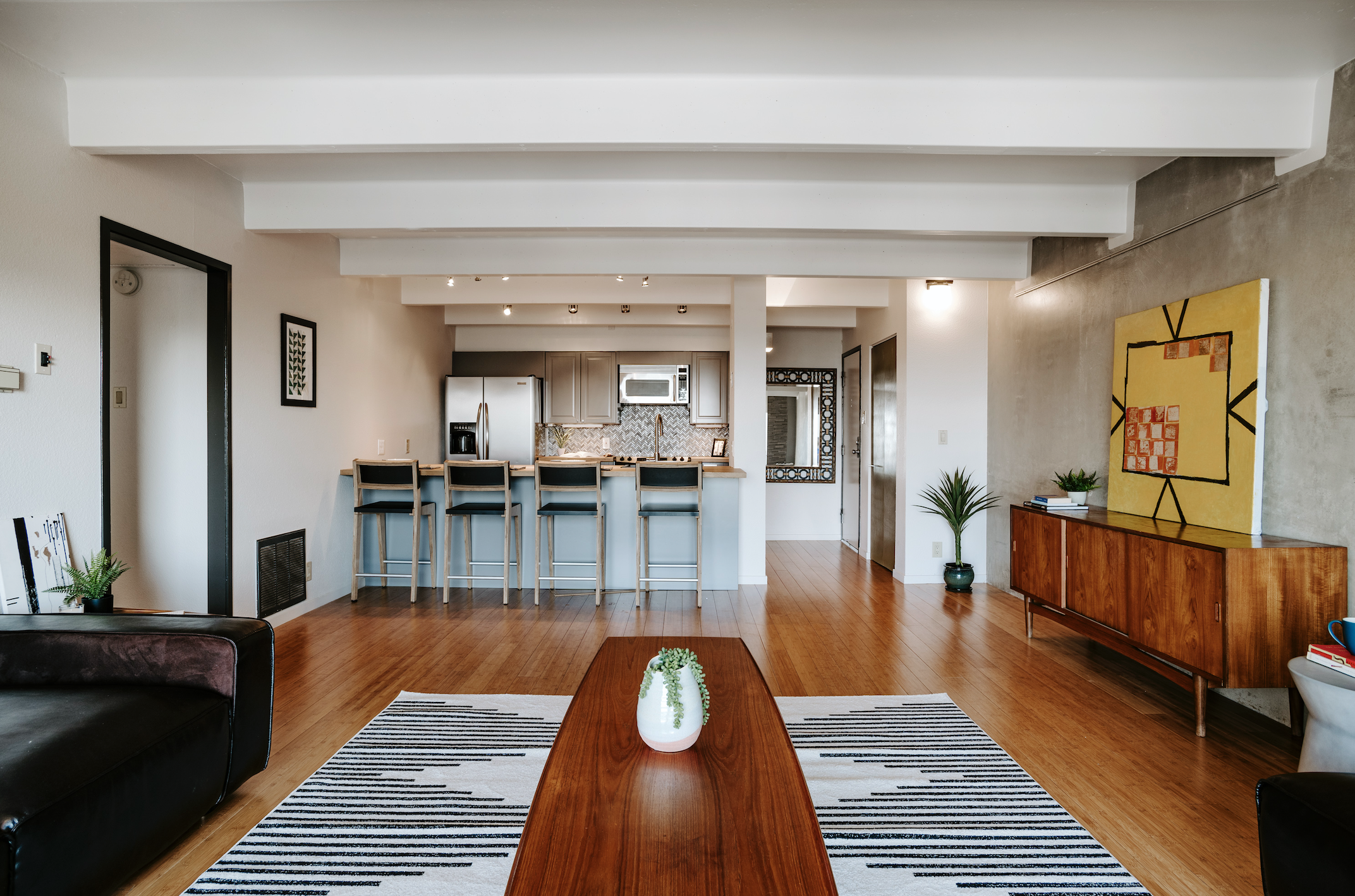
"This condo had great bones, but we were hitting the market right as attached listings were starting to stay on the market just a little bit longer due to Covid uncertainty, so we wanted to make sure that potential buyers were blown away by what they saw, both online and during in-person home tours."

Local staging company Guest House filled the space with beautiful pieces all sourced from local artists + makers, keeping both the neighborhood's vibe as well as the building's architecture in mind, and it got a lot of attention, as well as non-stop showing requests, resulting in a great offer for the seller  during the first weekend it was up for sale!

Whether starting with a vacant space or simply de-cluttering and rearranging, professional staging or bringing in an interior design pro almost always makes a huge difference. Love your space more...or sell it for more money. 

We’re here for it.

- Allie

 
Screen Shot 2021-02-17 at 9.29.30 AM.png
 
 
Screen Shot 2021-02-17 at 9.27.26 AM.png
 

Virtual Staging

Featuring Box Brownie

Whether you're having a tough time trying to envision what your current space might become, or hoping to make your home look amazing online in order to find the perfect buyer, virtual staging is a super-easy and affordable option - and it's as simple as uploading a photo and waiting just a few hours for a revised version with a completely new look!

 
Screen Shot 2021-02-17 at 9.27.52 AM.png
 
 
Screen Shot 2021-02-17 at 9.28.14 AM.png

For more remodel inspiration, visit the first edition of the West + Main Home Magazine.


Homebuyers put pets first when shopping for homes

image.jpg

Homebuyers put pets first when shopping for homes

According to a recent Realtor.com survey, almost 95% of homebuyers consider their pets when purchasing a home. Yes, you read that right.

Purchasing your first home is an exciting time. Whether you’re shopping for a fixer-upper or a home with a modern exterior, there’s nothing like finally being able to check the “buy a house” box off your bucket list. 

That said, finding the right home can be challenging and time-consuming. There are a lot of factors to consider. What neighborhood do you want to live in? How much house you can afford? And of course, will your pet be happy in their new home?

In March 2020, Realtor.com surveyed over 2,000 homebuyers and found that a majority of pet owners consider their animals’ needs before making a home purchase. Of the respondents, 61% were dog owners, 45% owned cats, 12% owned fish and 9% were bird owners. 

You’re probably wondering exactly what kind of features a pet needs in their home to be happy. According to Realtor.com, homebuyers should look for:

  1. Whether the HOA restricts the number of pets or the type of pet

  2. A dog-friendly floorplan (i.e., dark wood to hide any scratches and no stairs for dogs with joint problems)

  3. A fence in the backyard to keep pets safe and other animals from entering!

  4. Dog-friendly neighborhood

According to the survey, 38% of homebuyers looked for big backyards and 29% searched for homes with some kind of outdoor space. 24% of pet owners wanted dog runs and at least 22% looked for homes with ample amounts of indoor square footage. 

It should come as no surprise homebuyers have a list of must-haves when searching for their dream property. But who would’ve thought their pets’ needs would dictate what house they purchased? Well, it does. In fact, 68% of pet owners said they wouldn’t buy a house if it didn’t accommodate their furry friends.

“We believe that a home is so much more than a roof and four walls. It is where family and friends come together and memories are made,” realtor.com Chief Marketing Officer Nate Johnson said in a statement. “The results of this survey reinforce that our pets are our family and an important part of what makes a house a home.”


If there is a home that you would like more information about, if you are considering selling a property, or if you have questions about the housing market in your neighborhood, please reach out. We’re here to help.

Search Homes in Colorado

Search Homes in Oklahoma

The Key to Affordability? Move Back Home

 
bench-accounting-8D2k7a3wMKQ-unsplash.jpg
 

The coronavirus brought many challenges, and due to job losses and furloughs, many young adults found themselves back at their parents’ house to save money. According to a new realtor.com® report, this may be the key to homeownership affordability for the younger generations.

For those able to save their rent, those funds could convert into a down payment toward a home. Here’s a breakdown of how many months of rent it would take to save for a typical down payment in the nation’s 10 of the 20 largest metros:

Detroit-Warren-Dearborn, Mich.
One-Bed Median Rent: $970
Median Listing Price: $252,000
5 Percent Down Payment: $12,600
Months of Saving: 13

Houston-The Woodlands-Sugar Land, Texas
One-Bed Median Rent: $1,060
Median Listing Price: $330,000
5 Percent Down Payment: $16,500
Months of Saving: 16

Los Angeles-Long Beach-Anaheim, Calif.
One-Bed Median Rent: $2,250
Median Listing Price: $999,000
5 Percent Down Payment: $49,950
Months of Saving: 22

Miami-Fort Lauderdale-West Palm Beach, Fla.
One-Bed Median Rent: $1,691
Median Listing Price: $409,000
5 Percent Down Payment: $20,450
Months of Saving: 12

Minneapolis-St. Paul-Bloomington, Minn.-Wis.
One-Bed Median Rent: $1,358
Median Listing Price: $344,000
5 Percent Down Payment: $17,200
Months of Saving: 13

Atlanta-Sandy Springs-Roswell, Ga.
One-Bed Median Rent: $1,310
Median Listing Price: $350,000
5 Percent Down Payment: $17,500
Months of Saving: 13

Boston-Cambridge-Newton, Mass.-N.H
One-Bed Median Rent: $2,109
Median Listing Price: $649,000
5 Percent Down Payment: $32,450
Months of Saving: 15

Chicago-Naperville-Elgin, Ill.-Ind.-Wis.
One-Bed Median Rent: $1,521
Median Listing Price: $327,000
5 Percent Down Payment: $16,350
Months of Saving: 11

Dallas-Fort Worth-Arlington, Texas
One-Bed Median Rent: $1,125
Median Listing Price: $354,000
5 Percent Down Payment: $17,700
Months of Saving: 16

Denver-Aurora-Lakewood, Colo.
One-Bed Median Rent: $1,495
Median Listing Price: $533,000
5 Percent Down Payment: $26,650
Months of Saving: 18

“Although many members of the millennial and Gen Z generations were forced to move home because they lost their jobs in 2020, others chose to forgo their rental because they had the opportunity to work remotely and preferred to wait out the pandemic with family,” said realtor.com® Chief Economist Danielle Hale. “For those who have been able to channel their would-be rent into savings, the pandemic’s silver lining could be becoming a homeowner sooner than they otherwise would have.”

Fore more, visit RISMedia.

Related Links

Search Homes in Colorado
Search Homes in Oklahoma