It's GivingTuesday - Learn More + Do Something Good Today

Giving-Holidays-IG2.jpg

GIVINGTUESDAY IS A GLOBAL GENEROSITY MOVEMENT UNLEASHING THE POWER OF PEOPLE AND ORGANIZATIONS TO TRANSFORM THEIR COMMUNITIES AND THE WORLD.

GivingTuesday was created in 2012 as a simple idea: a day that encourages people to do good. GivingTuesday was born and incubated at the 92nd Street Y and its Belfer Center for Innovation & Social Impact in New York City. GivingTuesday is now an independent nonprofit and a global movement that inspires hundreds of millions of people to give, collaborate, and celebrate generosity.

Whether it’s making someone smile, helping a neighbor or stranger out, showing up for an issue or people we care about, or giving some of what we have to those who need our help, every act of generosity counts, and everyone has something to give.

In an era of global crisis and disconnection, we need new rituals to connect us. As the world’s largest giving movement, we believe we can go further, faster when we unleash generosity together.

GivingTuesday strives to build a world in which the catalytic power of generosity is at the heart of the society we build together, unlocking dignity, opportunity and equity around the globe. We believe that generosity leads to greater civic participation and other pro-social behaviors.

Our mission is to build a more just and generous world.

Learn more About GivingTuesday

If there is a home that you would like more information about, if you are considering selling a property, or if you have questions about the housing market in your neighborhood, please reach out. We’re here to help.

Search for Homes in Colorado

Search for Homes in Oklahoma

Study: US Cities with the Friendliest Neighbors

 
devin-avery-bx1G9db3FjA-unsplash.jpg
 

Some people are consumed with home improvement projects, others are consumed with neighbors who are "projects." (If only we could outsource the latter to professionals.) All that aside, in this turbulent season of coronavirus and contentious politics, we've decided to focus on what's good in the neighborhood.

We need neighborly love right now - at a safe distance, of course. In a recent poll of 2,500 Americans, we set out to learn how neighbors are getting along and where in America their bonds are tightest.

The response we heard from respondents is a ray of light in an otherwise dark year. No matter how it may look on social media, neighbors in America tend to like and care for each other - many spend time socializing, and most are quick to offer a helping hand.

If ever there were a test for neighborly bonds, it would be a global pandemic. So many aspects of this crisis have put pressure on neighbor relationships, most notably the fact that we’re now in and around our homes all the time.

It’s All Good in the Neighborhood

Sixty-nine percent of those we surveyed have gotten to know their neighbors better during the pandemic, and 65 percent have made an effort to be more friendly than usual. Even better, nearly seven in 10 Americans say they appreciate their neighbors more than ever, as a result of what’s transpired this year. These data make up a resounding takeaway from our survey: in 2020, Americans have gotten closer to the people they live near, and they are increasingly grateful for those relationships.

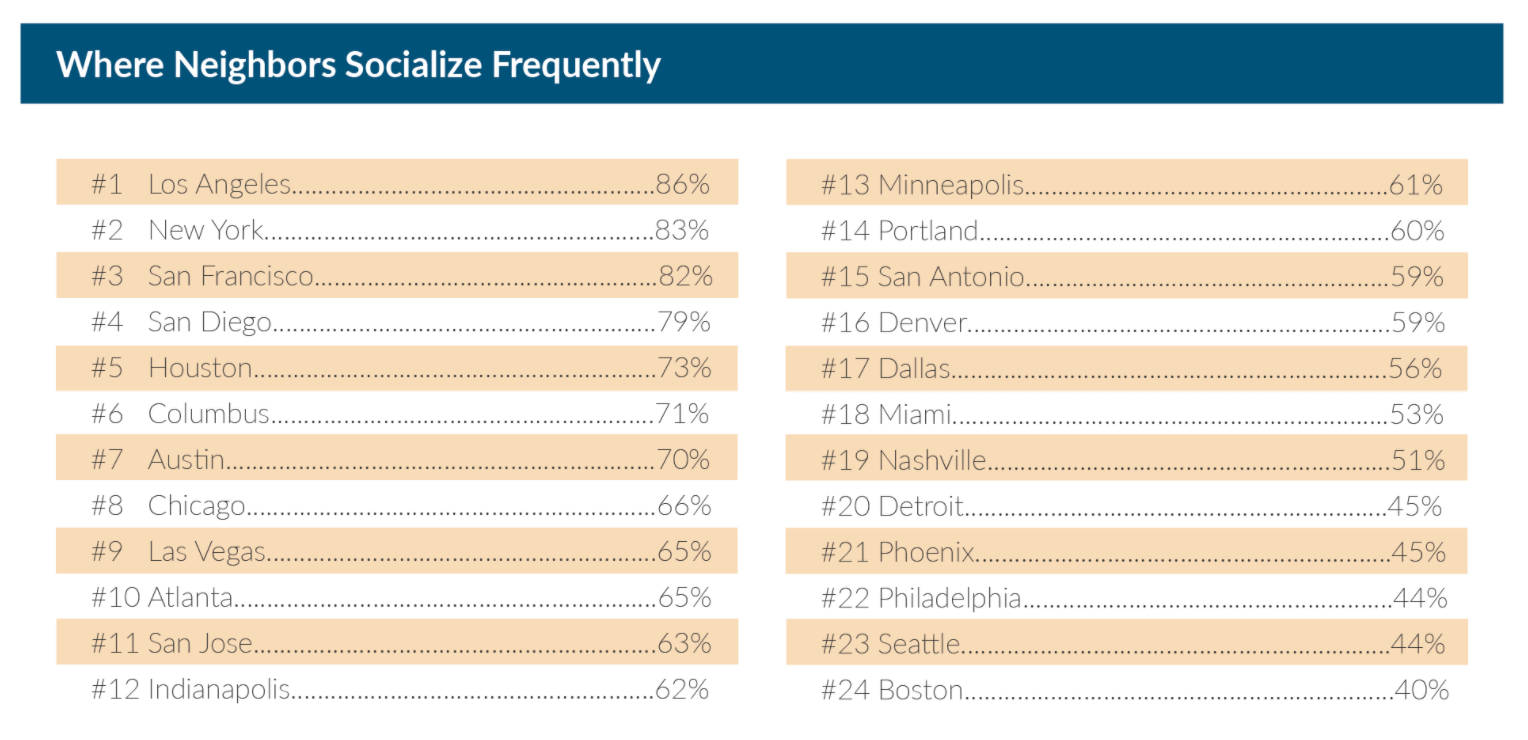
Relationships between neighbors go well beyond a smile and wave on the weekend. Nearly one in four people report frequently socializing with their neighbors and 86 percent get together at least occasionally. Fifty-four percent of those we surveyed report they had at least one socially-distanced gathering with neighbors during the pandemic.

The Friendliest Neighbors in America

Finally, Improve Net wanted to determine which among two dozen of our country’s most populous cities is home to the most and least friendly neighbors (and the most and least helpful neighbors). Here are the results.

Screen Shot 2020-11-26 at 6.02.52 PM.png
Screen Shot 2020-11-26 at 6.03.04 PM.png

For the full report, visit Improve Net.

If there is a home that you would like more information about, if you are considering selling a property, or if you have questions about the housing market in your neighborhood, please reach out. We’re here to help.

Search for Homes in Colorado

Search for Homes in Oklahoma


Winter's Home-Buying Game Has Changed - Here's How to Win

 
donnie-rosie-O7L3MrlSAHA-unsplash.jpg
 

Savvy home buyers know that winter is typically a good time to embark on a house hunt, since much of their competition stays holed up at home until spring.

But this winter, buyers might notice that despite the cold and the holidays, they've got company.

Lots of it, in fact.

"Normally winter is a good time for buyers," says realtor.com® chief economist Danielle Hale. However, since the coronavirus kept buyers on lockdown for much of spring, many are making up for lost time by home shopping hard right now.

"This year's unusual seasonal pattern means that buyers aren't getting the usual break from the market frenzy that they typically do in the cooler weather," Hale explains.

As a result, this winter is shaping up to be a seller's market, with low real estate inventory, high prices, and bidding wars that could give buyers a major run for their money.

This doesn't mean you should throw in the towel—just that you'll have to hone your house hunt in new ways to suit the times. Here are some tactics that will keep you ahead of the pack so you'll be sitting in a new home by the new year.

Secure your financing as soon as possible

Getting pre-approved for a mortgage and securing financing are an essential first step when buying a home. It gives you a clear picture of how much house you can afford, and lets you make an offer as soon as you find your dream home.

Starting early could also help you lock in an ultralow interest rate, which could affect your monthly mortgage payment and mean you could afford a more expensive home. As of Oct. 22, Freddie Mac listed rates at 2.8% for a 30-year fixed-rate loan.

Know what you want before you house hunt

COVID-19 has changed how we live and work. We’re spending much more time at home, and people are looking for different features in their living spaces.

Make a list of your must-haves before you start house shopping—and share your needs with your real estate agent.

In such a competitive landscape, knowing exactly what you want enables you to act fast when you want to make an offer.

Tour homes virtually first

More real estate agents are embracing virtual tours and remote showings to ease coronavirus safety concerns. In some cases, they’re even limiting in-person showings to the most serious buyers—those with financing already secured, for example.

Virtual home tours, using Zoom or FaceTime, let you view the home from anywhere, and depending on the setup, you might be able to ask questions in real time. So you can narrow down the homes you’re most interested in and physically visit only the ones that best meet your needs.

Don't dawdle if you want to make an offer

In September, there were nearly 40% fewer homes on the market than during the same month last year, according to a realtor.com report. At the same time, buyer demand has increased, creating an incredibly competitive marketplace. Homes were on the market for an average of 54 days in September, 12 fewer days than last year.

Make your offer stand out

Since inventory is so low, sellers are getting multiple offers on their homes these days. To make sure yours gets accepted, you’ll need to make it stand out.

For competitive markets, where you know you’ll be competing directly with many buyers, Jones suggests talking to your agent about escalation clauses. This is a contract addendum where you agree to pay more than other offers (up to a maximum you set).

To read more tips for winning your dream home, visit Realtor.com

Related Links

search homes in colorado
search homes in oklahoma

Home prices see greatest gain in over 6 years

According to the S&P CoreLogic Case-Shiller home prices index (Housing Wire)

The S&P CoreLogic Case-Shiller index covering home prices of all nine U.S. census divisions rose 7% in September from a year ago, the greatest year-over-year gain since 2014, and nearly 23% higher than its last peak in 2006.

The September increase was also greater than the 4.8% uptick reported in August, and represented the largest annual gain since May 2014 as record-low mortgage rates and a lack of inventory continued to put upward pressure on home prices.

“Home prices are normally sticky, meaning that they often take a while to respond to market shifts,” said Matthew Speakman, economist at Zillow. “These elevated levels of market competition have been placing upward pressure on prices for months, but home prices have just recently begun to take off in earnest. Some measures show home prices now growing at a faster pace than they ever have.”

Homes went under contract two weeks faster in September than they did a year earlier, but construction is playing catch-up to feed the frenzy, said Speakman.

Single-family housing starts, driven heavily by low interest rates and changing consumer patterns, rose to an annual rate of 1.53 million in October, the highest since this February and far past 1.108 million recorded in September, according to the U.S Census Bureau.

The price jumps reported in the Case-Shiller Index roughly matched up with statistics from the Federal Housing Finance Administration, which reported that prices increased 3.1% over the second quarter, the biggest gain since at least 1991, when the agency began keeping records.

Looking through a more localized lens, Phoenix experienced the steepest year-over-year gain, rising 11.4% – the 16th consecutive month Phoenix home prices rose more than those of any other city. Seattle took the second-greatest increase once again, up 10.1%, with San Diego following at 9.5%.

Housing prices were consistently robust nationally even in the worst-performing cities – New York (4.3%) and Chicago (4.7%)., according to Craig Lazzara, managing director and global head of index investment strategy at S&P Dow Jones Indices.

“Our three monthly readings since June of this year have all shown accelerating growth in home prices, and September’s results are quite strong. This month’s increase may reflect a catch-up of COVID-depressed demand from earlier this year; it might also presage future strength, as COVID encourages potential buyers to move from urban apartments to suburban homes,” said Lazzara. “The next several months’ reports should help to shed light on this question.”

Though home prices continued to rise in September, homebuyers showed little interest in slowing down, driving existing home sales up for the fifth consecutive month in October, 4.3% year-over-year.

However, the Conference Board’s Consumer Confidence Index declined slightly in November to 96.1 from 101.4 in October. The index, a key measure in gauging whether people are willing to make big-ticket purchases like homes, fell as consumers lost morale for business conditions and the labor market.

“While the worsening spread of COVID-19, and the economic uncertainty that accompanies it, do pose some potential risks to the booming housing market, it appears unlikely that this remarkable growth in home prices will abate in the coming months,” Speakman said.


If there is a home that you would like more information about, if you are considering selling a property, or if you have questions about the housing market in your neighborhood, please reach out. We’re here to help.

Search for Homes in Colorado

Search for Homes in Oklahoma

The Most Popular Thanksgiving Side in very State

What is Your Favorite Thanksgiving Side Dish?

Leave it up to the folks at Zippia to not only wonder what foods will every one be eating this Thanksgiving…but also to analyze the data!

The results? Thanksgiving may be called Turkey Day, but maybe it should be called mashed potato day. Or mac ‘n cheese day.

favorite-thanksgiving-sides.png

MOST INTERESTING FINDINGS

  • Mashed potatoes are the favorite of 10 states.

  • Right behind mashed potatoes is mac n’ cheese- 7 states know that it’s not Thanksgiving without the cheesy, delicious dish.

  • While most states are reaching for the carbs, Maine is all about that side salad.

  • The south isn’t a casserole belt, but the Midwest can’t get enough – especially of green bean casserole

  • Alabama doesn’t eat stuffing, they like “dressing” AKA southern people stuffing.

  • Only New Hampshire is a big fan of cranberry sauce.

  • Biscuits. Rolls. Crescent rolls. Forget fancy sides - just toss some rolls in the oven.

  • 47 states want their sides carby, cheesy, potato-y and delicious. Only 3 are reaching for veggies more.

HOW WE FIGURED THIS OUT

Using Google Trends, we determined what Thanksgiving side each state eats a disproportionate amount of. We examined over 20 Thanksgiving classics. From there, we determined what side is searched a disproportionately, high amount.

For example, while Maine eats all the Thanksgiving classics the rest of the country does, the search interest in side salad is excessively higher than the remaining states - making side salads more popular in Maine than anywhere else.

Some controversial decisions were made, including counting gravy as a side. However, since it’s not a main dish and hopefully isn’t being consumed as a beverage, our hands were tied. Sorry if your family has an uncommon tradition of shrimp cocktails, Red Lobster Cheddar biscuits, or whatever oddity for Turkey day, you didn’t fall into our data, but we’re still here for it!

What do you think? Does your State’s fave always end up on your Thanksgiving table?

No matter how you’re celebrating this year, we hope it’s tasty.


If there is a home that you would like more information about, if you are considering selling a property, or if you have questions about the housing market in your neighborhood, please reach out. We’re here to help.

Search for Homes in Colorado

Search for Homes in Oklahoma