Top 15 Cities for Millennial Renters

image.jpg

Texas is hot!

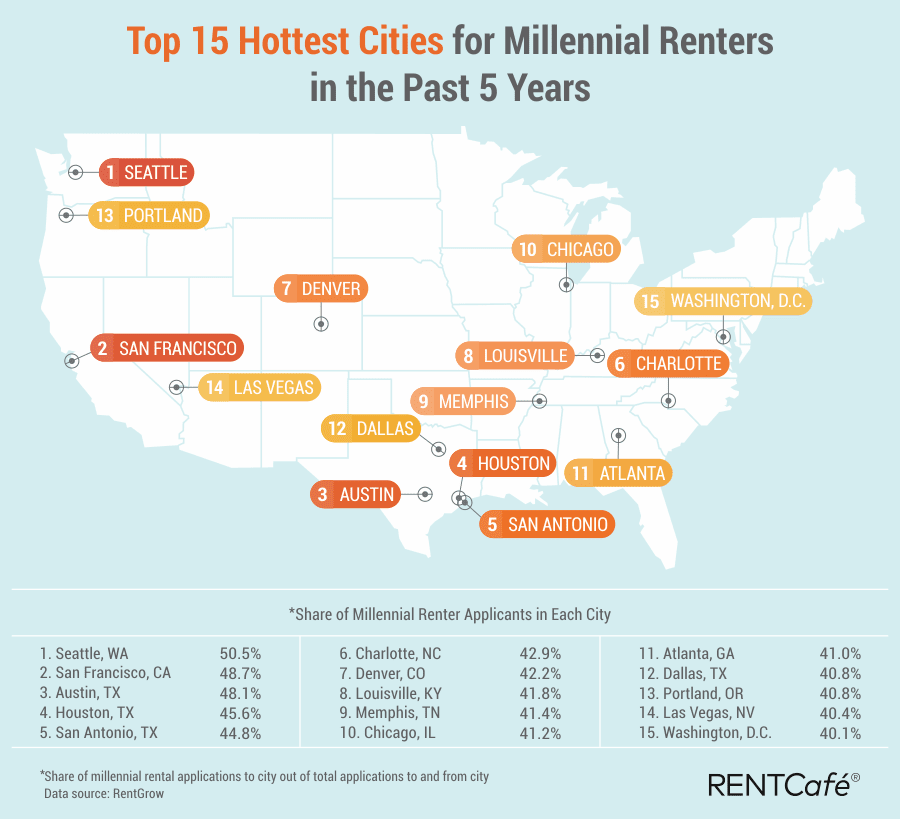
Aside from the climate, the rental market is booming in the Lone Star State, with four of the top 15 cities for millennial renters located there, according to a RENTCafe study.

Analyzing data from 13 million rental applications across the U.S., national internet listing service RENTCafe found the cities where millennials applied the most for rentals this year compared to the past five years.

“We focused on large and mid-sized cities—where millennials represent 38.5 percent of applications—and ranked them based on each city’s share,” according to the company.

In Texas, the four cities that cracked the top 15 list are: Austin (No. 3), Houston (No. 4), San Antonio (No. 5) and Dallas (No. 12).

hot_citiies_for_renters.png

However, although Seattle, Wash., has topped the list for the past five years, Austin is set to overtake the West Coast city. The Texas capitol came in at No. 1 for 2020 and, according to RENTCafe, more than half of the renters who applied for an apartment in Austin were millennials (50.5 percent).

Below is an infographic compiled by RENTCafe that highlights the top 15 cities for millennial renters over the past five years.

To view the full results of the survey, click here.


If you are wondering how current national and global situations might be impacting your property’s value, your neighborhood, or the Real Estate market in general, we are happy to provide more specific information.

If there is a home that you would like more information about, if you are considering selling a property, or if you have questions about the housing market in your neighborhood, please reach out. We’re here to help.

Search for Homes in Colorado

Search for Homes in Oklahoma

Urban-Suburban Offices Present Opportunity In A Remote Work World

What the future holds for office buildings is yet to be written. But what the here and now is telling us is that suburban office buildings – particularly those in walkable locations in close proximity to retail and housing – are faring much better than both their true urban and purely suburban counterparts. 

To be absolutely clear, this is not a new trend. It is only just being widely realized and accepted today due to ongoing current events, according to Forbes.

For the past decade investors – especially large institutional investors – focused heavily on major urban markets such as New York City and San Francisco. Their focus makes sense because commercial rents tended to be higher in urban locations due to their close proximity to talent, amenities, infrastructure and more. They did not pay as much attention to the growing trend of mid-density, urban-suburban – or “surban” – locations. As the pandemic sent the American office-using workforce into their homes, we are now watching in real time as the relationship between the office and employee changes. 

No longer are workers of all ages fully anchored to the biggest job centers. The most highly skilled, capable workforce in industries such as tech and finance are – in the near term – free from a single urban destination.

It’s also more possible than ever to accommodate the varying geographic desires of diverse employees, including entertainment and retail options, live events such as festivals, urban-like facilities, transportation infrastructure, and outdoor activities within urban-suburban areas.

While lockdowns in the densest cities may be temporary, many Americans are contemplating moving to less densely populated areas.

Many have and will turn the thought into action. Within New York City, for example, you’re seeing an explosion of demand to stay within the metro area but move nearby, to suburbs in Long Island, New Jersey and Connecticut. The same story is happening in San Francisco, with people moving to the East Bay and other nearby suburbs. What is particularly attractive about these locations today is that they have spent the last decade redeveloping their own suburban downtowns, which can attract younger, family-oriented millennials.

Walk around Cherry Creek in Denver, downtown Chandler in Phoenix, St. Louis Park in Minneapolis, or Carmel in Indianapolis, and one will see great examples of suburbs that have transformed with additional density and amenities. It’s this middle ground – having gained traction for at least the past half-decade – that I believe leads to a happy medium of urban-suburban locations where residents can enjoy the perks of city life outside of the city.

Sublease inventory has increased more dramatically in urban submarkets, such as central business districts, than in their suburban counterparts. This doesn’t mean that it will be smooth sailing for suburban offices in the longer term, but the discrepancy in sublease inventory at least provides for less competitive shadow inventory. 

If you’re conceptually on board, then the question becomes execution and how to actively deploy capital in a strategy focused on urban-suburban properties. The first step is to identify those locations that currently exhibit – or have the potential to exhibit – the infrastructure to support a mixed-use environment. That means looking at properties that are not totally isolated from residential and retail in the neighborhood.

The old suburban corporate campuses of the 1980s are good examples of properties that may struggle to find sea legs in the new era of demand, but similar vintage properties nearer to suburban cores may thrive. One also has to look at whether the market itself is growing jobs requiring offices.

For example, Minneapolis has a number of suburban office pockets, but not all are created equal. The West End in St. Louis Park is surrounded by homes and new retail drivers – and the tenants are diversified industry-wise but use office space heavily. Meanwhile, the further west-southwest into the suburbs one goes, the more small business demand there is, and the more spread out the office parks. Not surprisingly, there is a significant variance between the performance within the various suburban submarkets. The West End is fully realized now, but the growth was clear before it happened.

Same with Carmel, Indiana, which used a city process to redevelop a swath of industrial properties into a thriving community. Find these areas, and you’re likely to come across office properties that are well suited for future growth.

Investing in urban-suburban locations is an opportunity made clearer by new trends in office space use, geographic preference and already established mixed-use areas. These pockets offer an opportunity to create an acquisition pipeline of property. While it may take time to find properties, it will be worth waiting for the right opportunities to enter these markets for the long term.


If you are wondering how current national and global situations might be impacting your property’s value, your neighborhood, or the Real Estate market in general, we are happy to provide more specific information.

If there is a home that you would like more information about, if you are considering selling a property, or if you have questions about the housing market in your neighborhood, please reach out. We’re here to help.

Search for Homes in Colorado

Search for Homes in Oklahoma

How are home values being impacted in high-risk wildfire areas?


Homes in high-risk ZIP codes are priced lower than those in low-risk ZIP codes

Wildfires continue to rip through the west coast, but that doesn’t mean homebuyers won’t purchase in high-risk areas. More than 4.5 million homes are located in areas at high risk of wildfire across the states of Washington, Oregon and California, with a total estimated home value of $3.3 trillion, a new Redfin report said.

Since 2012, the median sale price of homes in ZIP codes with a low wildfire risk has increased 101% compared to an 88% increase for homes in high-risk ZIP codes, per a Redfin analysis of the housing market and U.S. Forest Service. Data was gathered from 2,700 zip codes in California, Oregon and Washington.

In the 12 months ending August 2020, homes in high-risk ZIP codes sold for an average of 3.9% less than those in low-risk zip codes – $640,000 compared to $656,000. According to Redfin, this is in part due to more intense competition in areas with low wildfire risk.

“This disparity exacerbates the affordability crisis in low-risk areas, forcing homebuyers who don’t have large budgets to look to more fire-prone regions for affordable homes,” the report said.

In low-risk areas, 35% of homes sold above list price, compared to 27% in high-risk areas. The competition is so fierce that 42% of homes sold in low-risk areas over the past three years went under contract within two weeks. In high-risk areas, only 33% of homes were purchased in the same timeframe.

“The lower cost of housing in wildfire-prone areas compared to low-risk areas is likely just the beginning of the consequences of climate change for the housing market,” said Redfin chief economist Daryl Fairweather. “Right now, wildfires are still a rare occurrence for homeowners, but if fires and other climate disasters continue to happen more and more frequently, some housing markets will go from less desirable to untenable, yet they will remain the only option for many families.”

Redfin said that for Bay Area homebuyers who are priced out of San Francisco, where the median home sold for $1.45 million in September, they may feel forced into more high-risk areas such as Santa Rosa, California, where the median price in September was $690,000, or Sacramento, California where the median price was $475,000. 

“The tougher competition in low-risk areas makes it harder to buy a home where it’s safer, and gives buyers another reason to shift their home search to risky areas where homes are more affordable and there’s less competition,” the report said.

“Right now people are still migrating to places that have suffered through wildfires or smoke in the central valley and wine country in California and parts of Oregon because homes in those places seem like a good deal,” Fairweather said. “Homebuyers often look at the lower sticker price on homes with more fire risk and are driven to buy because it’s what they can afford.” 


Our hearts go out to every person impacted by wildfire, and we are especially grateful for every firefighter + service provider working on and near the frontlines.

Thank-You-Firefighters2.jpg

If you are wondering how current national and global situations might be impacting your property’s value, your neighborhood, or the Real Estate market in general, we are happy to provide more specific information.

If there is a home that you would like more information about, if you are considering selling a property, or if you have questions about the housing market in your neighborhood, please reach out. We’re here to help.

Search for Homes in Colorado

Search for Homes in Oklahoma

Survey Finds Ghosts and Goblins Don't Have Homeowners Hanging a For Sale Sign

image.jpg

Most who believe their house is haunted are perfectly fine with a few bumps in the night, according to a recent Realtor.com survey.

Haunted houses are popular attractions this time of year, but most Americans say they wouldn't consider living in one. However, a majority of those who believe they currently live in a home that is haunted say the spooky happenings they've experienced are not reason enough to move, according to realtor.com®'s annual Halloween survey.

Survey results from more than 2,000 Americans reveal that 13% believe they currently live in a home that is haunted, and a majority of them -- 54% -- knew or suspected the house was haunted before moving in. Although nearly two-thirds (62%) of respondents indicated they'd be unlikely to consider living in a house that was rumored to be haunted, a majority (56%) of Americans who believe their home is haunted have not considered moving.

haunted_houses_real_estate.jpg

"Haunted houses typically draw big crowds this time of year, but we wanted to see how many people actually believe they live in one," said Lexie Holbert, realtor.com® housing and lifestyle expert. "Although only a small percentage of respondents indicated they believe their home is haunted, it was surprising to see how many are perfectly comfortable sharing their space with spirits from the world beyond."

Just where are these haunted houses?

The West led the nation with the most respondents who believe they live in a home that is haunted at 18%, followed by 13% in the Northeast, 11% in the Midwest and 10% in the South.

Of those who suspected their house was haunted prior to moving in, Northeasterners were most comfortable living with spirits at 76%, followed by those in the West at 57%, the South at 51% and 35% in the Midwest.

What is it about a house that makes it haunted?

Asked to select all the spooky happenings that made them think their home was haunted, strange noises topped the list at 44%. This was followed by:

  • Shadows -- 38%

  • Hot and cold spots -- 37%

  • The feel of certain rooms -- 34%

  • Odd pet behavior -- 30%

  • Items moving and the feel of being touched -- 29% (tie)

  • Levitating objects -- 17%

Interestingly, the survey found the denizens of the netherworld don't necessarily make their presence known in the same manner throughout the country. Regionally, here's what topped the list of ghoulish sensory exploits:

  • Northeast -- Feel of the room (41%), shadows (34%), strange noises (33%)

  • Midwest -- Strange noises (57%), shadows (37%), items moving and hot and cold spots (36%) (tie)

  • South -- Strange noises (58%), shadows (48%), the feel of a certain room (44%)

  • West -- Hot and cold spots (38%), strange noises and shadows (33%) (tie), the feeling of being touched (28%)

Who's more apt to buy a haunted house and at what price?

For most respondents, buying a haunted house is not something they see themselves doing.

Fifty-four percent of men said they were unlikely to ever consider living in a house that was rumored to be haunted, compared to 70% of women. By age, those aged 55 and over were most unlikely to consider living in a haunted house (64%), followed closely by those aged 18-34 at 62% and 35-54-year-olds at 59%.

Regionally, 66% of respondents in the Northeast said they were unlikely to consider living in a haunted home, while 65% of those living in the Midwest and South and 52% in the West said they were unlikely to.

When asked at what level of discount they would need to purchase a haunted house, 39% of those between the ages of 18-34, 33% aged 35-54 and 24% aged 55 and over said the discount would need to be greater than 10%. However, 37% of those 55+, 28% aged 35-54 and 23% aged 18-34 said no discount would be enough to live in a haunted house.

If you are wondering how current national and global situations might be impacting your property’s value, your neighborhood, or the Real Estate market in general, we are happy to provide more specific information.

If there is a home that you would like more information about, if you are considering selling a property, or if you have questions about the housing market in your neighborhood, please reach out. We’re here to help.

Search for Homes in Colorado

Search for Homes in Oklahoma


Download NEW West + Main Halloween Coloring Sheets!

Screen Shot 2020-10-18 at 4.48.48 PM.png

Happy Halloween!

Download Coloring Sheets

Looking for more fun coloring sheets? Click here.

If you are wondering how current national and global situations might be impacting your property’s value, your neighborhood, or the Real Estate market in general, we are happy to provide more specific information.

If there is a home that you would like more information about, if you are considering selling a property, or if you have questions about the housing market in your neighborhood, please reach out. We’re here to help.

Search for Homes in Colorado

Search for Homes in Oklahoma