Student Loans are Making Millennials Think They Will be Renters for Life

It’s just this simple: Many millennials looking at the high cost of housing and their heavy student loan burden don’t believe they can afford to buy homes.

Apartment List surveyed more than 10,000 people between the ages of 23-38 across the nation for the online real estate company’s latest report on millennials and the housing market.

Like earlier generations, millennials want to buy, Apartment List found. But across the country, 70 percent of millennial renters who plan to do so one day say they are waiting because they can’t afford it now. Nationally, 12.3 percent of millennial renters said they never expect to buy, up from 10.7 percent a year ago. Of those who plan never to buy, 69 percent said it’s because they can’t afford to.

In metro Denver, Apartment List found 12 percent of millennial renters expected to remain tenants for life. Of those in the Denver area who do expect to one day purchase a home, nearly half have yet to start saving for a down payment. Just 20 percent of Denver’s millennial renters will be ready to put down 10 percent on a median-priced starter home in the next five years, Apartment List calculated.

Apartment List found that nationally 57 percent of college-educated millennials were still paying off student loans. Their peers lucky enough to be free of such debt were the most likely to have saved for a down payment on a home and averaged more than twice the total savings of those who were debt-burdened. Apartment List found a wider gap between those with and without student debt than between those with and without a college degree.

If student loan debt payments among metro Denver millennials were instead put towards savings, Apartment List estimates the percentage of renters here who would be ready to buy a home would rise from 20 percent to 29 percent.

Apartment List researcher Rob Warnock described millennials as responding to “the collapse of the housing market, quick growth in the cost of housing, and worsening income inequality.”

“By the time millennials were old enough to want to buy a home, many were skeptical they could afford to do so,” Warnock wrote. “This economic uncertainty-characterized by relatively low homeownership rates, delayed marriages, and smaller families-has become a central tenet of the millennial identity.”

Related Links:

Search all homes for Sale in Colorado.

Work at West + Main Homes.

Denver’s Housing Market Isn’t Crashing - It’s Changing.

Millennials, Gen Xers, and Boomers in the Housing Market

 
banter-snaps-pMcXSFAoqik-unsplash.jpg
 

Work-life balance, parenting, retirement—each generation handles these life challenges in a different way than the one before. And that helps explain just where each group is putting down roots.

Millennials are opting out of the bright lights, big city lifestyle for more affordable small cities. Baby boomers facing retirement want walkable communities with urban amenities, not just 55-plus developments. The perpetually forgotten Gen Xers? They're splitting the difference, opting for larger and more expensive markets while they have the cash to do so.

But there's a sea change happening as millennials, the largest U.S. generation ever, truly come into their own. It's already having far-reaching repercussions across U.S. housing markets, according to a new report by the realtor.com® economic team on home buying across generations.

“For the first time, we’re finally seeing evidence of millennials outcompeting older generations in more markets than not,” says Javier Vivas, director of economic research at realtor.com. "If millennials continue to grow [their market share] at this pace, we expect them to buy more homes than Gen X and baby boomers combined in the next year.”

Still, the major factors motivating buyers remain the same: growing families, the requirements of work, and the combined freedom and restraints of retirement.

"Life stages is what drives demand in housing," Vivas says.

So which are the markets that have what each generation needs most to buy a home and build a life? To find out, the realtor.com economic team looked at the current share of home mortgages taken out by each generation and the change in that share from last year. These were combined to yield a generational "score" that we used to rank housing markets seeing the most activity from each generation.

To see the breakdown in housing preferences between Millennials, Gen Xers, and Boomers, read the full article on Realtor.com

Related Links

Inventory is back down after a slight uptick nationwide

In the earlier part of 2019, there were indicators inventory resurfaced.

Now, after the hot house-hunting season, listings remain scarce, according to Zillow’s latest Real Estate Market Report.

For the five months between September 2018 and February 2019, inventory started to tick up, after declining for nearly four straight years, according to data from Zillow. Come May of this year, however, there were 10.6 percent fewer listings nationwide—a deficit that fueled the 6.4 percent shortage today. The biggest drop-off? Entry-level listings, which expanded 6.7 percent in October 2018, but fell 10.3 percent in September of this year.

Search for homes

With the return of shortages, appreciation could potentially reignite, following nine months of slowing, the report shows. In September, annual appreciation continued to cool, at 4.8 percent—but, comparing quarterly rates, appreciation resurged 4.3 percent. Last month, appreciation clocked in at high rates in Indianapolis, at 8.1 percent; Austin, at 7.6 percent; Charlotte, at 7.1 percent; Columbus, Ohio, at 6.8 percent; and Atlanta, at 6.4 percent. In Austin and Columbus, notably, there were 14 percent fewer listings year-over-year.

Additionally, with low mortgage rates, buyer demand is predicted to rise, contributing to less options overall.

According to Skylar Olsen, director of Economic Research at Zillow, these changes signal strength.

“Housing appears to have renewed its place as a bright spot contributing to continued U.S. economic growth,” Olsen says. “The return of accelerating quarterly price growth, rising sales numbers and increasing home builder confidence and activity all point to closing out 2019 on a healthy note, despite greater volatility over the course of this year.”

For more information, please visit www.zillow.com.

West + Main Homes Celebrates 1000 Deals Closed!

1000th transaction marks landmark growth for Colorado Real Estate company!

Congratulations to our entire team at West + Main Homes + a huge THANK YOU to everyone who supported, trusted + helped us get here...cheers to the next 10,000!

What kind of layout do different generations envision for their home?

dining_room_colorado_home.jpg

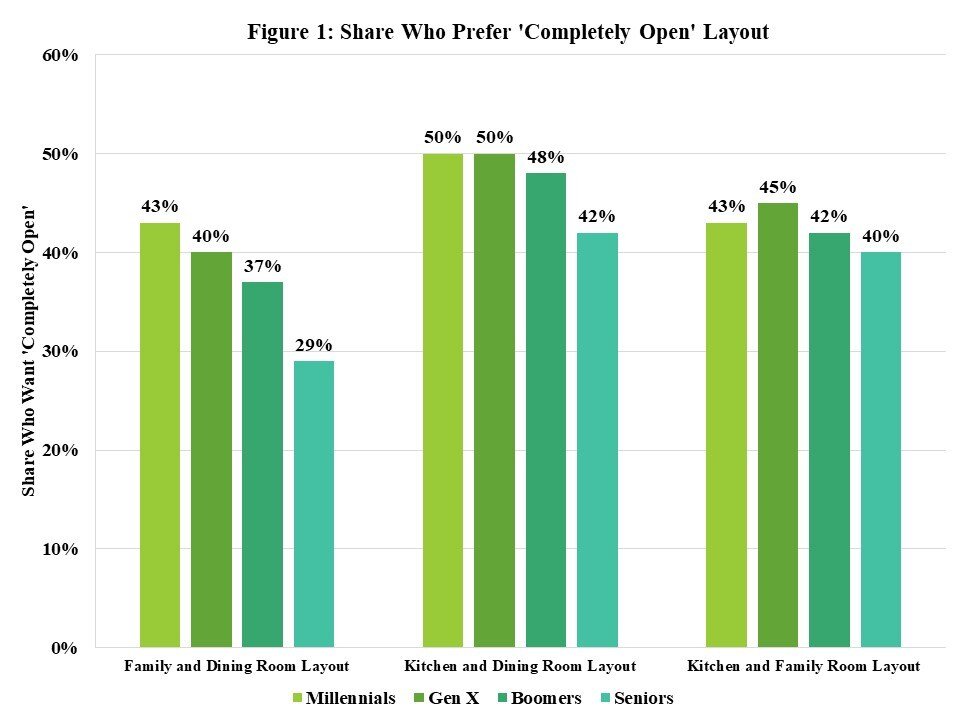
A plurality of Millennials – 43 percent – want a completely open layout for their family room and dining room, a higher share than any other generation, according to an NAHB report, What Home Buyers Really Want (Figure 1). The report is based on a survey that asks prospective and recent home buyers about the preferences they want in a home and community. The shares of those who desire a completely open layout for their family and dining areas drops to 40 percent among Gen X’ers, 37 percent among Boomers, and to just 29 percent among Seniors.


Half of Millennials want a kitchen and dining room layout that is completely open. This layout is just as popular among Gen X’ers (50 percent) and essentially the same among Boomers (48 percent), but fewer Seniors (42 percent) find it appealing.  On the other hand, there is general agreement across generations when it comes to a completely open kitchen and family room layout: 43 percent of Millennials want this, 45 percent of Gen X’ers, 42 percent of Boomers, and 40 percent of Seniors.

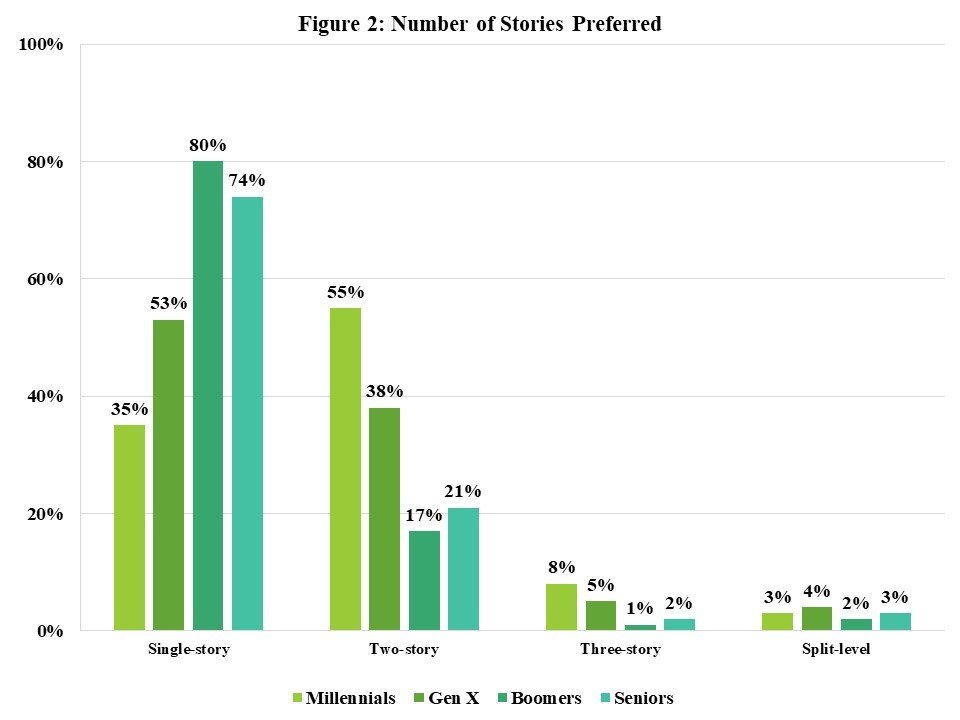
Millennials are the least likely to want a single-story home (Figure 2). Only 35 percent of them expressed a preference for it, compared to 53 percent of Gen X’ers, 80 percent of Boomers, and 74 percent of Seniors. A majority of millennials – 55 percent – want a two-story structure. However, this option is not as popular among Gen X’ers (38 percent), Boomers (17 percent), and Seniors (21 percent). A minority of buyers in all generations want three-stories or a split-level home.

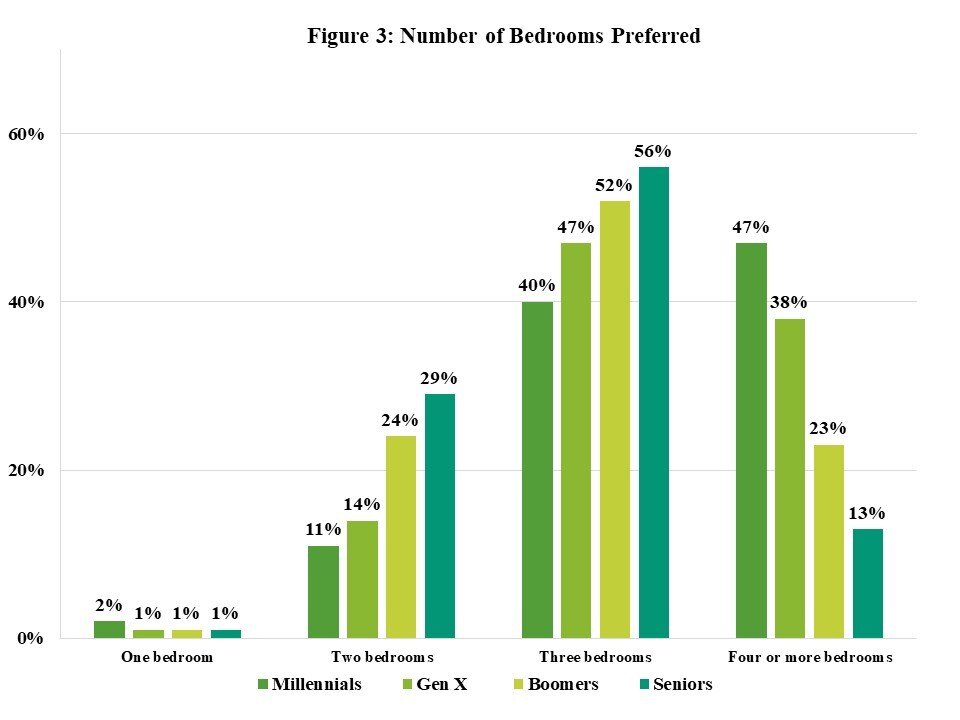
Considerable shares of Millennials want either ‘four plus bedrooms’ in their home (47 percent) or three bedrooms (40 percent) (Figure 3). This finding indicates that Millennials may want more space in their homes, perhaps to accommodate an expanding family.

A ‘four plus bedrooms’ may be too many for older generations as the preference for it falls with age: 38 percent of Gen X’ers prefer it, followed by 23 percent of Boomers, and 13 percent of Seniors. In contrast, the preference for ‘three bedrooms’ increases with age, from 40 percent of Millennials to 56 percent of Seniors.

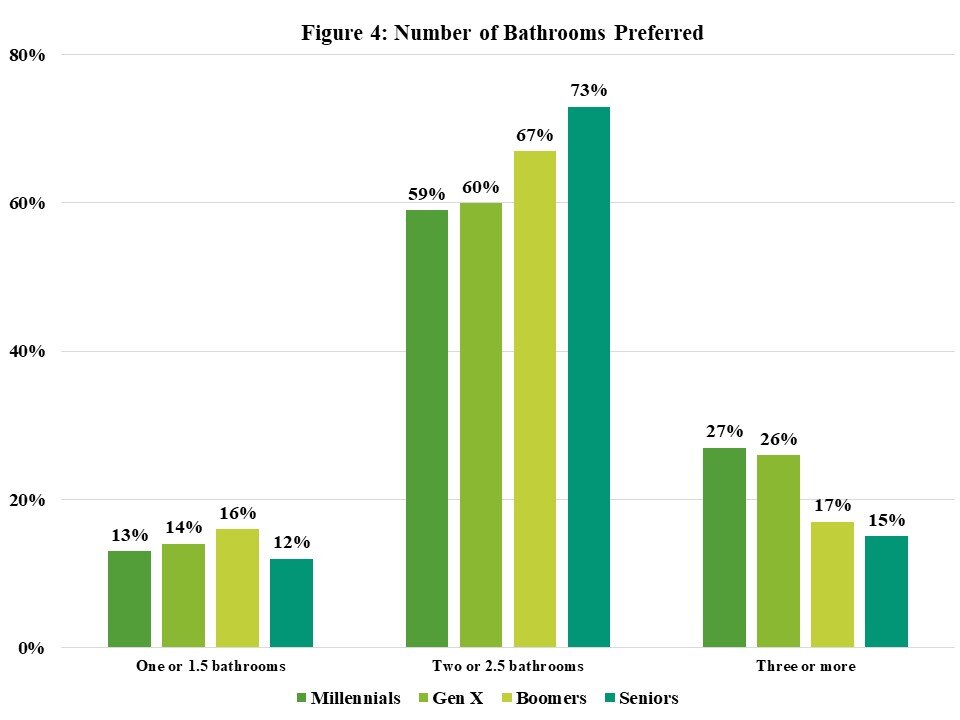
When it comes to the number of bathrooms preferred, a majority across all generations want 2 or 2.5 bathrooms (Figure 4). The preference for 2 or 2.5 bathrooms rises with age. While 59 percent of Millennials want 2 or 2.5 bathroom, the share increases to 73 percent among Seniors.

Among the generations, Millennials are the most likely to choose three or more bathrooms – 27 percent, compared to 26 percent of Gen X’ers, 17 percent of Boomers, and 15 percent of Seniors.

Figure 5 shows the preference for basements by generation. A majority of Millennials – 73 percent — prefer to have a basement: 37 percent want a full basement (at an additional cost of $45,000) and 36 percent want a half basement (at an additional cost of $22,500). A majority of Gen X’ers would also prefer a basement (64 percent), slightly less than Millennials. This is not the case for older generations: a majority of Seniors (61 percent) and Boomers (52 percent) prefer a home without a basement.

This analysis shows that Millennials have diverging preferences when it comes to home layouts: considerable shares of them prefer open layouts, two-stories, and a relatively large number of bedrooms and bathrooms compared to older generations. Millennials are also more likely to want a basement in their home.

For additional information, an August 2019 NAHB study showed the history of Millennials’ preferences for select housing characteristics.  The greatest level of detail—including preferences for hundreds of items broken down by generation, by geography, first-time vs. repeat buyer, household composition, race, income, and price expected to pay for the home—is available in the 2019 edition of What Home Buyers Really Want.