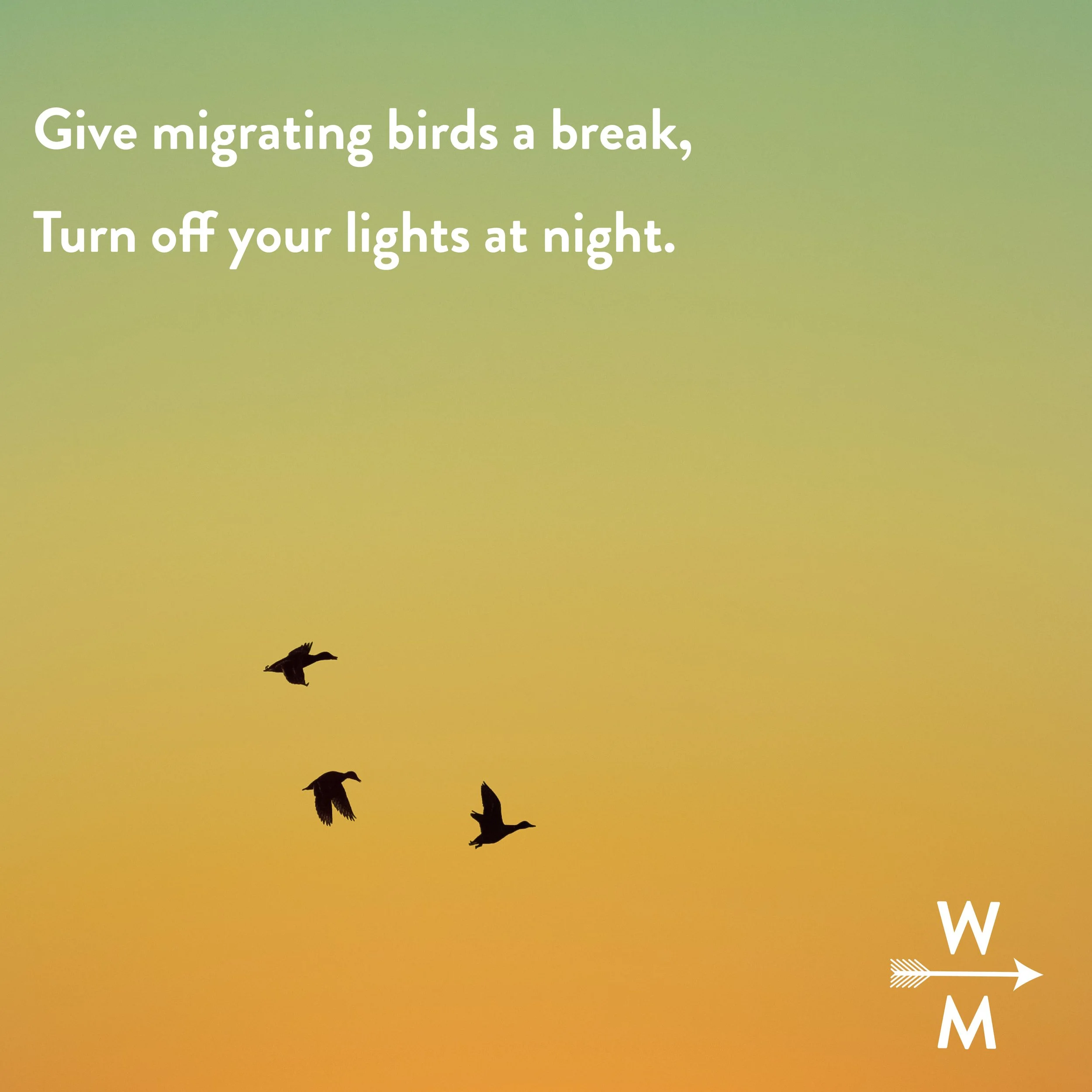
Here's How You Can Help Birds During their Migration


It’s bird migration season! Here are a few ways you can make sure they have a safe journey.

According to AllAboutBirds.org, Geese winging their way south in wrinkled V-shaped flocks is perhaps the classic picture of migration—the annual, large-scale movement of birds between their breeding (summer) homes and their nonbreeding (winter) grounds. But geese are far from our only migratory birds. Of the more than 650 species of North American breeding birds, more than half are migratory.

Why Do Birds Migrate?

Birds migrate to move from areas of low or decreasing resources to areas of high or increasing resources. The two primary resources being sought are food and nesting locations. Here’s more about how migration evolved.

Birds that nest in the Northern Hemisphere tend to migrate northward in the spring to take advantage of burgeoning insect populations, budding plants and an abundance of nesting locations. As winter approaches and the availability of insects and other food drops, the birds move south again. Escaping the cold is a motivating factor but many species, including hummingbirds, can withstand freezing temperatures as long as an adequate supply of food is available.

Where are the birds migrating?


For a live map, click here.

“Real-time analysis maps show intensities of actual nocturnal bird migration as detected by the US weather surveillance radar network between local sunset to sunrise. All graphics are relative to the Eastern time zone. When present, the red line moving east to west represents the timing of local sunset, the yellow line represents the timing of local sunrise. Areas with lighter colors experienced more intense bird migration. Orange arrows show directions to which birds flew. Green dots represent radar locations for which data are available; red dots represent radar locations with no data available. Note that many radars in mountainous areas (e.g. the Rockies) have obstructions that restrict radar coverage, providing the appearance of no migration where migration may be occurring.” - Birdcast.info

How you can help

This high-endurance pilgrimage isn't without danger. Outdoor cats, poorly placed communications towers, unforgiving and — to birds — invisible glass surfaces, and pesticide-laced plants all await. Add to that an ongoing crisis of habitat loss and it's no mystery why so many birds fail to reach their destinations during spring migration.

The good news is that all of us can take steps to make migration a little safer. Even better, many of these activities are simple, free, and require only a few minutes. To get started, have a look at abcbirds.org’s top suggestions — and find the solutions that work for you.

Turn Off the Lights

"Up to 1 billion birds die each year in the United States from colliding with buildings or structures. As migratory birds travel through cities with large buildings and bright lights, they can become disoriented by the lights, causing them to collide.

You can help birds during critical migration periods by turning off all non-essential lights from 11 p.m. to sunrise. Learn more about how you can help by visiting BirdCast's Lights Out webpage. You can also find out if a large number of migratory birds is passing through your area by checking BirdCast's online alerts."

Paint a Window Warning

"Hundreds of millions of birds in the U.S. die from hitting glass every year – almost half of those on home windows. Luckily, there are many ways to make your windows safe for birds. One of my favorite methods is applying tempera paint to the outside surface of glass. Tempera is nontoxic, cheap, easy to use (and remove) and amazingly long lasting — even in rain. If you're short on time, using a sponge is a good way to make a quick pattern. With a little more effort, you can create spring-themed designs or even small works of art depicting your favorite birds; either will help prevent collisions. Remember: Whatever kind of design you use, make sure your lines are no more than two inches apart to help smaller birds avoid collisions."

Support the Laws That Migratory Birds Can't Live Without

"The Migratory Bird Treaty Act (MBTA) is one of the most important pieces of legislation affecting birds in the U.S. Unfortunately, the previous administration made the MBTA harder to enforce by claiming that the law does not address unintentional harm to birds caused by industrial activities. This move is expected to be reversed by the Biden Administration, but we need to ensure that MBTA protections are in place permanently. Please ask your Representative and Senators to be co-sponsors of the Migratory Bird Protection Act, a bill that would strengthen the MBTA and go even further to protect migratory birds."

Protect Birds From Cats

"Cats are lovable pets, but they're also instinctive predators. One cat alone may kill up to 55 birds each year. It all adds up! So keep your cat on a leash or in an enclosure to protect migratory birds (and keep your cat safe, too). Don't have a cat? You can still support bird-friendly practices in your community by encouraging the passage of local ordinances mandating responsible pet ownership. Learn more about other simple actions you can take to protect birds on our Cats Indoors page."

Reduce Your Plastic Footprint

"It's estimated that there are about 330 billion pounds of trash on our coasts and in our oceans, with another 17 billion pounds of plastic entering the marine environment each year. Birds can ingest plastics or become entangled in them, which can cause serious injuries or even death.

No matter how far you live from our coasts, your daily actions can have an impact! Eighty percent of trash in the marine environment comes from land-based sources, as trash easily travels via gutters, rivers, bayous, and other watery pathways to our oceans. Switching from disposable plastic items to reusable alternatives is a great way to reduce trash. Consider using reusable bottles, cups, bags, utensil sets, and more — there are many great ways to reduce your plastic footprint! To learn more, check out ABC's clean coast program, Stopping Plastics and Litter Along Shorelines (SPLASh)."

Buy Bird-Friendly Coffee

"After oil, coffee is the most traded commodity in the world. To meet demand, coffee is often grown on monoculture plantations across the world, which cover hundreds of thousands of acres and reduce habitat for birds and wildlife. However, there is a better alternative. Shade-grown coffee, cultivated under existing tree canopies, doesn't require deforestation, leaving habitat intact for wildlife. It also tastes great.

The Bird Friendly coffee certification developed by the Smithsonian Migratory Bird Center establishes the best coffee farming practices to provide birds with forest-like habitat. Birds are not the only ones to benefit from Bird Friendly coffee; farmers who receive certification from the Migratory Bird Center can also access better prices for their coffee. In early 2021, ABC and its Venezuelan partner, Provita, worked with farmers to help market and sell Venezuela's first-ever Bird Friendly coffee."

Keep Your Woods Wild

"You can provide habitat for birds during spring migration by letting things around the house get a little messy. I have a wooded backyard, so I try to leave it as natural as possible. I let the understory grow and pull invasive plants such as Japanese Stiltgrass and Garlic Mustard. I leave logs and fallen branches in place to shelter insects and other small critters that birds feed on.

When larger trees break or fall, I leave them be — as long as they're not hanging over the roof. This gives snag-nesting migrants like the Great Crested Flycatcher places to nest — along with year-round residents like the Eastern Screech-Owl and Downy, Hairy, Pileated, and Red-bellied Woodpeckers — and is a nice source of grubs and other bird food."

Give Beach-nesting Birds a Break

"As temperatures rise, many of us begin heading to the beach. And we're not alone: This is a critical time for several migratory species — I'm thinking of Black Skimmers, Snowy Plovers, and Least Terns — that lay their eggs in the sand and are particularly vulnerable. One of the biggest challenges they face is the threat from unleashed dogs. Our team in the Gulf Coast region has seen loose dogs eat eggs and take chicks. This is a big problem, considering that nearly all of these birds have declining populations. The obvious solution is to leash dogs. As our team likes to say, 'Bird-friendly beaches have dogs on leashes!'"

Support Groups That Are Making Birding More Inclusive

"Everyone should be able to enjoy the wonders of bird migration, and we all have a role in making that possible. Many who engage in birding face issues related to discrimination, safety, and access, including birders of color, women, LGBTQIA+ people, or folks with disabilities.

In addition to events like Black Birders Week and Latino Conservation Week, groups such as Birdability and the Feminist Bird Club are working to address these and other barriers through advocacy, education, and community engagement. By following and supporting this work, we can help the communities these groups serve and the birding community at large. Bringing more people into the fold, with diverse perspectives and experiences, is also a good way to strengthen bird conservation. As Dr. J. Drew Lanham wrote: ‘If the goal is to conserve, then we need all involved that we can muster.'"

Fuel a Hungry Hummingbird

"Put out those hummingbird feeders during spring migration — the hummers are arriving. Be sure to use a mixture of four parts water to one part sugar. And do without the dye: Red dyes serve no purpose. Most hummingbird feeders already have enough color on them to attract hummingbirds, and, even worse, these dyes contain petroleum that may be harmful to hummingbirds. Don't forget to change the mixture and clean feeders often to be sure it's fresh and safe for those super-charged flying jewels."

Inspire a Future Bird Conservationist

"I have younger nieces and nephews in Wisconsin, and when I visit them during spring migration, I like to make sure they get outside, where I can introduce them to birds: Mr. Blue Jay, Mr. Cardinal, Mrs. Common Yellowthroat. Introducing birds to kids at a young age can instill a desire to explore the natural world. And that's only one benefit. It also helps children bond with wildlife and develop an environmental ethic that will, hopefully, remain with them for the rest of their lives. I'm hoping one of my nieces or nephews will be the John Muir of 2030!”

For more information, be sure to check out bird supporting organizations such as ABC Birds, All About Birds, and Birdcast.

Related Links

If there is a home that you would like more information about, if you are considering selling a property, or if you have questions about the housing market in your neighborhood, please reach out. We’re here to help.

Search Homes in Colorado

Search Homes in Oklahoma

Search Homes in Oregon

9 Things You Should Do to Your Home Before Fall Starts

 
fall-maintenance.jpg
 

Sweater weather is coming—and you need more than a PSL to get ready for it.

It would be amazing if all you needed to prep your home for fall was hang a wreath and light a bunch of pumpkin spice candles. While yes, those are a crucial part of getting ready for the change of seasons, there are more important (and not exactly fun) preparations that come with being a homeowner. Consider this everything you need to know before your house transitions from hot summer days to cool fall nights...and eventually freezing temperatures.

Clean, or possibly replace, your gutters.

Real talk: You're so used to your gutters working properly — and draining thousands of gallons of water from your roof yearly — that you forget they could use a little TLC. If they're clogged, you can end up with a flooded interior and damaged exterior. So clean them, and if necessary, replace them (Amazon Home Services will do it for $116).

Check for drafts.

Heat loss through windows is responsible for 25-30 percent of heating energy use, according to the U.S. Department of Energy. But it doesn't have to be that way, because weatherstripping is simple and probably the most cost-effective way to keep heating costs down.

Pro tip: To check if you have a draft issue, close a door or window on a strip of paper. If the paper slides easily, you need to update your weatherstripping.

3. Drain your outdoor faucets.

Say it with me now: "I will turn off all outdoor faucets before winter!" Drain and disconnect all garden hoses from outside spigots to prevent any water freezing. Not doing this can result to pipes bursting, so yeah, do this.

4. Bring your outdoor furniture in.

Yes, your furniture is outdoor furniture. No, that does not mean you should test the label by leaving it outside through hurricane-like weather and snowstorms. It cost you money and time to set that outdoor space up, so if you want to get another summer season out of it you should store it in a garage or shed. If you don't have anywhere to store the items, you should cover it in a waterproof furniture cover, which you can snag on Amazon for 36 bucks.

5. Fix any cracks in your driveway.

I know, I know — this seems tedious and is one of those things where you're like, "eh, it'll be fine!" But, it could very easily not be fine. When water gets into cracks it freezes, expands, and can make the crack even bigger. Enough small cracks can turn into big cracks, and eventually the concrete can crumble. Plus, uh, you'd probably prefer a driveway without a giant pothole. So, using concrete crack sealer, fill it up and be done with it.

6. Change your filters.

Found: Another thing in your house that might be costing you more money then it should be. If your filters are clogged, it's harder to keep your home at the temperature you want it too be which will increase your heating bills. Clean these filters monthly, not just before the fall, and thank me later. FYI: Disposable filters can be vacuumed one time before you replace it, and foam filters can just be vacuumed and not replaced.

7. Fertilize your lawn.

You know what they say: The best offense is a good defense. If you want to keep your lawn looking great in the spring and summer, you need to prep it for the fall and winter. Roots are still active when the grass isn't growing, so applying fertilizer will prevent winter damage. Doing this will also help your lawn turn green faster in the spring, which is crucial, because who wants to look at a sad lawn once it gets nice out?

8. Test winter equipment.

Hi, I'm here from the future, where your snow blower isn't working and you're stuck inside and can't get your car out to buy a new one. Seriously, just check it all now and make your life easier later.

9. Change your batteries.

Once a year you should be checking to make sure all smoke detectors and carbon monoxide devices are working. Since you're already testing everything else out, you might as well add this on.

Visit Home Beautiful for more.

Related Links

If there is a home that you would like more information about, if you are considering selling a property, or if you have questions about the housing market in your neighborhood, please reach out. We’re here to help.

Search Homes in Colorado

Search Homes in Oklahoma

As Featured in West + Main Home Magazine: Stay Fresh


With the previous layout of West + Main Homes agent Sam Messmer’s bathroom, the space was barely usable.

“The sink was located directly behind the door so you couldn’t leave it open if you were in the bathroom. You also couldn’t use the sink without fully closing the door. There were shelves for storage but you couldn’t access half of them because they were too tall to reach at the top, and the bottom was blocked by the sink,” said Sam.

She knew that in order to have a functional space, the bathroom would need a full remodel. To save some money before starting the renovation, Sam made a list of every item she wanted for the new bathroom and purchased it herself, having it ready for the team at Pride Property Services when they came in to demo.

We had a few layouts and designs in mind and collab- orated with CJ of Pride Property Services on his first visit to our house to come up with the best option for function and space. This entailed losing the tub, a con- troversial decision, I know, for a larger stand up shower, moving the sink next to the shower to open up the entry to the bathroom and get a full-size sink!
— Sam Messmer

After the major demo was taken care of, including the plumbing, electrical, and tiling, Sam was able to go in and prime, paint, add baseboards, hang fixtures, and build the built in drawers and shelves. This ended up saving her about $3,000 in labor costs.

“I love the amount of light and space in the bathroom now! It is so calming and spa-like in there we each definitely take our time getting ready in the mornings soaking up the new space.”

CONTRACTOR: CJ OF PRIDE PROPERTY SERVICES


If there is a home that you would like more information about, if you are considering selling a property, or if you have questions about the housing market in your neighborhood, please reach out. We’re here to help.

Search Homes in Colorado

Search Homes in Oklahoma

Search Homes in Oregon

Why home-price growth is still up 18% year over year


New listing data has fallen for 7 straight weeks.

On Tuesday, the S&P CoreLogic Case Shiller Index reported that national home prices grew 18% year over year. While the growth rate is cooling monthly, we are still in a savagely unhhealthy housing market trying to get national inventory levels back to pre-COVID-19 levels.

From the index:


I know it seems strange, but existing home sales are falling, and the monthly supply of new homes is at 10.9 months even if the last existing home sales report showed home price growth of near 11% year over year. 

There is a simple explanation for this, but you’re going to have to believe that supply and demand economics still work and that the credit profiles of homeowners matter more than people think. This means all those men and women since 2012 who have been saying its housing 2008 all over again on their YouTube, Twitter, Facebook and other social media outlets simply don’t have the proper training to talk about housing economics. I have documented the history of these housing price crash addicts for a decade now.

Housing inventory issue with no booming demand

My observation post-2020 is that many people have never read the total housing inventory data because we still have people who say active listings aren’t low or that it’s fake news. I understand why anti-Central Bank people say this because they want to blame everything on the Federal Reserve and say it’s just been booming demand.

However, we haven’t had a credit sales boom like the one we saw from 2002-2005. Nor can we ever have a credit sales boom again with lending standards back to normal. Case in point, purchase application data is already below 2008 levels today. 


Total Inventory had been growing from 2001-2005; total listings data in 2005 was at the higher historical range of 2.5 million listings. We broke to all-time lows post-2020, continuing the trend of lower inventory. Today, we stand at 1,310,000 active listings.


If we cut the timeline to the last time inventory grew, which was 2014, you can see this downtrend in inventory, unlike 2001-2005, when inventory grew from 2 million to 2.5 million. Inventory has been falling for years but people ignored the trend because some were always talking about the housing bubble 2.0 crash, especially from 2012-2019.

Then we can see a vicious break to all-time lows in 2020 when we didn’t have a seasonal push in inventory, and even today, with the weakness in home sales, we aren’t back to the range I believe would be ok, between 1.52-1.93 million. I don’t need to see total active listing get back to the historical range of 2-2.5 million to take the savagely unhealthy theme off, but I do need us to get into a range between 1.52-1.93 million, like I have talked about for some time now.

New listings are declining now

One of the issues with existing home inventory has been that, for the most part, a traditional seller is usually a buyer of a home. I am not talking about investors; I am talking about primary resident homeowners. Some sell to rent, of course. However, traditionally speaking, they buy a home.

One of the points of concern this year has been that when rates got toward 6%, this could potentially have new listings decline faster than normal because buying a home after selling might not be the best financial decision. Inventory is always seasonal, but the decline in new listings this year was not what I wanted to see. The decrease also happened when rates fell 1.25% from the recent highs of 6.25% back down to 5%. This is not encouraging news at all, in my view.

Read the full post on Housing Wire.

Related Links

If there is a home that you would like more information about, if you are considering selling a property, or if you have questions about the housing market in your neighborhood, please reach out. We’re here to help.

Search Homes in Colorado

Search Homes in Oklahoma

Search Homes in Oregon

Three Things Buyers Can Do in Today’s Housing Market


It’s clear the 2022 housing market has been defined by rising mortgage rates.

With rates on the rise, it’s also become more costly to purchase a home. According to the National Association of Realtors (NAR):

“Compared to one year ago, the monthly mortgage payment rose to $1,944 from $1,265, an increase of 53.7%.”

If you’re thinking of buying a home or have been trying to recently, that’s a big increase in a monthly mortgage payment – and it may be causing you to press pause on your plans. This jump is making homes less affordable, especially compared to the last two years when mortgage rates were at historic lows.

The good news is you can navigate today’s housing market and this rising rate environment with a few simple tips. Here are three things you may want to consider to help make your homeownership goals a reality.

1. Expand Your Search Area and Criteria

If you’ve been looking for a home in the city center or a specific area that’s starting to feel out of your price range, you may want to try looking a little further out in a location that could be more affordable. Expanding your search location or re-prioritizing the items on your wish list can open up opportunities you haven’t considered, and that could help you afford more of what you need (and want) in a home. As CNET notes:

“Area growth is likely to keep pace with the market, which means that the outskirts of town might be hopping within five years. Consider stepping out of your ideal location by searching in the nearby cities. You may find better prices and more square footage.”

2. Explore Alternative Financing Options

Working with a trusted lender to learn about the different loan types and options is essential too. According to Nerd Wallet:

“A variety of mortgages are available with varying down payment and eligibility requirements.”

Experts know how to point you in the right direction when it comes to exploring ways to find the best home loan for your situation. With rising mortgage rates making it more costly to finance a home today, there may be an ideal option out there your loan officer can introduce you to. This could make a home purchase more affordable and within your financial reach over the life of your loan.

3. Look for Grants, Gift Funds, and Down Payment Assistance

There are also many options available when it comes to securing the funding you need to purchase a home. One valuable resource to explore is downpaymentresource.com. Searching for specific down payment assistance options available in your local community could be a game changer when it comes to taking your first step toward homeownership. As NAR indicates:

“Many local governments and non-profit organizations offer down-payment assistance grants and loans, targeted to area borrowers and often with specific borrower requirements.”

Plus, there are programs and special benefits for individuals working in certain professions or with unique statuses, including teachers, doctors and nurses, and veterans.

Ultimately, that means there are many federal, state, and local programs available for you to explore. The best way to do that is to connect with a local real estate professional and your lender to learn more about what’s available in your area.

Bottom Line

If you’ve been searching for a home and have found yourself stepping out of the process because you’re worried about rising costs, connect with a trusted real estate expert. Having a team of local advisors on your side may be just what you need to guide your search in a new and more affordable direction.

Learn more.

Related Links

If there is a home that you would like more information about, if you are considering selling a property, or if you have questions about the housing market in your neighborhood, please reach out. We’re here to help.

Search Homes in Colorado

Search Homes in Oklahoma

Search Homes in Oregon