What would potential home buyers give up to reduce costs? You might be surprised


Some renters would give up a bedroom in their current place and rent a smaller unit if it meant they could save more quickly for a down payment on their first home.

Whether to settle for a three-bedroom house instead of four is a choice buyers have to make, and that will continue in the months ahead especially if housing costs and mortgage rates remain stubbornly high.

In the new-home sector, many builders are making that choice for them: not just in the number of bedrooms, but also the number of bathrooms, the size of the garage or lot, and anything else where builders can pare costs to make their plans less expensive to build. 

Going forward, says Anja Seng, a senior research analyst at John Burns Real Estate Consulting, builders will be facing the same challenges as their customers. Some will charge ahead as planned; some will mothball projects and wait for a better market. 

But Seng says “the most creative” among them will seize the day by making bold design choices. Some builders, like the three spotlighted in a recent Burns newsletter, already have. One gave up primary baths, one eliminated private yards and the third took garages off the table. If their success is any measure, other builders may soon follow. 

And if other builders need more convincing, they should consider a recent survey by RentCafe, a rental search engine, which found that 1 in 3 renters would gladly give up a bedroom if it helped them save for a house a little more quickly. (Full disclosure: RentCafe is owned by Yardi, which also owns Multi-Housing News, a publication for which I write a monthly column.) 

RentCafe asked 3,659 visitors to its website if they would be willing to downsize to better save for a down payment, and 36% said they would. The study found that tenants who are willing to compromise on space could save an average of $3,735 per year. With that kind of savings, the typical renter would have enough for a 10% down payment on a starter home in their particular markets in six years and seven months. That’s still a long time, to be sure, but that’s without putting up any other funds — and it’s just the national average. 

Building a down payment can occur much quicker in some spots. In Dayton, Ohio, for example, a renter would save enough by renting a smaller place — $3,168 annually — to set aside 10% down on a $57,652 starter house in just 21 months. And a renter in Philadelphia would put away enough — $7,416 a year — to build up a 10% down payment for a $142,288 house in 22 months. 

That renters are willing to make such a sacrifice to fulfill their dreams should embolden builders to do the same. The question every builder has to answer is: What are first-time buyers willing to give up to go from tenants to owners? 

One potential giveaway is a big, lush, expensive primary bathroom with shower and tub, compartmented water closet and dual sinks. That’s what one builder did at the Eagle Ridge development south of Seattle, where two of the five floor plans offered have no primary bath. Instead, the primary and secondary bedrooms shared a bathroom, according to the Burns report. 

The target market: renters who were already accustomed to sharing a single bath. The result: The shared bathroom plans sold just as well as the builder’s more conventional layouts.

At the Kissing Tree community south of Austin, Texas, meanwhile, private yards were swapped for a prime location in which the clustered houses overlook a golf course. The houses sold so well, the consulting firm reports, that the builder is opening two new phases. 

And at Chatham Park Cottages in suburban Raleigh, North Carolina, 23 of the 30 houses have assigned parking spots instead of garages. 

Although the builder expected some pushback, Seng reports, the idea was well-received and the company plans to replicate the idea elsewhere. And why not? How many apartments offer tenants assigned spaces, let alone garages? Whether other rookie buyers would give up a luxurious bath, a lawn of their own or a garage is hard to say. 

But those are not the top priorities of the recent and wannabe buyers who are polled every year by the National Association of Home Builders. Almost invariably, the most unwanted features are of little consequence because most builders targeting first-time buyers don’t offer them — elevators, for example, or cork flooring. More importantly, the 10 most unwanted features are selected from a list of 200. 

When asked specifically about their desired number of bedrooms, most respondents said that three would do just fine. Bedrooms aren’t all that expensive to build, save the extra cost to put a roof over them. But full bathrooms are costly: roughly $25,000 each. And with that in mind, most poll respondents said two baths were enough. 

Garages aren’t cheap, either: about $27,000 to park one car and $45,000 for two. Knowing the cost, most buyers still said they’d opt for a two-car garage, though 18% said a one-car would suffice. 

Finally, there’s also a notable shift to completely or partially open floor plans that feature kitchens that open to the living room, dining room or family room. That means fewer walls, which translates into somewhat less cost, at least for the builder. 

All of this indicates to me that today’s buyers are more flexible than ever. They realize that something has to give to bring prices down to a level they can afford, and they are willing to make compromises. 

Keep reading on Miami Herald.

Related Links

If there is a home that you would like more information about, if you are considering selling a property, or if you have questions about the housing market in your neighborhood, please reach out. We’re here to help.

Search Homes in Colorado

Search Homes in Oklahoma

Search Homes in Oregon

The 10 best U.S. cities for new grads to start a career—and none are New York or LA


For new college graduates, the best cities in the U.S. to begin a career aren't coastal — they're in the Midwest, according to a recent ranking that has St. Louis at the top of the list.

Since college grads tend to earn less earlier in their careers, an analysis by insurance provider Insurify ranked cities in the U.S. by employment opportunity and affordability, as well as transit costs and livability. 

The rankings were narrowed down to the best city in each state, and based on an "overall appeal" score out of 100, with 100 being the most appealing.

Here's a look at the 10 best cities for new grads to start their careers:

  1. St. Louis: 100

  2. Minneapolis, Minnesota: 98.3

  3. Rapid City, South Dakota: 88.8

  4. Pittsburgh: 85.5

  5. Lincoln, Nebraska: 84.9

  6. Portland, Oregon: 78.9

  7. Fargo, North Dakota: 75.8

  8. Fort Wayne, Indiana: 73.7

  9. Denver: 73.3

  10. Tampa, Florida: 73.0

Six out of the top 10 cities are located in the Midwest, including the top three. These cities have relatively low costs of living while offering comparable transit and entertainment options to larger coastal cities.

Big cities like New York City, Los Angeles and Seattle ranked between No. 12 and No. 20 on the overall list, with New York placing the highest of the three at No. 12. These cities have higher costs of living, but did well overall because of access to alternative transit options and entertainment choices.

A city received a higher overall appeal score if it has a lower unemployment rate, a lower cost of living, lower one-bedroom rental costs, a high alternative transit score and a higher number of arts and entertainment venues per capita.

The cost of living is based on the average U.S. household budget, using U.S. Bureau of Labor data from 2021. Because the cost of living also includes housing, Insurify lowered its weighting of rental costs by half. To account for higher savings associated with not owning a car, alternative transit scores were weighted with a 1.5 multiplier.

Estimates are based on data compiled from the U.S. Bureau of Labor Statistics and the U.S. Bureau of Economic Analysis. Other data comes from rental site Apartment List, gas price tracking site Gas Buddy and private health-care foundation The Commonwealth Fund.

Get more on Apple News.

Related Links

If there is a home that you would like more information about, if you are considering selling a property, or if you have questions about the housing market in your neighborhood, please reach out. We’re here to help.
Search Homes in Colorado

Search Homes in Oklahoma

Search Homes in Oregon

Colorado ski slopes could see above-average snowfall this winter thanks to a “triple-dip La Niña”


The coolest surface water temperatures since 2010 means potential pow-pow in the Rockies

Confidence is growing that Colorado skiers and snowboarders could see above-average snowfall this coming winter, based on one of the key climate factors meteorologists monitor to predict seasonal precipitation patterns in the U.S.

Because of relatively cool surface temperatures in the central and east-central equatorial Pacific Ocean, meteorologists say a “robust” La Niña phenomenon is strengthening there, and that usually means good to great mountain snow for Colorado and the northern Rockies. La Niña events typically produce storm tracks that predominantly flow from the Pacific Northwest.

The opposite phenomenon, El Niño, occurs when surface water temperatures in the central and east-central equatorial Pacific are above normal, producing storms that predominantly track across the southern U.S.

Current conditions could portend abundant powder come winter.

“These are the coolest temperatures we’ve seen in the east-central Pacific for the month of August since 2010,” said meteorologist Sam Collentine, chief operating officer for the ski-oriented OpenSnow weather forecasting and monitoring service.

“That’s telling us there’s a pretty robust La Niña setting up right now, and when we look back at the last significant La Niña event, that was a very healthy snow year — not only for Colorado, but the entire western United States,” he added.

That was the ski season of 2010-11. In a report posted Wednesday on OpenSnow, Collentine cited figures from the snowfall recording site bestsnow.net that put snowfall in Breckenridge that winter at 80% above normal. Steamboat came in at 35% above normal.

“Colorado mountains — northern, central and southern — ranged from 400-500 inches that season, which is well above average,” Collentine said. “When we look back at significant La Niña events, we typically see average to above-average snowfall in Colorado, much of the northern Rockies and the Pacific Northwest.”

In fact, Collentine reported, there have been seven significant La Niña winters since 1988, and the current La Niña surface temperature ranks fourth-coolest among them.

Also worth noting, this will be the third consecutive La Niña winter — something meteorologists have been calling a “triple-dip,” according to Open Snow — although the effect was less pronounced in 2020 and 2021.

Meteorologists necessarily hedge their bets because other weather phenomena can come into play, but the August data coming from the Pacific is encouraging.

“These are multi-year cycles we go through,” Collentine said. “For skiers and snowboarders in Colorado, it helps us get a hint at what we could see for the next few months into the winter season.”

Keep reading on The Denver Post.

Related Links

If there is a home that you would like more information about, if you are considering selling a property, or if you have questions about the housing market in your neighborhood, please reach out. We’re here to help.

Search Homes in Colorado

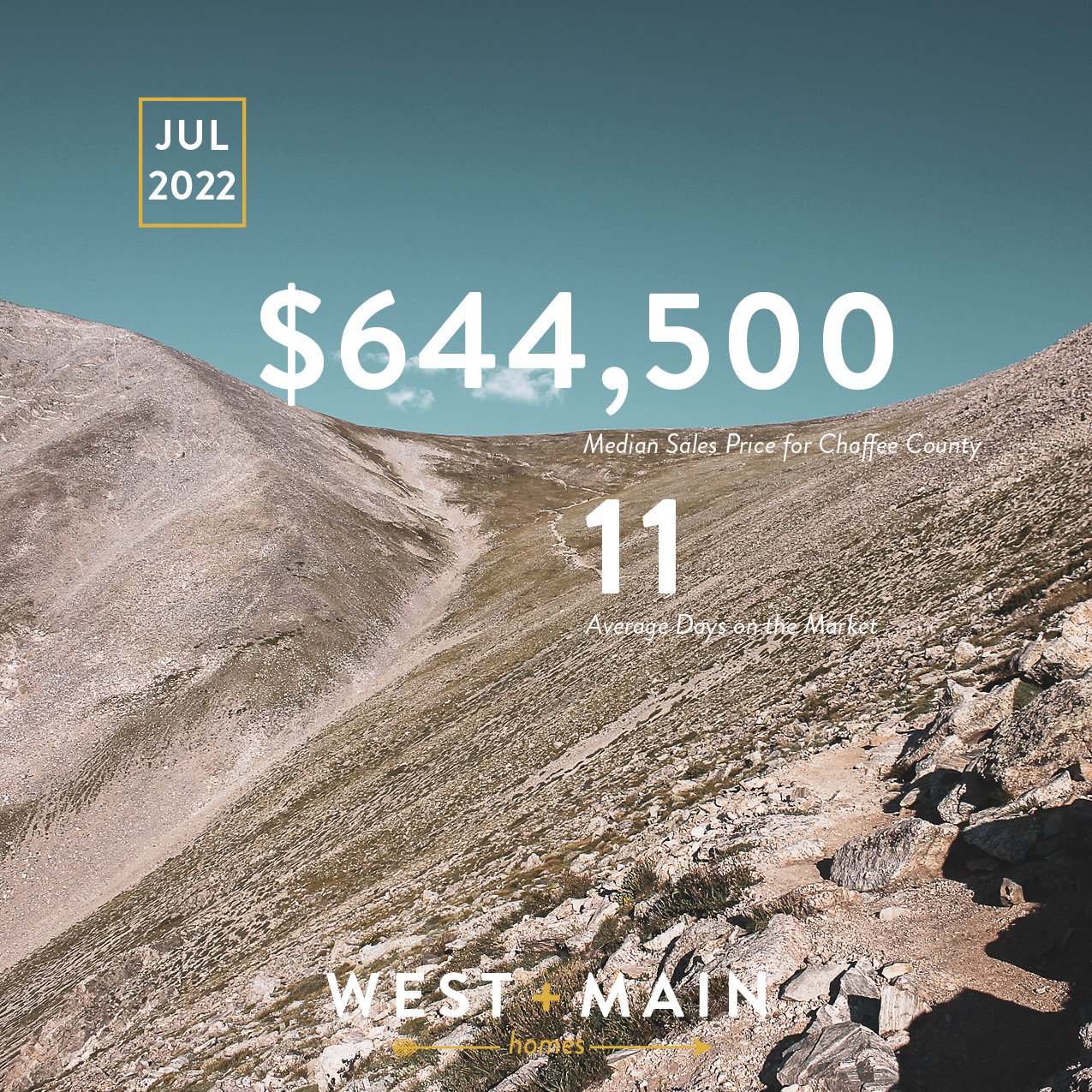
Chaffee County Real Estate Market Report from July 2022

Chaffee County Housing Market

Buyer demand pulled back in July as prospective buyers took a closer look at their finances given today’s home prices and higher interest rates. The number of July closings was lower than both last July and last month throughout the county. Although still higher than we saw last July, the median amount buyers paid for a home was 4% lower than last month, which is a sign that home prices are stabilizing. The number of listings that are currently pending sale was 27% lower than last year and 20% lower than last month. Those listings took longer to move off the market, indicating August will bring continued declines.

On a positive note, sellers continue to bring more new listings to the market, giving buyers more choices. At the end of July there were 177 listings actively available for sale, which is 127% more than July 2021.

Download the Full Report


If there is a home that you would like more information about, if you are considering selling a property, or if you have questions about the housing market in your neighborhood, please reach out. We’re here to help.

Search Homes in Colorado

Just Listed: Great views from front and back in Granby Ranch


Welcome to Granby Ranch!

This .33 acre lot has great views from front and back and backs to open space. Very buildable lot and already has building plans included, soils testing also attached. Utilities at the lot line and paved roads. This is a place with so many activities and events year round which makes it the PERFECT getaway. Ski or golf, snowshoe, mountain bike, camp, fish on the Fraser River that passes through Granby Ranch (this portion of the river is private property and is closed to the general public for all uses), take a guided hike, go horseback riding just to mention a few options at Granby Ranch! The Clubhouse is where you'll find the pool, exercise room and game room. Perfect lot to build your mountain getaway!

Listed by Rachel Cardwell for West + Main Homes. Please contact Rachel for current pricing + availability.


Have questions?
West + Main Homes
(720) 903-2912
hello@westandmainhomes.com

Presented by:
Rachel Cardwell
(623) 451-5823
rachelcardwell@westandmainhomes.com


Search homes in Colorado