5 Reasons Why Buying an Old House Is a Great Idea


We understand the appeal of moving into a newly constructed home.

After all, it’s hard not to be enticed by brand-new appliances, floors, and heating, cooling, and electrical systems. Plus, buying an old place that needs work can be intimidating, especially for those of us whose only brush with restoring a house has come from watching reruns of “Fixer Upper.”

However, home buyers can see all the beauty and potential in older houses. What some view as eyesores, others see as charm—four walls full of history that can’t be duplicated. Besides the nostalgia factor, an old house can be a smart purchase for the sake of your wallet.

Take a look at the top reasons why buying an old house might just be the best decision you’ll ever make.

1. Old homes are cheaper than new homes

What classifies as an older home? In general, if a home does not use or contain modern materials such as high-performance concrete, it qualifies as “old.” Normally, these homes would have been built before 1970.

Shelley Cluff, a real estate broker and owner of Park Place Homes, in Midland, MI, explains that an older home gives you substantially more bang for your buck.

“On average, a comparably sized new construction can sell for 10% to 20% more than an older, updated home,” she says. While newer homes might cost less to maintain, they are also built with different materials such as energy-efficient products that drive up the cost of building them and, by extension, the cost of buying them.

2. Old homes have better-quality construction

The saying “they don’t build ’em like they used to” is generally true. Established houses are built to last, and many aspects of the construction cannot be reproduced today. Older homes might be built with wood made from old-growth trees (trees that attained great age by not being significantly disturbed) and therefore more resistant to rot and warping.

Even the walls are likely different. In an older home they’re probably built with plaster and lathe, making them structurally stronger than the drywall construction of modern homes. These older materials also provide a better sound barrier and insulation.

3. Old homes are often in established locations

When choosing a neighborhood, home buyers weigh a number of factors—including the school district, crime rate, and walkability. If you’re looking at buying an old house, chances are it’s in a well-established, and probably stable, area. This is a good thing. 

4. Old homes have more character

See that mature oak tree towering over the front yard that took decades to reach such heights? You’re not going to get that kind of curb appeal from a new construction.

Some older homes have managed to maintain the amenities that are characteristic of the era it was built in—for example, original crown molding, herringbone-patterned hardwood floors, and built-ins.

While newer homes will reflect the trends of current times, they won’t satisfy other eclectic tastes. Victorian homes with authentic stained-glass windows or a midcentury sunken living room can’t be found in modern houses. While many designers do emulate these characteristics, you might prefer to go for the real thing.

5. Lot size tends to be larger with old homes

Newer homes might come with newer amenities, but on the outside (specifically in the backyard) things aren’t as remarkable. According to data from CoreLogic, new constructions tend to have a larger house with a smaller lot.

“The median size of a new home increased from 1,938 square feet in 1990 to 2,300 square feet in 2016, but lot sizes during this same period decreased from 8,250 square feet to 6,970 square feet.”

In an effort to keep the cost of new homes down and bring in more revenue, homebuilders have favored building larger homes on smaller lots. Why?

“When home prices appreciate at a fast pace, the land value rises even faster, which in turn drives the cost of homes higher,” according to CoreLogic.

So if a big backyard is on your list on nonnegotiables, you’re most likely to find that in an older home.

Read more like this on Realtor.com

Related Links

If there is a home that you would like more information about, if you are considering selling a property, or if you have questions about the housing market in your neighborhood, please reach out. We’re here to help.

Search Homes in Colorado

Search Homes in Oklahoma

Search Homes in Oregon

Why Women Might Beat Men at Negotiating a Real Estate Deal


Who can negotiate a better real estate deal when buying a house—women or men?

While men might assume they’re the masters of wheeling and dealing on a house (and much more), some research suggests that women might be more naturally gifted at hammering out favorable terms.

“The myth or misconception is the belief that negotiation is all about toughness, the bark and bite,” says Cindy Watson, attorney and author of “The Art of Feminine Negotiation.” The reality, however, is that 5 of the 6 key skill sets that make and mark the most effective negotiators are traits that most people would consider feminine.

What’s more, when it comes to a house hunt, women seem to be calling more of the shots, with one study from Harvard Business Review finding that women pick which home to buy in 91% of transactions.

“Studies breaking down gender roles in residential real estate show women leading in most areas of the homebuying process, including problem recognition, information search, how much to pay, and final decision,” says Watson. As such, they may be better equipped from the get-go to come to the negotiation table prepared.

While women may innately possess more of the skills that could make them the secret weapon in negotiating a fantastic real estate deal, the good news is that anyone—male, female, or otherwise—can learn to use these tactics effectively. Here’s some advice to keep in mind.

The ‘deadly sins’ of negotiating a real estate deal

To begin, Watson says that women are less likely to engage in the “deadly sins of negotiation.” They are the things you want to leave at home before heading into a real estate negotiation:

  • Ego: This can show up as a need to win, the need to look good, an inability to admit you don’t know something, or simply talking too much.

  • Attachment: This could appear in the form of clinging to the idea of getting the deal sealed in your favor, to the point that you continue to bargain after it no longer makes sense.

  • Reactivity: Getting angry or otherwise reactive in bargaining will cause you to lose objectivity and equilibrium and make you less likely to make rational, informed decisions.

  • Not listening: Active listening is a key to effective negotiation—and women are typically better at this skill.

  • Jumping straight to business: Men are more likely to jump straight to business without building the necessary connection and trust to increase influence.

“Whenever you find yourself making a negotiation all about you, stop and push reset,” says Watson. “Turning your attention to the needs and perspectives of the other party will always get you further.”

Effective ways to negotiate a real estate deal

At this point, you’re ready to learn to negotiate using six traits that experts regularly bring into play: assertiveness, rapport, empathy, flexibility, intuition, and trust.

Watson has created a simple mnemonic to help you remember these key skills.

“Just think you ‘ARE FIT’ to be a great negotiator,” says Watson, who explains how each skill could play out in classically masculine and feminine negotiating styles—and how to flip the script, if needed.

Assertiveness

“Assertiveness is the only skill of the sextuplet that is considered to be a masculine trait, but that belief is based on a mistaken conflation of aggressive with assertive, and they are not the same thing,” says Watson. “Assertive does not mean being tough for the sake of being tough, or any other misguided sense of boldness or forcefulness. It means being confident and self-assured, holding the line when required.”

That confidence comes, in part, from knowledge, which comes from putting the work in and being prepared.

Masculine approach: Imagine an aggressive negotiator was trying to haggle on the price of an offer.

He might say something like, “This property is a dump and needs a lot of work. Heck, I’ll probably have to bulldoze the place. You can’t possibly expect to get what you’re asking.”

Feminine approach: You can hold firm—or be assertive—on the bottom line while still bringing empathy, respect, and compassion to the table.

A feminine negotiator might more successfully say something like, “I can see why you love this property. There was obviously much care and attention put into this house. I’d appreciate the chance to bring another generation of love to it. Unfortunately, my situation only allows me to go up to this amount of money.”

Rapport

Building rapport is all about relationship.

“Women were required to develop this skill in a world where for too long they had fewer rights,” says Watson. “Our very survival depended on becoming adept at developing relationships.”

Masculine approach: A male negotiator is likely to just jump straight to business, talking about the offer/numbers, but that approach might mean losing opportunities for a better deal that could come from getting to know the person on the other side of the table.

Feminine approach: At the outset of the negotiation, a feminine negotiation technique would be to try to break the ice with “safe” small talk not related to the real estate transaction at hand. Find a shared experience or element of common ground, and use the other person’s name early in the conversation, while also trying to inject humor, offering a genuine compliment, or asking some variation of “tell me about yourself.”

A successful negotiator is also more likely to pay attention to body language and will personally try to maintain a relaxed open posture, leaning slightly toward the other person while maintaining eye contact.

Also effective is using “mirroring techniques” such as subtly mimicking the other person’s body language, tone of voice, pace, and word choices. This makes your “opponents” more comfortable and feeling like you understand them.

Empathy

“Empathy is the art of being able to put yourself in the shoes of another person, the capacity to understand another’s feelings from their frame of reference, to show compassion, sympathy, concern, and consideration,” says Watson. “Studies seem to support that women have higher capacities to recognize what others are thinking and to respond appropriately.”

For that reason, Watson says that truly understanding the other party’s perspective and motivation is a powerful tool in any negotiation.

Masculine approach: Imagine the person selling the home is an elderly woman who just lost her husband. A brusque negotiator might not care what the circumstances are as long as he gets his desired numbers and terms.

Feminine approach: In this same scenario, a feminine negotiator would consider the fear, attachment, and potential reactivity of the widow. She would empathize with her situation and ask questions that might reveal that fetching the highest-priced offer pales in comparison to this widow’s fear of change, or losing the many fond memories she has in the house. At that point, a feminine negotiator might propose alternatives that could meet those needs, like a longer closing so the widow could take her time packing.

Flexibility

The ability to be flexible—able to change, pivot, or bend as necessary—is important to both the process and outcome of any given negotiation.

“Flexibility is typically an area where women excel. Some would say this is out of necessity,” says Watson. “The need to juggle many balls at the same time, to multitask in multiple areas, all makes us well-equipped to bring flexible approaches to life and negotiations, and to adapt as may be required in any given situation.”

Masculine approach: Imagine that the sellers advise they can’t meet the closing date. A masculine negotiator would say, “I don’t care, make it work,” and insist on meeting the contractual close, threaten legal consequences, and say this will put the deal at risk.

Feminine approach: In the same scenario, a negotiator might be open to a different closing date—and negotiate additional perks or benefits as a result. For instance, she might say, “If I move forward closing by a week, might you be open to hiring a professional cleaning service for the house before I move in?”

Intuition

The ability to rely on strong instinct, to read your counterpart, and to pick up on cues—both verbal and nonverbal—in negotiations is a valuable tool.

Masculine approach: Imagine a real estate deal where there are quick decisions that need to be made when multiple offers are on the table. A classically masculine negotiator might take his sweet time submitting a counteroffer, not picking up on signs that a home seller is desperate to close as soon as possible. As a result, he could lose the deal to a competing buyer who offers a quick close.

Feminine approach: This is all about picking up subtle signals from the seller. For example, a negotiator might get the strong sense that the seller urgently needs the money and wants a quick close. As a result, this homebuyer might suggest a counteroffer that bumps up the closing date as early as feasible while holding firm on her price. If her intuition is correct, she could get the deal over someone who offered more money and a later closing date—all simply because she was able to read between the lines.

Trust

Justified or not, Watson says, the reality is that people tend to trust women more in negotiations.

“Perhaps it’s because we’ve not been [historically] regarded as threats,” says Watson. “Or perhaps it’s because women are typically considered to be more open with their emotions, which is perceived as transparency and candor.”

Whatever the rationale, trust is a definite asset in any negotiation.

Masculine approach: Since a more masculine negotiator might hold his cards tight to his chest, he might not mention how much loves the home seller’s patio furniture. But what if the home seller didn’t care for that furniture and had hoped to leave it behind? In this case, both the home seller and buyer lose out, all because they didn’t trust each other enough to loosen up and mention the furniture.

Feminine approach: A negotiator might mention how much she loves the patio furniture—or the home sellers might mention how they’d prefer to leave it behind. In either case, it could mean that the patio furniture ends up as a sweet parting gift all because you treated these home sellers the way we all want to be treated—like people rather than a transaction.

As Watson says, “Whenever possible, bring human connection to the equation.”

Read more on Realtor.com

Related Links

If there is a home that you would like more information about, if you are considering selling a property, or if you have questions about the housing market in your neighborhood, please reach out. We’re here to help.

Search Homes in Colorado

Search Homes in Oklahoma

Search Homes in Oregon

50% of millennials think they need $300,000 or less to retire in comfort: Here’s how much they actually need


“I’m concerned that they’re not thinking big enough in terms of how much somebody should save.”

How much are you going to need to retire? Whatever your answer, there’s a good chance you’re low-balling it, experts say.

According to a new survey from the Transamerica Center for Retirement Studies, half of millennials (born 1981 to 1996) believe that they’ll need $300,000 or less in savings to retire comfortably — a fraction of what most estimates say they’ll need.

Gen X (born 1965 to 1980) and Gen Z (born 1997 to 2012) had slightly higher estimates for their retirement needs: The median guess for each group came in at $500,000. Boomers (born 1946 to 1964) had the highest median guess, at $750,000 — which makes sense, since many of them are near or at retirement, so they have a clearer picture of what their retirement needs will be. However, even that amount probably won’t be enough to retire on in comfort, experts say.

“The estimated retirement savings for all workers are on the low side,” says Catherine Collinson, CEO and president of the Transamerica Institute, the parent foundation for the Center for Retirement Studies. “I’m concerned that they’re not thinking big enough in terms of how much somebody should save.”

So how much money do you actually need to retire comfortably? The rule of thumb is that you want an annual retirement income that’s about 75% of your pre-retirement income, according to experts.

Based on Grow’s retirement calculator, the median millennial (age 32) earning the median U.S. household income ($68,703) would need to save $1.8 million in order to retire on three-quarters of their income at age 67.

That might sound daunting, but it doesn’t have to be overwhelming. There’s plenty of help out there to get you on the right track.

Don’t estimate your retirement needs by guessing

One of the surprises for Transamerica’s researchers, who surveyed 10,000 people at the end of November 2020, was the number of people who estimated their retirement needs simply by guessing.

More than 40% of respondents said it was how they landed on the answer they gave. Only a quarter said they’d used a retirement calculator or filled out a worksheet.

“It’s surprising that people are not taking as much advantage as they can and should of the tools that are available,” Collinson says.

These tools take the guesswork out of your retirement planning and they can help you be clear-eyed about reaching your goals, Collinson says. She cites boomers, who had the highest guess about how much they would need to have saved for retirement, as an example.

Their $750,000 estimate “is much more than they’ve actually saved in all their retirement accounts,” Collinson says. The median retirement savings for boomers came in at just over $200,000, according to the survey.

In good news, more young people ‘have started saving’ for the future

The survey isn’t all doom and gloom. It contains several data points that are very encouraging, especially when it comes to how younger people are thinking about retirement. This was the first year that the survey, which has been conducted annually for more than 20 years, collected data from Gen Z, and Collinson was pleasantly surprised by its findings.

“One of the things that’s most surprising about Gen Z is that they have started saving at an age younger than their older counterparts,” Collinson says. About “7 in 10 Gen Zs are saving for retirement, and the median age they started is 19. We’ve never seen that in the survey before.”

Most Gen Zers are college-aged, and few are fully in the workforce, so things could change. That said, the way they’re thinking about retirement is “awe-inspiring,” Collinson says.

Even if you didn’t start saving for retirement at 19, now is still a great time to start. Experts suggest you set aside 15% of your income for retirement, but barring that, anything that you put away is a good thing, says Janet Stanzak, a certified financial planner and founder of Financial Empowerment in Minnesota.

“Something is better than nothing,” Stanzak recently told Grow.

One great way to start? If the company you work for offers a 401(k) program, set aside a small percentage — even 1% — of each paycheck for that account. That kind of employer-sponsored retirement savings program is “the number one best way” to get started, Stanzak says. If your job matches the contributions you make, try to contribute enough to get the entire match.

Those contributions can add up to big savings by the time you’re ready to retire. The concept of 401(k) and IRA millionaires — that is, people who have saved $1 million or more in their retirement accounts — has become a reality in recent years, as more and more people reach that milestone.

The number of 401(k) plans with a balance of $1 million or more jumped to a record high of 365,000 in the first quarter of 2021, according to data from Fidelity. The number of IRA millionaires increased to 307,600, also an all-time high.

Learn more.

Related Links

If there is a home that you would like more information about, if you are considering selling a property, or if you have questions about the housing market in your neighborhood, please reach out. We’re here to help.

Search Homes in Colorado

Search Homes in Oklahoma

Search Homes in Oregon

Just Listed: Build Opportunity on Lot Next to Open Space in Conifer


Welcome home to your own mountain oasis.

A beautiful lot with incredible opportunity.
With a little over 10 acres, you get the joy of this upscale neighborhood but also great privacy in addition to breathtaking views once your build site has been cleared. This lot also shines in the community being that your 10.23 acres is not interrupted, and sits entirely on one side of the road sloping towards the amazing views. Wildlife, mature trees, and this lot is adjacent to open space that won’t be developed.
There is a well permit (84458-F) though a well has not yet been installed on the property. Additionally, the Sellers have gone through all steps hiring an architect and builder. The planned home has already been approved by the HOA as well, and we can provide all of that documentation in addition to well drilling plans, septic and leach field plans, and other site build information.

Listed by Carey Skains for West + Main Homes. Please contact Carey for current pricing + availability.


Have questions?
West + Main Homes
(720) 903-2912
hello@westandmainhomes.com

Presented by:
Carey Skains
(630-740-6729
carey@westandmainhomes.com


Search homes in Colorado
 

As Featured in West + Main Home Magazine: Revamp your kitchen


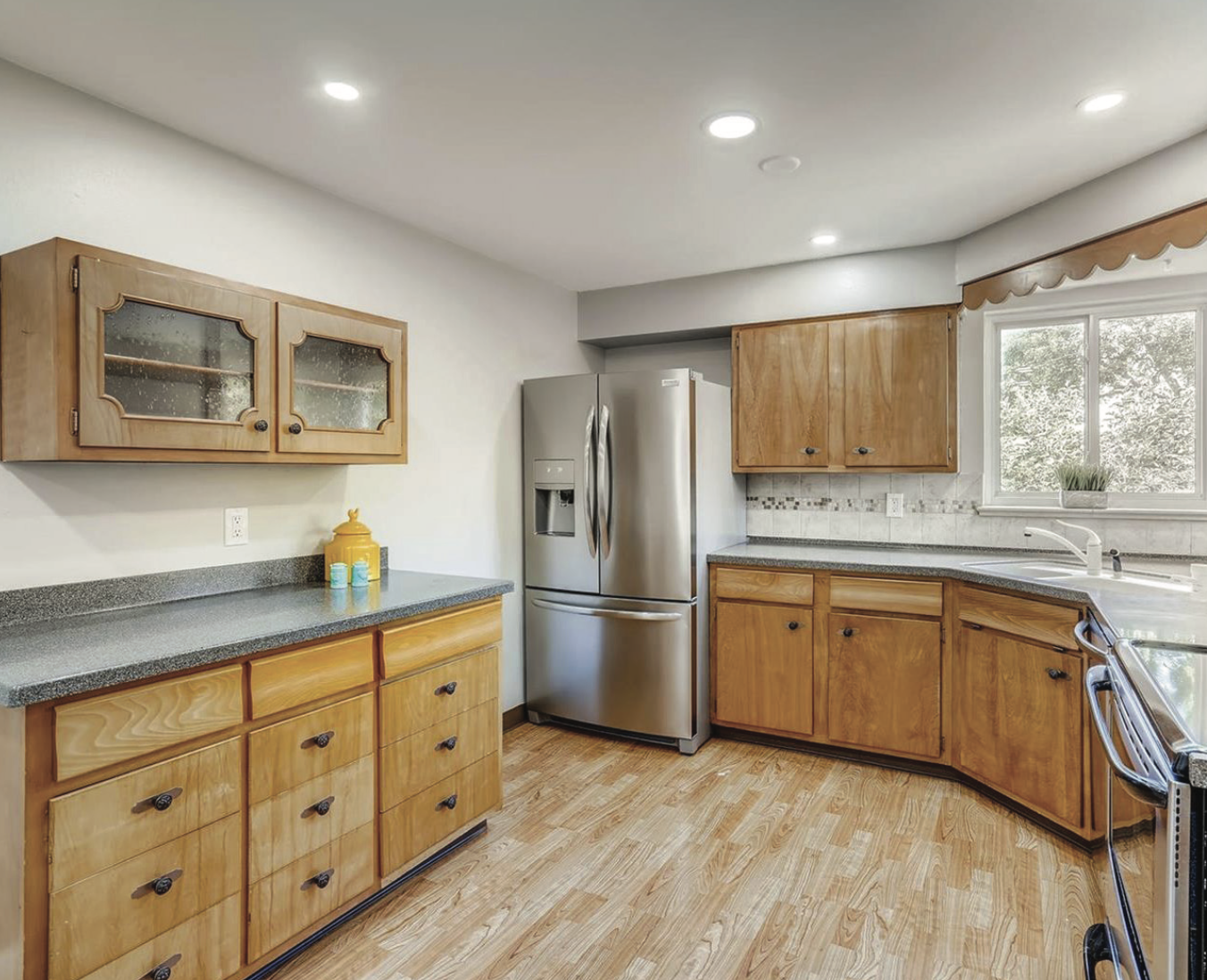
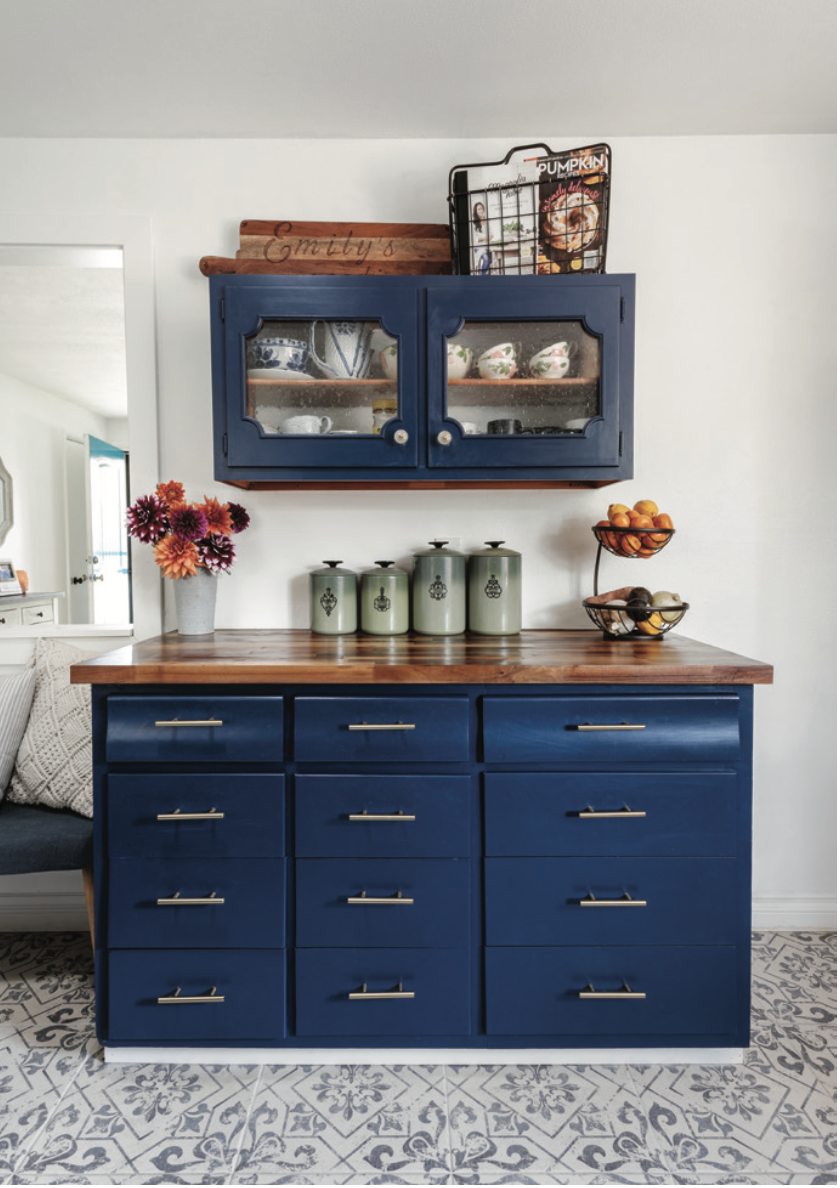
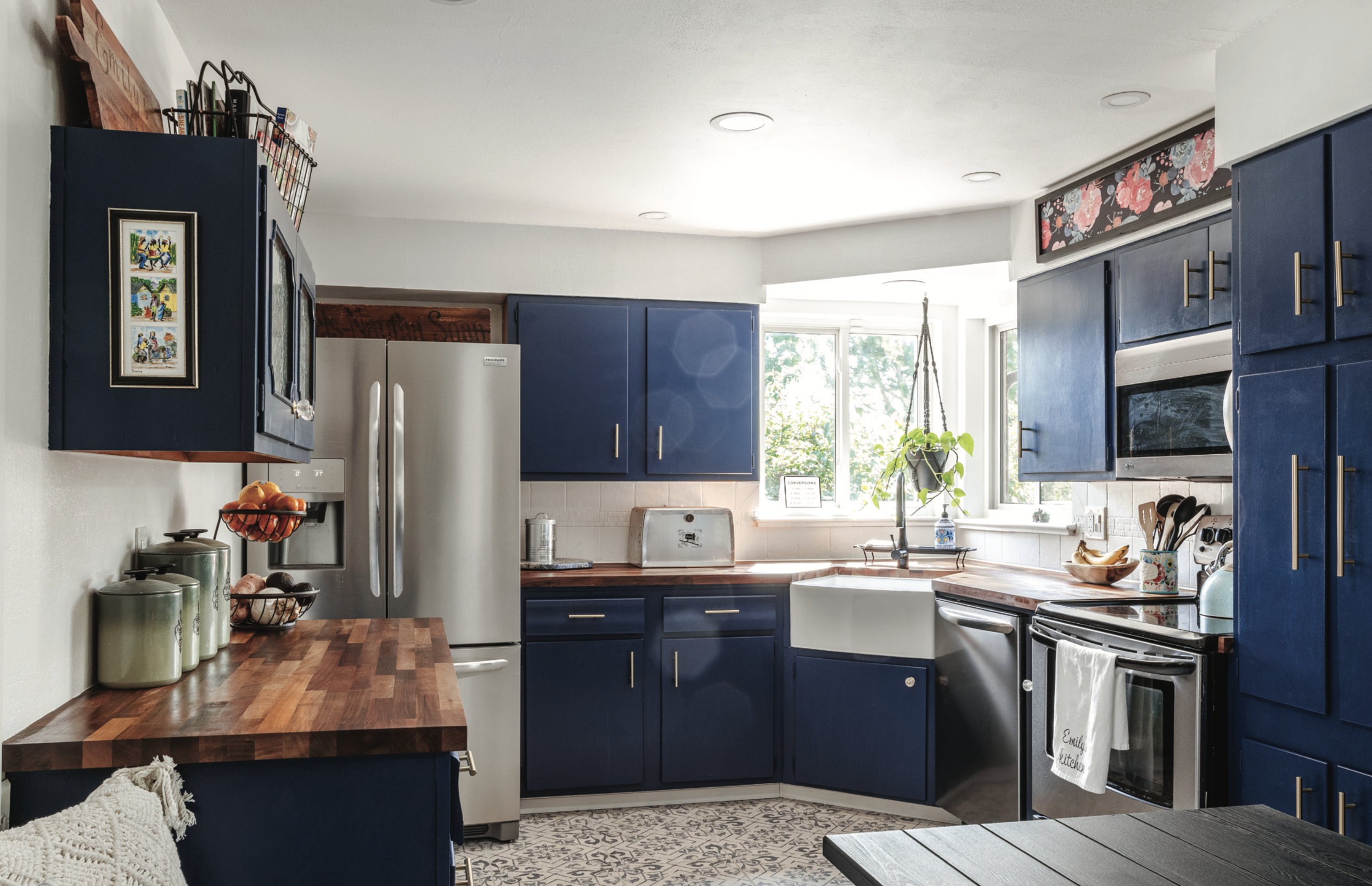
“When Lexie and I bought our house last year I was in love with the original cabinets in the kitchen, as well as the corner window by the sink and the giant window in the dining area," Said West + Main agent Emily Hayduk. "Adding thick wood butcher block counter tops, a large tile design for the floor, and painting the cabinets a deep navy blue with gold hardware, along with a deep apron front sink and black faucet completely transformed the heart of our home! I love when people tell me my house is comfortable and livable – I want it to be welcoming and not feel like a showpiece!

Our fave special touch: the canisters and the metal bread box were Emily's Grandma's (the original Lexie!)

EMILY'S KITCHEN

LABOR - SINK + COUNTER INSTALL - $1,250

FLOORING AND WALL DEMO AND FINISHING - $2,200

MISC MATERIALS (BRUSHES, NAILS, FLOOR TRIM, ETC.) - $500

LARGE CERAMIC TILE – HOME DEPOT0 - $540

WHITE WASHED WOOD FOR WALL – HOME DEPOT – WEABER 4X4 WHITE WASH WEATHERED BOARDS - $33.50

BUTCHER BLOCK SLABS IN EUROPEAN WALNUT – HOME DEPOT – $600

VERY NAVY BEHR PAINT FOR CABINETS – HOME DEPOT - $42/ GALLON

GOLD KNOBS AND PULLS – HOBBY LOBBY - $60

FARMHOUSE SINK, FAUCET + HANGING DINING LAMP – WAYFAIR - $500

PROJECT TOTAL: $5,859


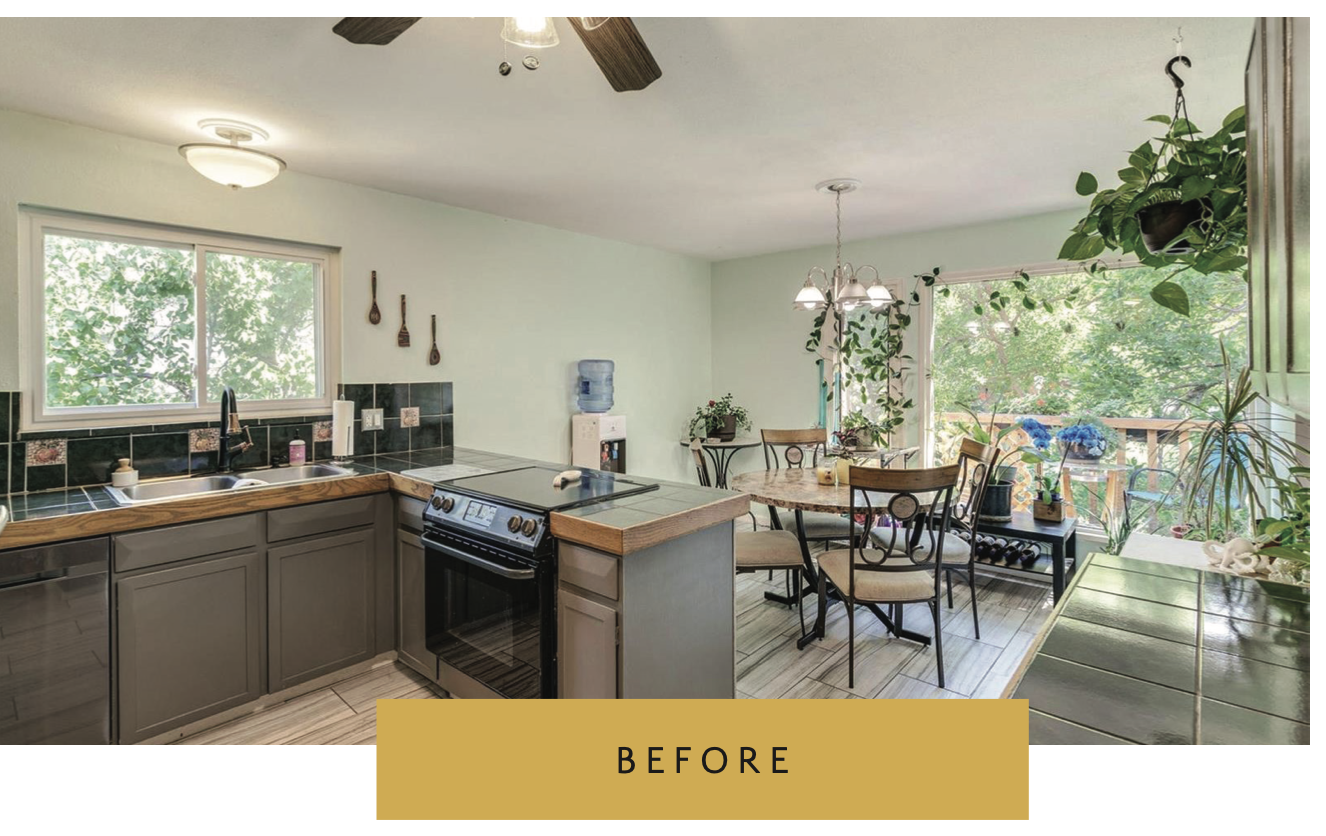
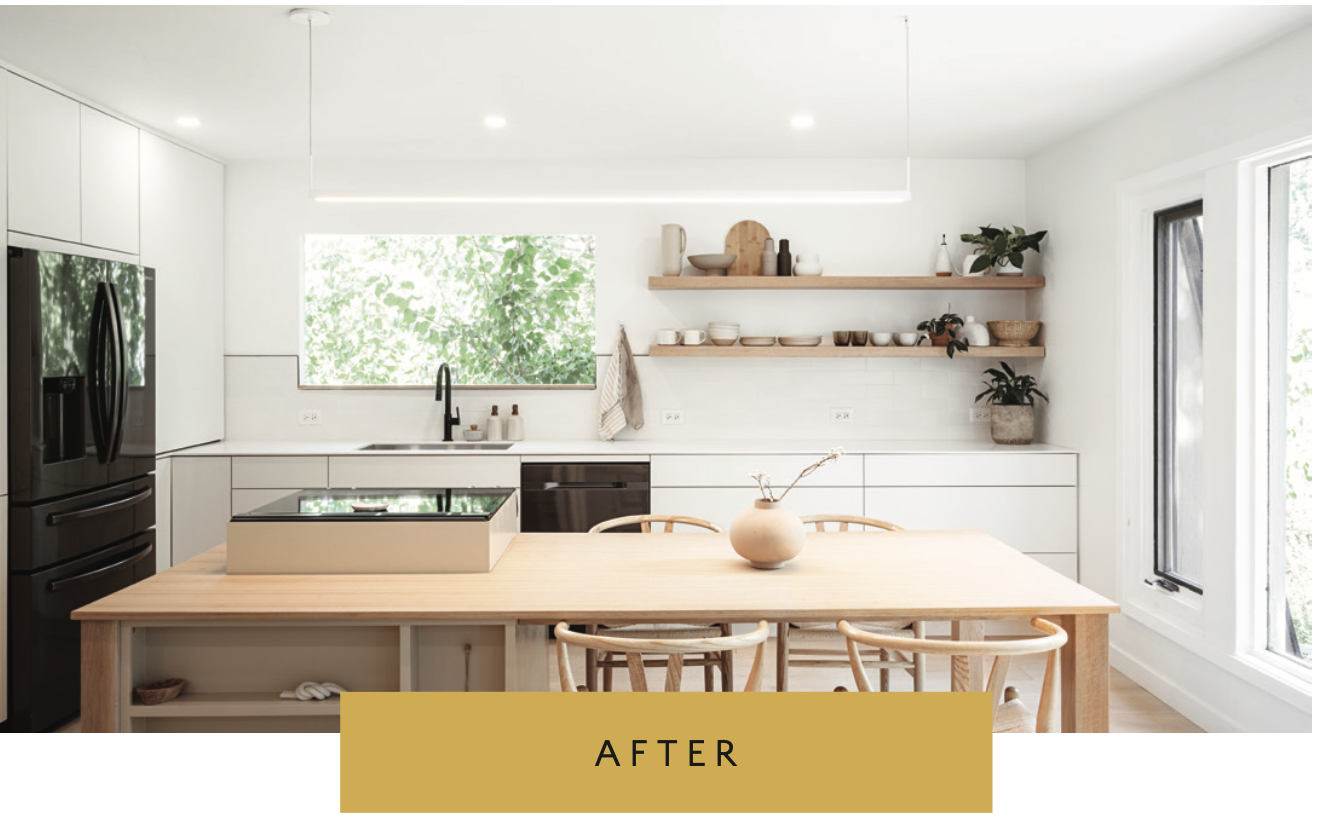
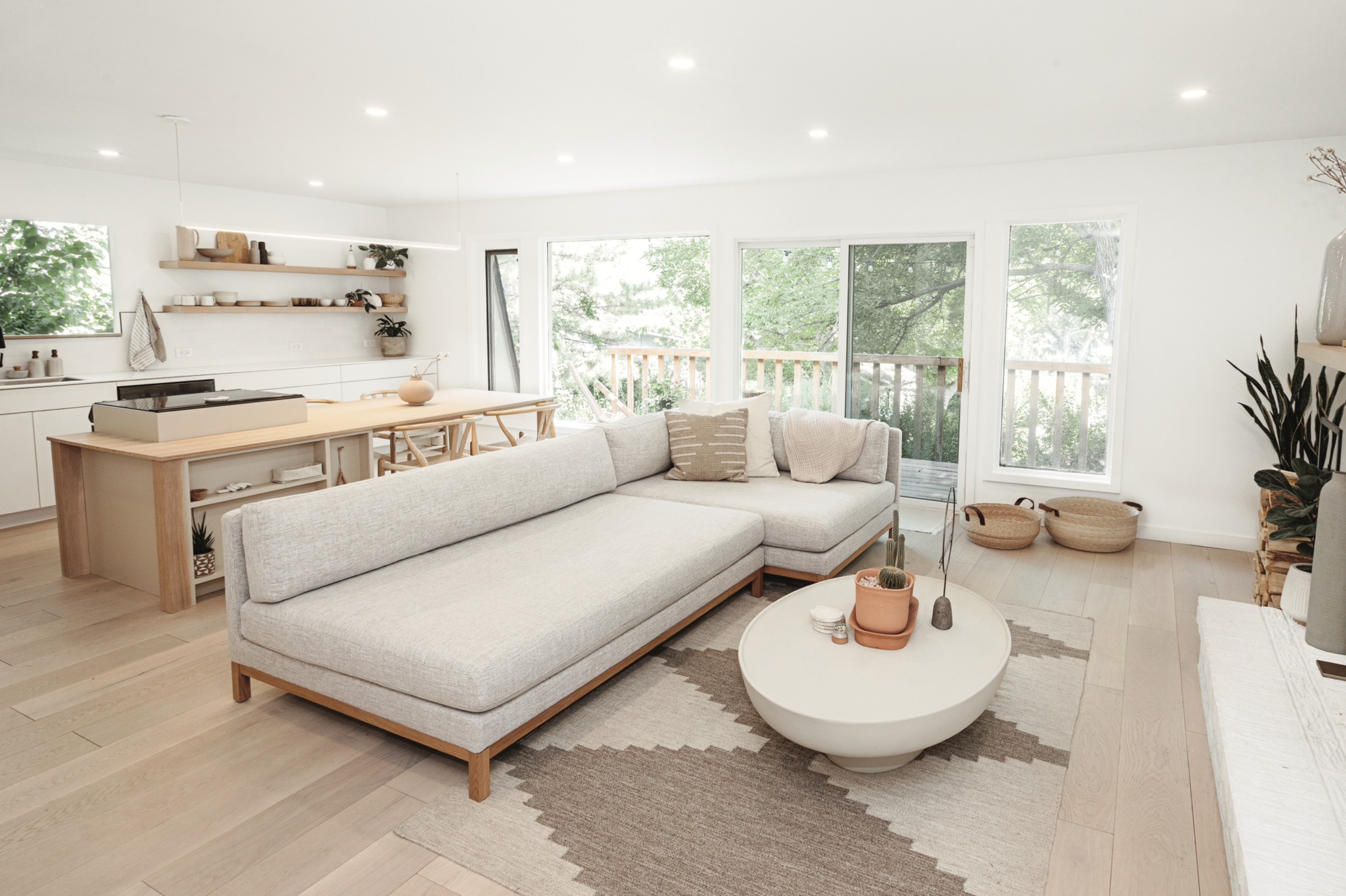
Chad Green purchased his home with the help of West + Main agent Joy Opp and had a pretty clear vision of what he wanted almost immediately.

"I wanted the main living and kitchen space to be beautifully integrated and to have a seamless flow for how we would live and function in our day to day lives," said Chad. "There were large windows in place that brought in so much of the outdoors and I wanted to play off of that so that it all felt connected."

Building the table that seconds as an island, the floating kitchen shelves and a fireplace mantel from light woods, Chad then added green plants of different varieties and sizes to help with visual connectivity.

"I put a lot of effort into all of the little details, as I wanted to find pleasure in all the time and activity taking place in our home," explained Chad. "It’s wonderful knowing each design decision, furnishings selection, etc. was thoughtful and intentional – smaller parts that made up the greater whole. I plan on raising my children here so this all had way more to do with creating the space we wanted to live and create memories in as opposed to making decisions based on future retail value."

Above: Before and after of Chad Green’s Kitchen + Living Space

If there is a home that you would like more information about, if you are considering selling a property, or if you have questions about the housing market in your neighborhood, please reach out. We’re here to help.

Search Homes in Colorado

Search Homes in Oklahoma

Search Homes in Oregon