Avoid These 6 Mistakes When Upsizing to a New Home

 
olga-subach-XbqRB4E-iH4-unsplash.jpg
 

Tired of having your already cramped bedroom do double duty as a home office and at-home gym?

It might be time to upsize. But while getting more space may seem enticing, upsizing can hold pitfalls for unwary home buyers.

“It is important to be aware of these mistakes because upsizing can be expensive, but if you plan it well, do your research, and shop around, it doesn’t have to be,” says Lior Rachmany, founder and CEO of Dumbo Moving and Storage in New York.

Mistake No. 1: Rushing to buy a bigger home

You can’t stop fantasizing about bigger spaces, but take a break for a reality check. You don’t want to ditch your current dwelling without understanding the market and thinking things through.

“Although the frenzy of the current real estate market creates motivation to move as quickly as possible, it is important to be diligent and thoughtful in your decision process,” says John Hollyer, senior portfolio manager at Bespoke Real Estate in New York. “Make sure you understand the market, comparable sales, and value of the house you may bid on. Your broker can assist with an analysis of sold properties and competing inventory.”

And in the rush, don’t get suckered into paying for any conveniences you don’t need, such as expediting certain services.

“A lot of times, when you want service to your old home or upsized home, you are paying more for speed,” says Rachmany.

Instead, allow yourself time to get those things done.

Mistake No. 2: Miscalculating your space needs

It’s important to be realistic about how much space you actually need.

“Assess your space in your current home, and what’s missing or necessary to improve upon it,” says Hollyer. It may turn out that the floor plan or your furniture layout is the problem, and not a lack of space. By the same token, make sure that space in a new home is laid out for maximum usability.

And once you move into that bigger space, live in it for a while, without buying extra furniture, to assess what pieces you really need, says Rachmany. He says furniture needs space to be used effectively, so you can move between pieces without squeezing through.  

“Also, plan your home for everyday use, not for special occasions. People have a habit of buying too much chairs and larger-than-needed sofas for company. But you can always use foldable chairs for that,” says Rachmany.

Mistake No. 3: Ignoring long-term factors

When making any major purchase, try to picture how your life might change in coming years.

“Buying a new home that won’t potentially fit your needs in the future will only lead to another purchase and move that could be avoided with proper forward thinking,” says Hollyer.

He says to make sure to have a realistic projection of how long you plan to stay in the new home, how your family’s needs might change in that time, and whether the home would continue to meet your requirements.

Another thing homeowners often forget is that upsizing brings extra costs that can snowball over time—bigger homes cost more to maintain. 

“Factor in for larger utility bills, and hav

Mistake No. 4: Disregarding financing

Make sure to do your homework on financing, and don’t go in blind when trying to buy a bigger (read: more expensive) home.

“Without accurate information regarding what you are qualified for, you’ll be wasting time,” says Hollyer.

Rachmany suggests leaving it to the experts if you aren’t well-versed in applying for loans or mortgages. Consider using a financial consultant and/or a mortgage broker—ask around for referrals.

“It is very easy to get screwed over by interest rates when applying for loans,” says Rachmany.

And while mortgage rates are at historic lows, experts say you should still compare financing options, which can vary considerably.

“Bigger homes mean larger property taxes, larger mortgage, and larger homeowner insurance,” says Rachmany. “Only upsize your home if you have the budget, realistically, for it.”

Mistake No. 5: Neglecting your current home

Don’t let maintenance of your current home fall by the wayside in your rush to upsize.

Rachmany suggests keeping up the maintenance of your home, and if something breaks, to fix it before you move out.

“In order to capture your current home’s peak value, you want to keep it in top condition,” says Hollyer. “Investing in routine and proactive maintenance of your current property is necessary to provide more value to you when it’s time to sell.”

Mistake No. 6: Spending too much on items for the new home

Upsizing to a new home doesn’t give you carte blanche to go crazy and overspend.

“People have an initial ‘hotel’ experience with their new home, where they leave all their lights on, and just really change their living at home habits and become more wasteful,” says Rachmany.

He suggests holding off on buying all new stuff. Instead, replace items when they break or are no longer usable.

“Extra space doesn’t always need extra items. You don’t have to fill up your kitchen counter with gadgets just because you have extra space,” says Rachmany. “See how much your living expenses change, then get extra items if needed.”

Read more on Realtor.com

Related Links

If there is a home that you would like more information about, if you are considering selling a property, or if you have questions about the housing market in your neighborhood, please reach out. We’re here to help.
Search Homes in Colorado

Search Homes in Oklahoma

Where do you move after selling in a hot market? To a smaller city

 
olivia-hutcherson-M6PkXg4q2uo-unsplash.jpg
 

Smaller cities for homeowners selling in a hot market to move to include Sioux Falls, Honolulu, Miami, Orlando and Baltimore.

Homeowners who sell in an overheated real estate market face a conundrum. Even though they often sell their homes for more than they ever imagined, they then struggle to find an affordable place to move.

But those questions have created a boom for small cities. Mortgage originations, or measure of completed mortgage loans, in smaller metros saw a jump in the first quarter, according to data from ATTOM Data Solutions, as homeowners cash in their houses and trade for more space and better remote working conditions.

The five cities that saw the largest number of mortgages originated for purchase included Sioux Falls, South Dakota, Honolulu and three locations in the Southeast.

“Rents are back up in many of these metropolitan areas,” said Todd Teta, chief product officer at ATTOM Data Solutions.

Cities with populations larger than 1 million that saw the biggest increase in first-quarter mortgage lending were nearly all Sun Belt locations: Orlando and Miami, Florida, Tucson, Arizona, and Nashville, Tennessee, along with Baltimore. Overall, ATTOM data found a first-quarter jump in mortgage originations in 85 of 211 metro areas.

With the new census, both California and New York lost seats in the House of Representatives. The Brookings Institution said the decennial census data revealed a continuation of the southward migration that has been underway for the past half-century.

In 1970, the Sun Belt states comprised just under half the country’s population. Today, that has risen to 62 percent, a 14 percentage point increase. This increase was roughly split between the South and the Western regions, while the share of population in the Midwest and the Northeast fell.

Experts say it’s no coincidence that the labor market is also gyrating through an abnormal level of volatility.

Keep reading.

Related Links

If there is a home that you would like more information about, if you are considering selling a property, or if you have questions about the housing market in your neighborhood, please reach out. We’re here to help.

Search Homes in Colorado

Search Homes in Oklahoma

5 Questions to Ask Yourself If Decluttering Is a Struggle

In The Afrominimalist's Guide to Living with Less, author Christine Platt explores what our past can teach us about letting go.

So much of who we are and how we behave or respond to certain situations is rooted in our childhood.

Whether it's always looking for a deal, our innate response to stock our pantries because we grew up with food scarcity, or even conforming to gender roles, the behaviors and experiences from our childhood often inform our adult spending habits. What we watched, were told, and learned from our caregivers and community often has a profound impact on our relationship with money and how we spend it.

Often, we are unaware of how these experiences impact our lives on even the smallest levels. One of the stories I like to share that underscores just how deeply our childhood influences our adult behaviors involves one of my friends and her dear husband, who has an affinity for using a lot of dish soap when he washes the dishes. To protect their identity, even though there is no shame in any of our childhood stories-we did not choose our caregivers-let's call this wonderful couple Mary and Brian.

One day, as Mary and I engaged in conversation about the husbands we loved but who annoyed us so much, she shared, "I just walked past the kitchen and Brian is in there washing dishes. Girl, the bubbles are literally overflowing out of the sink! I just don't know why he has to use so much dish soap and make such a mess!"

Ever the friend who equally complained about such trivial matters, I laughed. "Well, at least he's doing the dishes!"

"Seriously," Mary said. "He's been doing this ever since we got married. It's so annoying and unnecessary."

Upon realizing this was a true sore spot for her, I inquired, "Well, have you ever asked him why he does that?"

A few days later, she told me that she did indeed ask Brian about his obsession with dish soap bubbles and was moved to discover why. Although he was now successful and quite wealthy, Brian had grown up poor. Raised by his grandmother in the Deep South, most of their household items were purchased at dollar stores and, even then, had to be used in moderation.

Whenever Brian washed the dishes, his grandmother only let him use minuscule amounts of dish soap, just enough to clean the dishes and never enough to make bubbles. So, now that he is an adult, he buys the best dish soap and enjoys making as many bubbles as he wants. Whereas my friend Mary sees a mess, Brian finds fulfillment in bubbles overflowing out of the sink, and enjoys an experience he longed for but never got to delight in as a child.

As you begin the self-discovery of learning about why you have more than you need, think about how your childhood experiences may have knowingly or unknowingly influenced your behaviors.

Think about what your caregivers determined were necessities and how they went about both acquiring and managing them. Consider how they prioritized their spending to meet your family's needs versus fulfilling their personal wants. Reflect on how your circumstances with abundance or scarcity may be influencing your current decisions.

5 Questions to Ask Yourself:

What Did I Learn About Spending and Saving as a Child?

  1. Was money-spending and saving-talked about openly in your home? If so, was the discussion healthy or a source of contention?

  2. Did you receive an allowance? If so, did you have to "earn it" or was it given freely?

  3. How did your family celebrate milestones and key achievements? Were you rewarded with money, gifts, or non-tangible affirmations?

  4. What did your family do for fun? Which experiences were considered regular activities, and which were considered "a treat"?

  5. Can you identify unmet needs and desires from your childhood? If so, how have they shown up in adulthood and/or in what ways do you find yourself seeking to resolve them?

Credit: Simon & Schuster

Adapted from THE AFROMINIMALIST'S GUIDE TO LIVING WITH LESS by Christine Platt. Copyright © 2021 Simon & Schuster, Inc. Reprinted by permission of Tiller Press, a Division of Simon & Schuster, Inc.

Screen Shot 2021-07-15 at 5.25.37 PM.png

Related Links

If there is a home that you would like more information about, if you are considering selling a property, or if you have questions about the housing market in your neighborhood, please reach out. We’re here to help.

Search Homes in Colorado

Search Homes in Oklahoma

The National Western Stock Show announces dates for its 2022 return

Grab your Stetson. We’re going to the rodeo.

The National Western Stock Show on Wednesday released its January 2022 dates after being canceled this year due to the pandemic.

The 115th edition will return to Denver starting on Jan. 8 and run through Jan. 23. It will reopen with some new digs, including the newly-constructed Cille and Ron Williams Yards, which will be 20 acres and provide space for cattle, bison, yaks, longhorns and other livestock. Next year will also mark the grand opening of a new 46,000 square-foot HW Hutchison Family Stockyards Event Center, a new events center with auction and show arenas.

The two are part of the National Western Center redevelopment project, which is prompting some backlash from people who live nearby. The project has been in the works for years, and parts of it had to be paused last year after a dip in lodger’s tax revenue caused by the pandemic.

Tickets for the 2022 National Western Stock Show go on sale starting on Sept. 18.

Subscribe to Denverite!


Related Links

If there is a home that you would like more information about, if you are considering selling a property, or if you have questions about the housing market in your neighborhood, please reach out. We’re here to help.

Search Homes in Colorado

Search Homes in Oklahoma

Just Listed: Spectacular Contemporary Mountain Home in Tabernash

 
63 GCR 864.Hillside Dr-fb.jpg


Designed to leave you in awe around every turn, this spectacular home sets a new standard in mountain living.

Sleek contemporary comforts have been expertly combined with rustic touches to create a unique and character-filled home that is as warm and inviting as it is stylish. Inside features 4 bedrooms, plus office, 3.25 baths & 3 oversized living areas. The main living area boasts tall ceilings overhead and large windows. The open kitchen was remodeled in 2019 complete with quartz countertops, stainless steel appliances, a farmhouse-style sink and premium fixtures. A wrap-around deck provides the perfect place where you can relax in the shade, soak up the sunshine or host guests as you admire the sensational mountain views. See document section to read about the updates.

Sitting on picturesque acre of land in the heart of Grand County. World-class skiing, golfing, and biking out your front door is at your fingertips. Grand Lake, Lake Granby and Rocky Mountain National Park are all a short drive away. The exterior siding is cedar wood, treated with a lifetime coating and the corrugated metal is fire resistance. Both features make this home a low maintenance home.
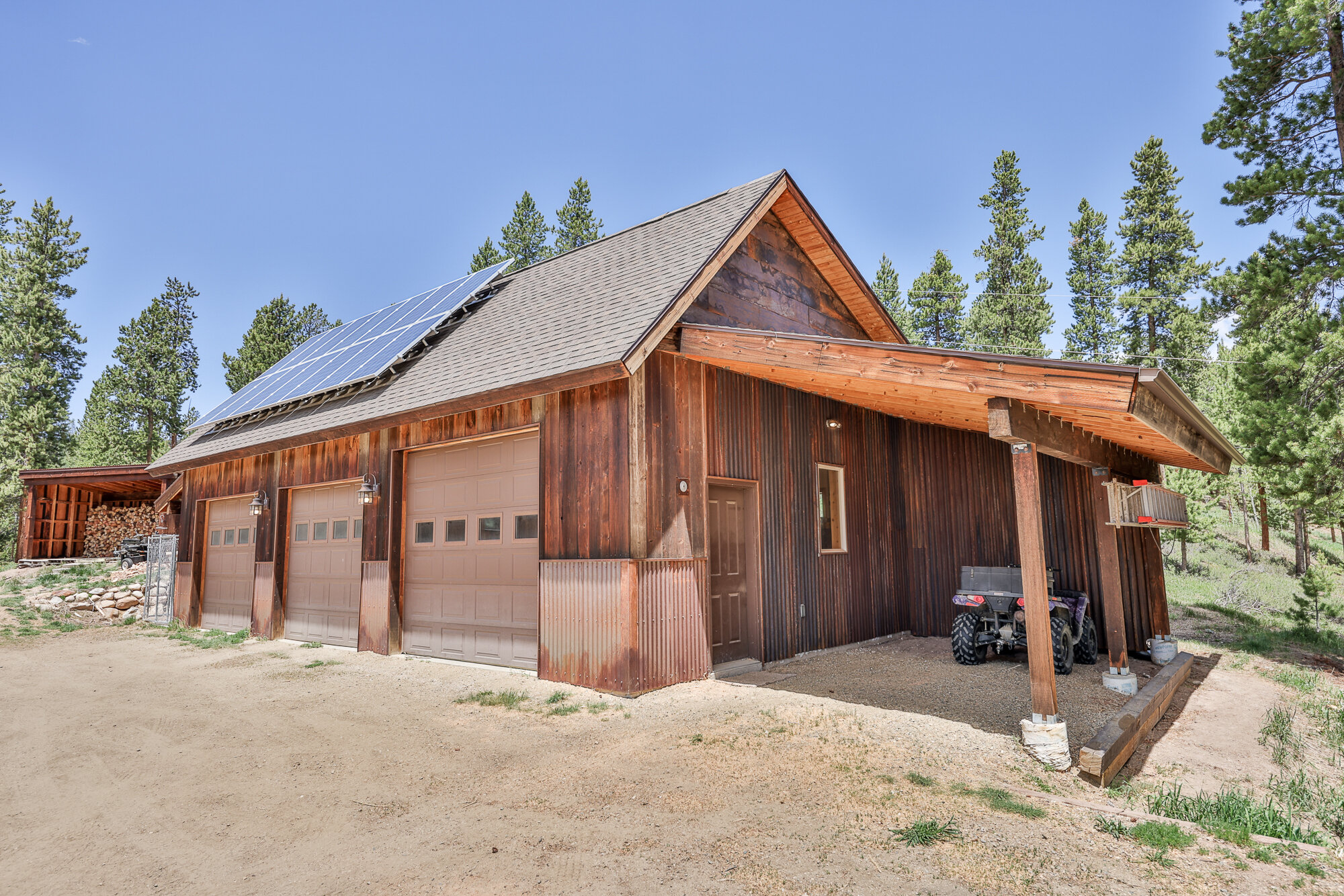
The list of additional features is long and impressive as it includes a large mudroom with custom cubbies, a solar panel system, a three-car garage, and two additional carport areas providing ample sheltered vehicle storage. To top that there is a built-in kennel, garden area, she shed, ATV parking, an area for RV parking, an extra shed on the property, an outdoor hot tub and a woodshed.

Listed by Leah Bishop for West + Main Homes. Please contact Leah for current pricing + availability.


Have questions?
West + Main Homes
(303) 935-8787
hello@westandmainhomes.com

Presented by:
Leah Bishop
(970) 531-4723
leahbishop@westandmainhomes.com


Search homes in Colorado