How to Spot Foundation Issues in an Old Home


It's no secret that older homes often come with a variety of issues, from outdated plumbing and electrical problems to structural issues.

One of the most common issues faced by homeowners of older homes is foundation problems. But how can you tell if your home has foundation issues? In this blog post, we'll take a look at some of the warning signs that may indicate a problem with your home's foundation.

Signs of Foundation Problems
One of the most obvious signs of foundation problems is visible cracks in the walls, floors, or ceilings. If you notice any large or unusual cracks, it's important to have them professionally inspected as soon as possible. You should also be on the lookout for any signs of sagging floors or sloping walls, which could indicate an issue with the underlying structure. Other warning signs include doors and windows that are difficult to open or close and floors that feel uneven when walked on.

Pay Attention to Changes
It's also important to pay attention to any changes in your home's exterior appearance. If you notice any areas where the ground has shifted or sunken, this could be an indication that there is an issue with your home’s foundation. Additionally, if there are any water stains on your walls or flooring, this could be a sign that moisture is getting into your home and causing damage to the structure.

How to Repair Your Home's Foundation
If you suspect that there may be an issue with your home's foundation, it's best to have it checked out right away by a professional who specializes in foundation repair and structural repairs. A qualified technician will be able to assess the situation and determine what repair work needs to be done in order to ensure your home remains safe and secure for years to come.

Foundation problems can quickly become serious if left unchecked, so it’s important for homeowners of older homes to keep an eye out for potential issues before they become too costly and time-consuming to fix. Keep an eye out for visible cracks in walls, floors, and ceilings. 

Look for sagging floors, sloping walls, difficult-to-open doors and windows, unevenly felt floors, shifted ground outside, water stains inside, and other changes in appearance inside and outside the house—all of these could potentially signal an issue with your home’s foundation that requires immediate attention from a professional contractor. 

By being proactive about monitoring these warning signs you can save yourself time and money down the road.

Learn more in RISMedia.

Related Links

If there is a home that you would like more information about, if you are considering selling a property, or if you have questions about the housing market in your neighborhood, please reach out. We’re here to help.

Search Homes in Colorado

Search Homes in Oklahoma

Search Homes in Oregon

What Do I Need to Do with My Property Tax Bill?


Each year, regardless if you escrow your property taxes, you will receive a copy of your tax bill.

This is for your records and does not need to be paid by you. This is the responsibility of your loan servicer. While the county will update your account once they have processed your payment, this can take time.
One of the best ways to see if your property taxes have been paid, is to check your monthly mortgage statement. Generally, escrow account balances will be noted on the bottom of your statement and once paid, you will see a reduction indicated.

If it happens that your property taxes increase, you will get notification. You can then choose to pay the difference in full, or you can escrow the payment out over the course of the year.

If you do not escrow, and instead you are paying your property taxes in two installments:

  • The due date for the first half of your property taxes is February 28, 2023.

  • The due date for the second half of your property taxes is June 15, 2023.

If you are paying your property taxes in full, the due date is May 1, 2023, due to the statutory due date of April 30, 2023 falling on a Sunday.

Thank you to Molly Manley at Streamline Home Loans for providing this information!

If you ever have questions, always feel free to reach out to one of our trusted loan officers at Streamline Home Loans.

Related Links

If there is a home that you would like more information about, if you are considering selling a property, or if you have questions about the housing market in your neighborhood, please reach out. We’re here to help.

Search Homes in Colorado

Home Design Ideas That Will Change the Way We Decorate in 2023


A forecast led by interior designers with a pulse on trends that will be shaping the upcoming year, and beyond.

With the pandemic somewhat in the rearview mirror, mainstream designers and TikTok creators alike are predicting that home decor will take on an optimistic turn filled with vibrant colors and sustainable DIY projects, all the while maintaining a love for nature-inspired textures and accessories. 

While the soft green palettes are still trending, especially when it comes to kitchen cabinetspinks are coming in strong. Repurposed furniture is also having a moment with tutorials on transforming a dining table into a chic coffee table or building a plant enclave out of an apothecary cabinet. Perhaps one of the most exciting things about 2023 home design ideas is the mix of new and old design elements, a twist on the ever popular grandmillenial trend with a decidedly contemporary refresh. “2023 is taking us to a new level of design,” says Cleveland-based Ashleigh Clark, principal of Ashleigh Clark Interior Design Group. “We saw a neutral approach to design throughout the pandemic, creating homes that look like a Pinterest ad. People are now craving character and warmth. Personality driven decor is sweeping across the nation. Art that is personal, color that evokes a positive mood mixed with natural elements, are creating homes that feel cozy while adding plenty of character.” 

If you fear that the only way to embrace all of 2023’s home design ideas means parting with your current decor and starting from scratch—all the while draining your bank account—fear not. Many of next year’s best looks are easy to DIY, meaning you can exercise your creativity and save cash while making your space covetable and conversation-worthy. The following 31 home design ideas are just too good to ignore. 

1. Infuse decor with warm wood tones 

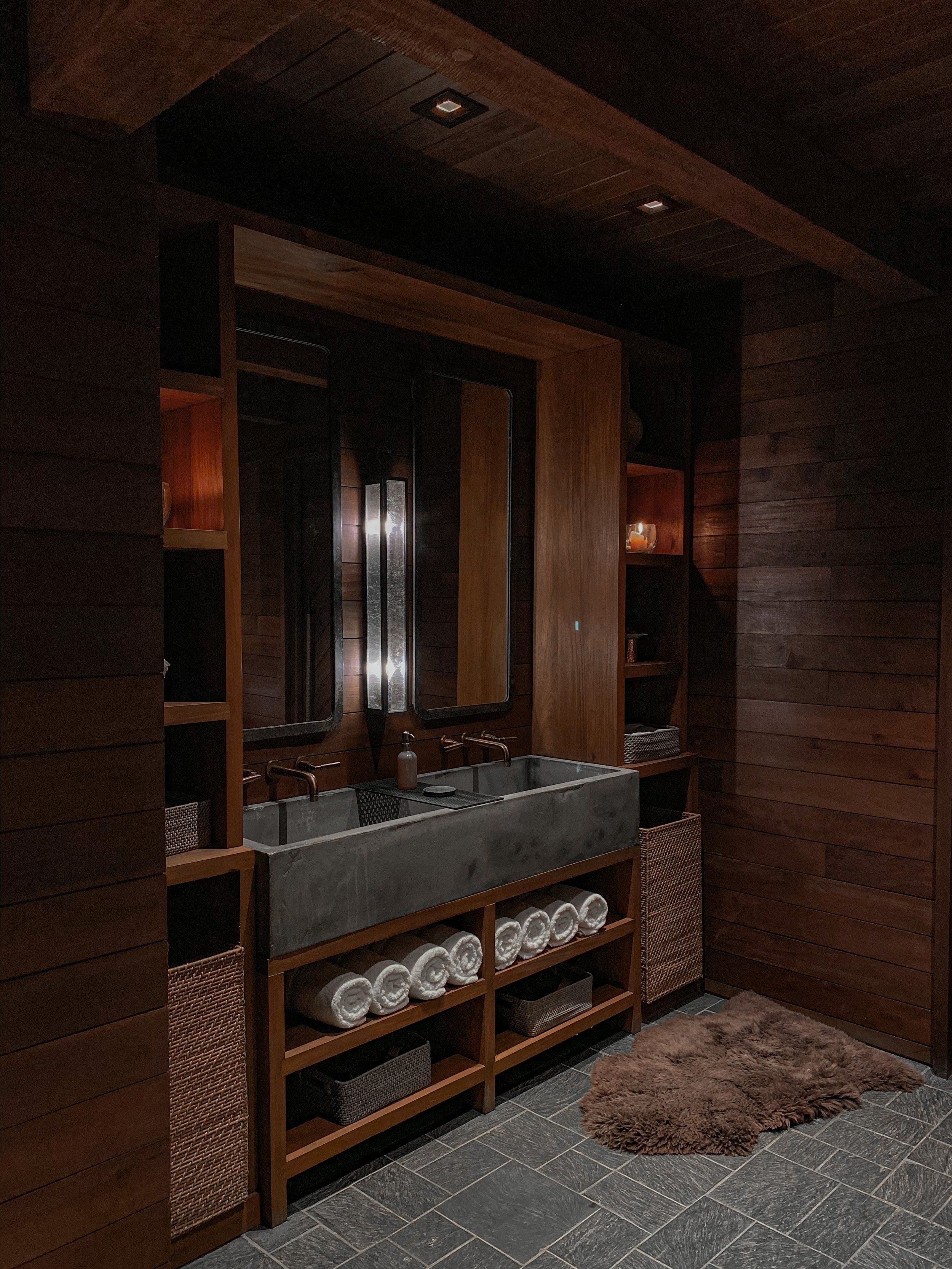
Warm wood is making a comeback, notes designer Lindye Galloway of Lindye Galloway Design Studio and Shop, based in Costa Mesa, California. “Wood can bring warmth, depth, and an intimate feel that creates a serene scene,” she says. Galloway particularly enjoys incorporating it into the ceiling and vanity pieces in the bathroom. “This can especially help with an all-white bathroom where you want to keep it light and bright but have that warm feeling,” she adds. On a smaller scale, consider DIY’ing a warm wood frame for an existing mirror that could use an upgrade, or swapping builder-grade metal drawer pulls with stylish wooden options

2. Add a fashionable influence to bedrooms

When formulating a vision for this bedroom, which was featured in the 2022 Brooklyn Heights Designer Showhouse, New York designer Tara McCauley was inspired by fashion designer Elsa Schiaparelli, who lived in Paris at the peak of the Art Deco and Surrealist movements. “The draped canopy above the bed certainly doesn’t echo the streamlined, machine-inspired forms of the Art Deco period, but I wanted to juxtapose the rectilinear headboard and bedside lamps with something soft,” McCauley explains. “The canopy feels a bit more Hollywood Regency than Art Deco, but it takes just one look at film sets from Hollywood’s Golden Age to see how those two styles are closely entwined.” DIY a canopy of your own—no matter your preferred aesthetic—with these designer tips. 

3. Pantries continue to reign

Pantries that prioritize function and maximize storage are something we’ve grown to appreciate even more in recent years. “If being under quarantine at home revealed anything during the pandemic, it’s how to become more organized,” explains Houston-based Sherrell Neal of Sherrell Design Studio. “The pantry is not just a junky storage room of dry goods, it’s how we plan meals, sort food groups, and make shopping lists. It’s really become an extension of the kitchen space.” Neal anticipates that we will continue to see an emphasis on pantry organization and design into the new year. 

4. Mix and match old with new

Styling antique finds alongside contemporary furnishings will never go out of style, says designer Joshua Smith of studio Joshua Smith in New York. “The thrill of combining these items is incorporating modern pieces into more traditional spaces, or vice versa,” says Smith who suggests by tossing in a French Louis chair into a modern space. Just don’t go overboard by adding too many periods into one room. “It brings confusion to the energy of the space,” he continues. “Think about common threads between the objects, like color, texture, shape.” 

5. Say yes to plaster

Take the walls and ceilings to the next level with the addition of a plaster finish. “Plaster is making a comeback along with all other natural surfaces because of the character it adds to a space and the character that it adds over time as it lives in a space,” explains interior designer Katie Paulsen of Maestri Studio in Dallas. “Even in its most polished state, it adds a comfort that can’t be achieved with faux looks.” Not ready for a major revamp? Incorporate plaster fireplace surrounds, chandeliers, and side tables into your home, Paulsen suggests. “Its versatility allows us to use it in so many different ways,” she adds. “We’re predicting that it will be making an appearance just about everywhere.” 

6. Go bold in the kitchen

The phasing out of the all-white kitchen continues. And the penchant for color is visible in coating cabinets in bold, unexpected hues. Grab that paint brush and get to it. “Rich cool tones, such as peacock or royal blue as well as emerald green, are colors that create a stunning contrast when combined with the quartzite and marble options,” notes Jerad Gardemal of JF Gardemal Designs in Baton Rouge. “You have two beautiful elements that are distinct alone, but when combined make a grand statement.” High gloss and lacquer finishes further emphasize the jewel-like kitchen spaces.

7. Get artsy with statement light fixtures 

Say goodbye to the standard-looking light fixtures and opt for something that makes a statement instead. “Although popular in the last decade, traditional lanterns and pairs of lanterns have become mundane,” Gardemal says. “Improvements in both the design and technology of multi-point lighting make them much easier to work with,” he adds. “You now have the ability to experiment with globe styles, heights, and finishes to create a truly custom statement.”

8. Rethink bathroom walls and floors 

If your bathroom floors or walls need a facelift, plan to go retro with hexagons, rhomboids, and circles, Gardemal advises. “These tile shapes have made appearances for hundreds of years and though the shapes aren’t new, the variety of tile sizes available has given them a refresh,” he explains. Opt for tiles with combos of white, gray, and black to nail that classic vintage aesthetic. Alternatively, try larger tiles paired with patterned accent tiles boasting touches of metallics and iridescent glazes

9. Consider Trompe-L’oeil

Make like designer Nick Olsen and add major wow-factor to your home by incorporating patterns and furnishings that deceive the eye. Take a peek inside his Dutchess County, New York, home to get inspired by clever takes on wall coverings, textiles, and floor designs that go way beyond the basic. 

10. Stencil floors 

While stenciling tile is nothing new, creators are steering away from the overdone encaustic tile patterns in grey, black, white and blue and experimenting with contemporary motifs. “Choose starkly contrasting colors for a crisp and fresh look,” suggests Annie Sloan, paint and color expert based in Oxford, England, and creator of Chalk Paint, who has utilized household objects including cereal bowls and magazines to create one of a kind stencils. “These simple shapes look fabulous in block bright colors. Pastel square shapes reference ’50s diners, perfect for grandmillennial interiors, while curved designs reference Vernor Patton and ’60s cool.” 

See the full list on Architectural Digest.

Related Links

If there is a home that you would like more information about, if you are considering selling a property, or if you have questions about the housing market in your neighborhood, please reach out. We’re here to help.

Search Homes in Colorado

Search Homes in Oklahoma

Search Homes in Oregon

Here’s Why Your Bedding Doesn’t Seem to Fit Quite Right


Is there anything worse than a loose fitted sheet or a not-quite-full duvet?

I mean, of course there is, but ill-fitting bedding is something that drives me wild. You would think all bedding would have standardized sizes, since most mattresses conform to prescribed lengths and widths, but that’s not the case. When purchasing sheets, duvets, and other bed linens, it’s important to get a good fit because it translates into a more comfortable sleep. Watch out for these sizing issues when shopping for sheets and other bedding:

Bedding base layers

Too-large fitted sheets and mattress protectors are a common problem because mattresses come in a variety of depths. Some bedding manufacturers acknowledge this and offer their products in different depths; for example, The Company Store sells mattress pads in 11-inch deep and 18-inch deep sizes. If you have a particularly plush mattress, be on the lookout for pads that can accommodate your depth, and if you have a particularly thin mattress (especially low-profile mattress, like those sold for bunk beds), it’s best to avoid anything with especially generous dimensions.

When buying sheets, be very careful when you take the sheet out of its packaging, and make note how it was folded. Try it on your bed before washing to ensure a good fit. If it’s a little baggy, immediately refold it following the creases and put it back in the packaging. Take it from me: It probably won’t shrink down to the proper size, so you should find something else. 

Duvet covers

Duvet covers of all bed sizes are often mysteriously oversized. I assume this is because the manufacturers are trying to accommodate the fluffiest of down comforters and account for possible shrinkage, but I’d rather a slightly too small duvet than one with a limp border of fabric around the edges any day. (I’m not alone in this preference; I once even interviewed a blogger who told me she used a king duvet insert in her queen duvet cover because she preferred a full duvet, and this is a great hack if you feel the same way!) 

Another culprit in the category of misfit duvets is the attempt to create full/queen products. Full (or double) beds and queen-sized beds are close in size at 53 inches by 75 inches and 60 inches by 80 inches, respectively, so many manufacturers offer one size duvet for both, often labeled as “Full/Queen.” In terms of comfort, the one size will probably feel fine on either bed, but it can result in ill-fitting duvet covers down the road. If you want a better, close fit, measure the duvet you have and shop for ones that match your dimensions. You can also avoid this issue altogether by going with a comforter versus a duvet, but, of course, washing it will then be a more frequent chore.

If your problem is a too-long duvet and you have a sewing machine handy, you can remove the excess inches on the non-buttoned short end fairly easily. All you need to do is turn the cover inside out, sew a straight line where you want to cut it off, and then trim the excess fabric. A dry cleaner can also do this for a small fee (Mine charged just $12 for an XL twin duvet she whittled it down to a regular twin size).

Twin versus XL twin and king versus California king

Twin and king bedding can be particularly complicated because of the alternative but close sizing situation. Some brands try to say their bedding fits both models of twin or king mattresses, but it’s a much better idea to buy bedding specifically designed for either a standard twin/king or XL twin/California King, especially when it comes to fitted sheets. Read the descriptions carefully and check the measurements: A regular twin is 38-inches by 75-inches, and an XL twin is 80-inches long; a regular king is 76-inches by 80-inches, and a California King is 84-inches long. Bigger is definitely not better when it comes to bedding!

European brands

Another place I’ve run into trouble in the past is with European bedding brands. I once ordered what was meant to be a twin duvet from the Danish brand HAY, and it was comically large — almost big enough for my queen-sized bed. In Europe, all the bed sizes are different, and it can be confusing trying to find the right fit for your American bed. When in doubt, always go back to the measurements.

Get more like this on Apartment Therapy.

Related Links

If there is a home that you would like more information about, if you are considering selling a property, or if you have questions about the housing market in your neighborhood, please reach out. We’re here to help.

Search Homes in Colorado

Search Homes in Oklahoma

Search Homes in Oregon

Why Today’s Housing Market Isn’t Headed for a Crash


67% of Americans say a housing market crash is imminent in the next three years.

With all the talk in the media lately about shifts in the housing market, it makes sense why so many people feel this way. But there’s good news. Current data shows today’s market is nothing like it was before the housing crash in 2008.

Back Then, Mortgage Standards Were Less Strict

During the lead-up to the housing crisis, it was much easier to get a home loan than it is today. Banks were creating artificial demand by lowering lending standards and making it easy for just about anyone to qualify for a home loan or refinance an existing one.

As a result, lending institutions took on much greater risk in both the person and the mortgage products offered. That led to mass defaults, foreclosures, and falling prices. Today, things are different, and purchasers face much higher standards from mortgage companies.

The graph below uses data from the Mortgage Bankers Association (MBA) to help tell this story. In this index, the higher the number, the easier it is to get a mortgage. The lower the number, the harder it is.


This graph also shows just how different things are today compared to the spike in credit availability leading up to the crash. Tighter lending standards have helped prevent a situation that could lead to a wave of foreclosures like the last time.

Foreclosure Volume Has Declined a Lot Since the Crash

Another difference is the number of homeowners that were facing foreclosure when the housing bubble burst. Foreclosure activity has been lower since the crash, largely because buyers today are more qualified and less likely to default on their loans. The graph below uses data from ATTOM to show the difference between last time and now:


So even as foreclosures tick up, the total number is still very low. And on top of that, most experts don’t expect foreclosures to go up drastically like they did following the crash in 2008. Bill McBride, Founder of Calculated Risk, explains the impact a large increase in foreclosures had on home prices back then – and how that’s unlikely this time.

“The bottom line is there will be an increase in foreclosures over the next year (from record level lows), but there will not be a huge wave of distressed sales as happened following the housing bubble. The distressed sales during the housing bust led to cascading price declines, and that will not happen this time.”

The Supply of Homes for Sale Today Is More Limited

For historical context, there were too many homes for sale during the housing crisis (many of which were short sales and foreclosures), and that caused prices to fall dramatically. Supply has increased since the start of this year, but there’s still a shortage of inventory available overall, primarily due to years of underbuilding homes.

The graph below uses data from the National Association of Realtors (NAR) to show how the months’ supply of homes available now compares to the crash. Today, unsold inventory sits at just 2.7-months’ supply at the current sales pace, which is significantly lower than the last time. There just isn’t enough inventory on the market for home prices to come crashing down like they did last time, even though some overheated markets may experience slight declines.


Bottom Line

If recent headlines have you worried we’re headed for another housing crash, the data above should help ease those fears. Expert insights and the most current data clearly show that today’s market is nothing like it was last time.

Keep reading.

Related Links

If there is a home that you would like more information about, if you are considering selling a property, or if you have questions about the housing market in your neighborhood, please reach out. We’re here to help.

Search Homes in Colorado

Search Homes in Oklahoma

Search Homes in Oregon