Just Listed: New Home in Broomfield with Thoughtful Upgrades


Welcome home to Baseline, one of Broomfield’s newest communities!

Stunning 4 bed, 5 bath newly built David Weekley home without the wait! This turn-key home offers modern finishes, plenty of room for entertaining and tons of thoughtful upgrades throughout! Step inside to a bright and welcoming open-floor plan living with 10-foot ceilings. The kitchen boasts crisp white cabinetry, upgraded backsplash, a large quartz island with built-in sink and pantry closet. You will love cozying up by the living room fireplace on chilly Colorado nights before heading to the spacious and private first floor owner’s retreat, with a bathroom to die for and large adjoining dressing room. Head upstairs to find a flex space that could make an excellent home gym, library or secondary living room. From here, step outside onto the generously sized second story deck which serves as an amazing outdoor entertaining area which overlooks the community park and playground adjacent to the home. The fourth bedroom features lovely French doors and could make a roomy home office for all your work from home needs. All of the secondary bedrooms are sizable, one with an en-suite bathroom and both with oversized closets - plenty of room for everyone and everything! But wait … there’s more! Head upstairs to the huge loft with a powder bath, where you can really let your imagination soar! You will find ample storage space, black hardware, upgraded carpet, built-in garage storage, and so much more throughout this expertly built and designed home. Location is unbeatable with easy access to I-25 and the Northwest Parkway to get you anywhere you need to be quickly. Fully transferable home warranty. Close to schools, amenities, shopping, and grocery. Premium lot, low maintenance, low HOA! Don’t miss out on the opportunity to own this stunning home!

Listed by Shanna Rivkin for West + Main Homes. Please contact Shanna for current pricing + availability.


Have questions?
West + Main Homes
(720) 903-2912
hello@westandmainhomes.com

Presented by:
Shanna Rivkin
(732) 648-1246
shanna@westandmainhomes.com


Search homes in Colorado
 

Vail Valley Real Estate Market Report from April 2022


Vail Valley April 2022 Market Report is in!


If there is a home that you would like more information about, if you are considering selling a property, or if you have questions about the housing market in your neighborhood, please reach out. We’re here to help.

Search Homes in Colorado

Grand Lake, still reeling from East Troublesome fire, is being shaken again by mayoral recall over housing


Mayor Steve Kudron is the target of a recall election fueled by concerns over housing and keeping the mountain town’s character intact.

Like a dozen Grand Lake mayors before him, Steve Kudron smiled and waved at his constituents during the annual Buffalo Days parade last month.

But Kudron added a twist no one had ever seen in 74 years of Buffalo Days. The vintage Hummer he paraded in sported a sign reading: “Vote No! Stop the Recall of Mayor Steve.” The hubcaps were replaced with “no bully” logos. And the vehicle was flanked by people waving their own “vote no” signs.

This juxtaposition of the old with the new is at the heart of the Grand Lake mayoral recall election, which is scheduled for Oct. 5. On one side are longtime residents who are afraid the small town’s character and sense of community are being destroyed. On the other side are relative newcomers like Kudron who want to move quickly to address a changing town’s needs. 

And at the center of the conflict is a rising crisis that other mountain towns have faced for decades: how to provide affordable housing for workers and young families.

“It’s small-town politics, but it’s really a microcosm for the bigger world,” says Kirsten Heckendorf, a member of the Grand Lake Area Citizens Against Recall group.

A sign urging residents to retain Grand Lake Mayor Steve Kudron seen in town on Tuesday. (Hugh Carey, The Colorado Sun)

Lakefront boomtown

The 1-mile-square town of Grand Lake, which is wedged between Colorado’s largest natural lake and the western entrance of Rocky Mountain National Park, has a population of around 500 people. But some Grand Lake residents also view the thousands of second-home owners in nearby Grand County as part of the community. And that number is growing.

“A lot of people have discovered Grand Lake over the last couple of years,” Town Manager John Crone says. “It’s only two hours from Denver. People are realizing it doesn’t take any more time to get to Grand County than to Summit County.”

Within the past year, property values in and around Grand Lake have gone “absolutely crazy,” Crone says. “We’re seeing houses selling for $800 a square foot, with no view and almost no land.”

Many of those are second homes that are only occupied during the summer. Crone says Grand Lake has traditionally had a 16-week tourism season, from June through September. Winter visitors to Grand County have mainly focused on the ski town of Winter Park and, to a lesser extent, the nearby U.S. 40 towns of Fraser, Granby and Hot Sulphur Springs. But increasingly, cold-weather tourists are heading to Grand Lake to snowmobile, cross-country ski and ice fish. 

Crone says that’s resulted in more need for year-round, affordable workforce housing, which is in short supply throughout Grand Lake and Grand County.  A 2018 report said by 2023, Grand County would need 175 more affordable housing units. But that was before the coronavirus-fueled rush to the high country  and the East Troublesome fire that destroyed or damaged 366 homes.

How other towns cope

On Aug. 17, the Winter Park Town Council began discussing a proposal that would offer cash incentives to short-term rental owners willing to lease their properties to local businesses. The businesses would then sublease those rental units to their employees. 

If approved, the town would spend $325,000 on the program, with incentives ranging from $5,000 for a studio leased for six months, to $20,000 for a three-bedroom unit leased for a year. The goal is to create 40 new workforce housing units. 

In Granby, which has traditionally supplied much of the workforce housing for towns and resorts throughout Grand County, there’s land available for affordable housing—but no one to build it. Granby Town Manager Ted Cherry says the town was deeded 30 acres in 2006 as part of the Granby Ranch housing development annexation agreement, and there have been plans for years to build workforce and affordable housing on the land. 

But most private developers are busy building new, market-rate housing or rebuilding homes burned last fall in the East Troublesome fire. And trying to get Housing and Urban Development or Colorado Housing and Finance Authority funding for affordable housing is a bureaucratic nightmare, Cherry says.

Homes along the shoreline of Grand Lake with visible burn scars from East Troublesome Fire inside Rocky Mountain National Park in the background . (Hugh Carey, The Colorado Sun)

Grand County does have a housing authority, but it’s understaffed and underfunded. It mainly manages three senior affordable-housing facilities in Granby and Kremmling. But that may soon change. 

Sheena Darland, operations manager for the Grand County Housing Authority, says she’s been working with local town attorneys on intergovernmental agreements to form a regional housing authority that would be funded by a mill levy or sales tax. 

“We’ve been trying to get this done for a year, and it seems like we now have support or buy-in from all municipalities in the county,” Darland says. If all goes well, she says funding for the new housing authority could be on the November 2022 ballot. 

A grand property battle

In the meantime, Grand County towns are on their own when it comes to providing not only workforce housing, but also housing for younger, lower-income residents who are leaving town because they can’t find an affordable place to live.

“The reality is that people live in their campers, in the forest that got burnt,” Kudron says. 

He says that’s a big reason why the Grand Lake Town Board of Trustees moved quickly last year to buy 21 acres of undeveloped property in unincorporated Grand County, about a mile northwest of downtown.

Property owner Tom Stanley tried for over a decade to develop the 21 acres and annex it into Grand Lake, with plans to build about 100 single-family homes and duplexes. In mid-2019, he listed the property for sale for $1.3 million. 

In April 2020, Grand Lake residents voted in four new members to the town’s six-person board. Kudron, who moved to Grand Lake in 2012 and opened the Quacker Gift Shop, was elected to a four-year mayoral term by an 83-13 vote. 

“There’s new, fresh blood on the town trustee board, and we’re doing things differently,” says Ernie Bjorkman, the former Denver TV news anchor who’s part of the new wave of trustees. “The town has been talking for 20 years about affordable housing, but hasn’t been doing enough.”

The board reportedly discussed buying the Stanley property during its retreat in August 2020. About two weeks later, the board held a closed-door executive session regarding negotiations for the property. Two weeks after that, on Sept. 28, 2020, it voted unanimously in a public meeting to approve a contract to buy the Stanley property for $1.25 million. 

“Since we’re surrounded by national forests and parks, this is the only big piece of developable property left. We felt we had better take it and land-bank it,” Bjorkman says. “My thought is that we’d be better stewards of that land than a developer coming in and building 100 homes.”

Tom and Kathy Weydert, residents of Grand Lake of 34 years, pause for a photo at the town park. The Weyderts and several residents filed a petition to recall the mayor citing lack of transparency and communication in the town’s planning. (Hugh Carey, The Colorado Sun)

But some residents, including Tom Weydert, who has lived in Grand Lake for more than 34 years and served on the town board for 20 years before being defeated in the 2020 election, have concerns about how quickly the board voted to make such a big purchase and the lack of public input. In December, Weydert, who is also the Grand County assessor, and other residents circulated a petition against the property purchase.

About 325 people signed the petition, many of them second-home owners in Columbine Lake Country Club, a Grand County neighborhood that backs up to the Stanley property. Their outcry, along with a 107-page letter from a lawyer hired by Weydert, his wife, Kathy, and two Columbine Lake homeowners, led to a virtual town meeting on Jan. 19 that 144 people attended.

Some town trustees cited that opposition when voting during a Jan. 25 board meeting on a financing package to buy the Stanley property and a small park the town had been leasing. The package was approved by a 4-3 vote, with Kudron voting in favor. 

The town has since hired a consultant to determine the best use of the Stanley property. Along with forging a public-private partnership to build affordable and workforce housing, other ideas include relocating the town’s public works facility and preserving some land as open space. Kudron promises that the consultant’s plan will have plenty of opportunities for public input. 

But Weydert says the town should have worked out all of this, along with water rights, road access, an environmental study and other key development logistics, before buying the property. He would have liked the trustees to put down a retainer on the property, hold more public meetings and then have an election about the purchase. 

“The government used to listen to the citizenry,” Weydert says. “We need to be kinder, gentler and more transparent.”

“A very vocal face of change”

Kudron says Tom Stanley was only interested in a “straight sale” that didn’t involve a retainer. And Kudron opposed more delays. 

“I’m pretty adamant about things getting done,” he says. “Grand Lake is changing and while I didn’t cause it — the world caused it — I am a very vocal face of change.” 

And now he’s the face of a recall. In June, Kathy Weydert and three other residents filed a petition with the town to recall Kudron, citing improper leadership, fiscal irresponsibility, violation of Colorado open meetings laws and insufficient financial and comprehensive planning. Many of the charges have to do with the Stanley property purchase. 

After a challenge from Kudron’s allies about improper signature collecting, an independent hearing officer ruled the petition was valid and the recall election could proceed.

Voters who are residents of Grand Lake will decide whether Kudron should be recalled and whether Judy Burke, the only person who filed to be mayor as part of the recall election, should be elected. Burke, who owns Grand Realty and was Grand Lake’s mayor from 2004 to 2016, says she’s on the ballot because “I feel like we need to get things straightened out quickly. I have the background and I know how to do that.”

Town Manager Crone says ballots will be mailed to the approximately 300 registered voters in mid-September. He estimates the recall election will cost about $10,000, plus up to another $50,000 in staff time and professional and legal fees. 

Read the full article on The Colorado Sun.

Related Links

If there is a home that you would like more information about, if you are considering selling a property, or if you have questions about the housing market in your neighborhood, please reach out. We’re here to help.

Search Homes in Colorado

Housing CEO details 'the safest bet in real estate'


When it comes to getting the best return on investment in the housing market, one real estate investor swears on student housing.

“I think that's the safest bet in real estate,” said Rogers Healy, CEO and Owner of Dallas real estate company Rogers Healy and Associates.

The student housing market is what initially drew Healy to real estate: He gained his footing in the real estate market as an undergraduate at Southern Methodist University in 2001.

“If I could go do it all over again, I would have taken what I learned pretty early on as a college student about helping find my friends an apartment and I would have parlayed that into doing some development deals,” Healy said. “I think it's as guaranteed money as you can get, whether the school is paying for it, the parents are paying for it, or they have some kind of scholarship or stipend.”

The focus on student housing may seem counterintuitive given the drop-off in college enrollment during the pandemic and the increase in students taking a gap year. But Healy maintained that finding housing for undergrads is still "easy money."

"I know that right now, college applications are at an all-time low," he said. "But I think those trends are going to shift here in the next few years as well because people my age who went to college want their kids to go to college because we're getting older."

'Millennials are the driving force' 

Sending children off to university is just one way millennials could shape real estate in the coming years. Zillow forecasts that 6.4 million more households will be formed by 2025 as the largest U.S. generation and hits 34 — the prime age for first-time homebuyers.

“I'm 42 years old, and I've been in real estate half of my life. And for the first half of my real estate life, millennials were the enemy,” Healy said. “They were the ones that were driving rent prices, and they weren't able to go and afford property. And next thing you know, you know, whether it was pandemic fueled or not, millennials are the driving force, where we have almost 50% of buyers nationwide, especially in a city like Dallas, they're the ones that are making the decisions.”

Millennial wealth has doubled since the COVID-19 outbreak from $4.55 trillion at the end of 2019 to $9.13 trillion by the end of 2021, according to the Federal Reserve.

However, housing costs have also surged for millennials who are just now getting their foot in the door of the American dream of homeownership. The reality of higher mortgage rates, a lack of affordable housing, and low inventory means buyers may not be able to afford their forever home yet. And renters are also facing an uphill battle.

“So, interest rates, obviously, are higher than they were a month ago, higher than they were a week ago. But we still have rising rental rates as well,” Healy said. “So if people want to go and get into the American dream, and they want to go own real estate, they're going to have to shift their mindset and realize that you might not live there for 10 years. You might be there for two years.”

That’s good news if you’re a realtor looking for sustainable success as buyers seek out their next move at a faster pace.

Like student housing, Healy also expects the commercial market to come roaring back as workers return to the office and pent-up demand outstrips consumers' inflation concerns.

"I think commercial usually is two to three years behind the trends of residential, and we do a lot of commercial deals here in [Dallas-Fort Worth]," Healy said. "And I think, again, whether it's expanding our office space here, where 2 and 1/2 years ago... if someone would have told me we were going to 5x our space in two years, I would have said, 'You're crazy.' But now we're literally busting at the seams because people want to come back to the office."

“The experience we missed out on with retail, with going to dinner, going to get frozen yogurt, to a coffee, whatever, those things are starting to catch up as well," Healy said. "So we see a significant shortage of office space, retail, but especially industrial."

Learn more.

Related Links

If there is a home that you would like more information about, if you are considering selling a property, or if you have questions about the housing market in your neighborhood, please reach out. We’re here to help.

Search Homes in Colorado

Search Homes in Oklahoma

Search Homes in Oregon

Greater Denver Area Real Estate Market Report from April 2022


April 2022 real estate showed that sellers are eager to get their homes on the market during prime seasonality, and buyers shouldn’t sit on the sidelines.

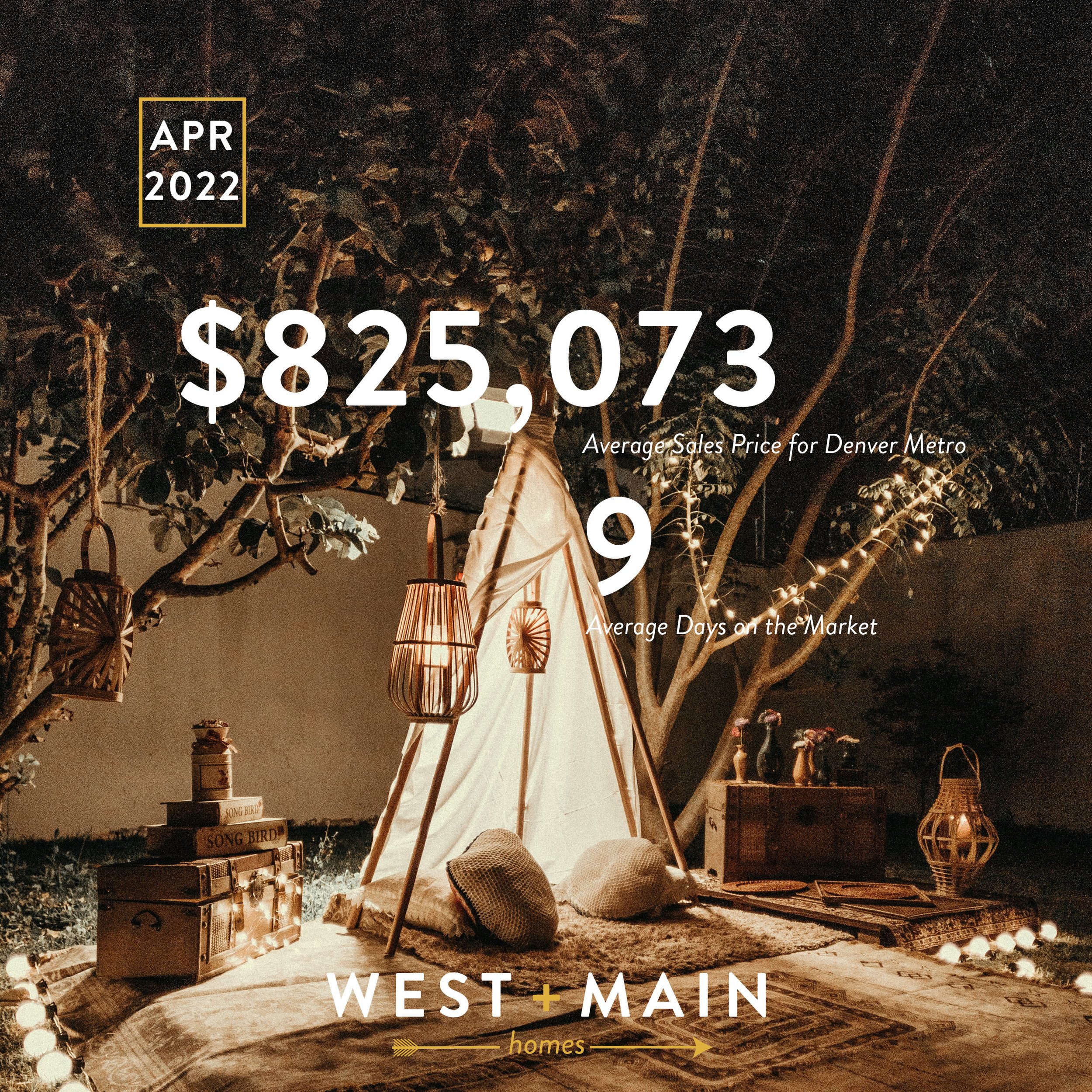
While inventory is on the rise, so are prices. The average price of a single-family detached home in Denver Metro is $825,073, representing a 3.93 percent increase from last month. With consecutive months of increased prices and interest rates, a buyer's monthly mortgage has increased as well. The average close-price-to-list-price ratio in April for the detached market was 107.29 percent. With the increase in supply, the close-price-to-list-price ratio is an example of how the market was reacting a month ago. 

The relationship between closed sales and month-end active inventory impacts the supply and demand of the market and, therefore, many other statistics including average sales price. The most significant factor influencing the supply and demand of this market is interest rates. With many individuals refinancing due to low-interest rates on their house and interest rates north of five percent, there is minimal financial incentive to move.

“While buyers may be thinking they overpaid if they bought two months ago, this is not the case,” commented Andrew Abrams, Chair of the DMAR Market Trends Committee and Metro Denver Realtor®. “They likely got a slightly lower interest rate and the market is continuing to rise, just not as fast. In the chaos of the recent market, buyers had been waiving their inspections, doing full appraisal gaps and even offering to make their earnest money non-refundable before getting an inspection. Now, we are shifting to a more responsible market. There will still be bidding wars, appraisal gaps and limited inspection items on future properties, but the frequency of those will be less.”

The increased interest rates are already impacting the amount of inventory sitting on the market. While Denver Metro is still relatively low in inventory, the word “historic” is no longer applicable as there were 610 fewer properties on the market last year compared to today. The market usually sees an 8.59 percent increase in month-over-month inventory. This month, it saw an outstanding 44.26 percent increase.

Our monthly report also includes statistics and analyses in its supplemental “Luxury Market Report” (properties sold for $1 million or greater), “Signature Market Report” (properties sold between $750,000 and $999,999), “Premier Market Report” (properties sold between $500,000 and $749,999), and “Classic Market” (properties sold between $300,000 and $499,999). 

Meanwhile, in the Luxury Market, inventory is on the rise, with a 57.65 percent increase in new listings from this time last year. However, as a result of inflation, more homes will cross the threshold into the Luxury Market simply due to list price or more likely due to bidding wars that end 20 percent or more over the original ask price.

In part due to seasonality, new listings for detached homes rose 26.62 percent from last month. However, this is a 63.73 percent jump from last year for new listings. Pending sales rose 27.15 percent to 562 properties and 599 closed homes, a 17.91 percent increase from last month. Unsurprisingly, the average days in MLS decreased to 14 days from 17 last month, while the median days in MLS of four held strong month-over-month. 

The close-price-to-list-price ratio jumped slightly to 108.45 percent up just 0.39 percent from last month. Most notably, this data point was 102.62 percent this time last year, which means there has been a 5.68 percent rise in the last year. As such, the price per square foot total also jumped 16.27 percent from last year to $386 per square foot. 

“The spring selling season is off to a great stat and it feels as though more inventory is becoming available than even the data represents,” said Libby Levinson-Katz, DMAR Market Trends Committee member and Metro Denver Realtor®. “My partner and I have had more listings this year than we’ve ever had which feels like a slight change in the marketplace with more Denverites opting to either sell investment properties, move out of state or jump into this crazed market. For perspective, the Luxury Market year-to-date has 2,350 new listings with 1,793 closed. Back in 2018, there were 1,283 new listings with 649 closed properties.”

Download the report

West + Main agent Nick DiPasquale dug further into the Signature Market (properties sold between $740,000 and $999,000).


Thank you to our partners at the Denver Metro Association of Realtors for compiling this information.

If there is a home that you would like more information about, if you are considering selling a property, or if you have questions about the housing market in your neighborhood, please reach out. We’re here to help.

Search Homes in Colorado