Market Trends

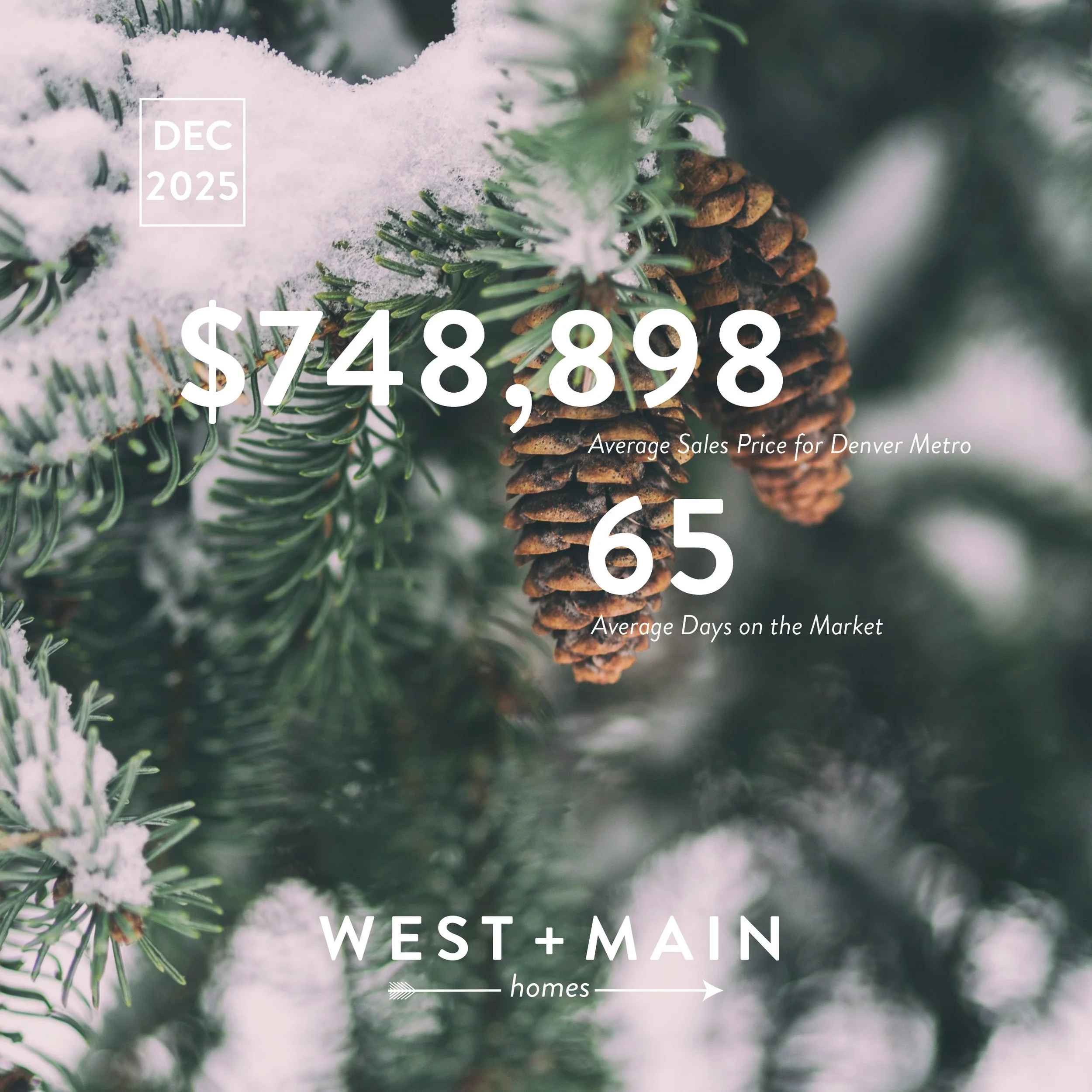
Greater Denver Area Real Estate Market Report from December 2025


The Denver Metro real estate market in 2025 continued the stabilization pattern we’ve observed since 2023, according to the Denver Metro Association of Realtors Market Stats Committee. 

Affordability, ownership costs and mortgage rates dominated buyers' decision making. Sellers navigated a thoughtful adjustment of expectations. They made price adjustments, experienced longer time on the market and accommodated buyer needs through concessions and rate buy-downs. 2025 reflected an industry adapting to a more balanced environment where both buyers and sellers had to adjust their footing.

In many ways, real estate became collateral damage from wider economic forces beyond the industry’s control. The Federal Reserve rate cuts, influenced by persistent inflation concerns and tariff uncertainties, kept mortgage rates anchored in the six to seven percent range. Bond market volatility increased borrowing costs, and consumer confidence declined amid rising economic uncertainty. Labor market dynamics and immigration policy added construction cost pressures. These economic variables shaped housing market psychology more than traditional supply-and-demand fundamentals, leaving both buyers and sellers navigating conditions largely determined by forces outside the real estate sector.

As a result, the market remained fairly flat year-over-year. The median sale price in the Denver Metro area increased by just 0.39 percent for detached homes, while attached homes decreased by 2.85 percent. The combined median sale price of attached and detached homes in 2025 was just 0.85 percent higher than in 2022. This stability in median home values reflects a combination of the economic impacts outlined above and the rebalance following the rapid 38.5 percent increase in home values from March 2020 to April 2022.

New inventory in the market in 2025 increased from 2024 and 2023, and buyers appreciated the increase in options. The total number of sales has remained flat for the past three years, fluctuating by less than one percent year-over-year, as has the sales volume. The combination of increased inventory and steady sales has shifted conditions in the buyer's favor. The number of active listings at month’s end in December decreased by 27.59 percent month-over-month, due mostly to many sellers removing their homes from the market over the holidays. It is expected that most of these listings will re-enter the market in the first quarter of 2026.

As we look ahead to 2026, the fundamental market conditions that defined the past three years—modest price appreciation, steady transaction volumes and mortgage rates in the six to seven percent range—show little indication of dramatic change. In this environment of sustained stability, success will depend less on market timing and more on strategic execution and flexibility.

Buyers will need to focus on creative financing solutions. They should explore rate buydown options, consider a wider range of neighborhoods and property types and work with lenders who can structure loans that maximize purchasing power. Sellers, meanwhile, must focus on competitive pricing from day one. Investing in presentation and pre-listing preparation is essential. Sellers must also remain open to negotiating terms that address affordability concerns.

The opportunities in 2026 won't come from dramatic market swings. Instead, they will come from thoughtful, well-informed strategies designed for today’s realities. Those who approach their transactions with professional guidance, realistic expectations and a willingness to collaborate will find that the Denver Metro market continues to reward preparation over waiting.

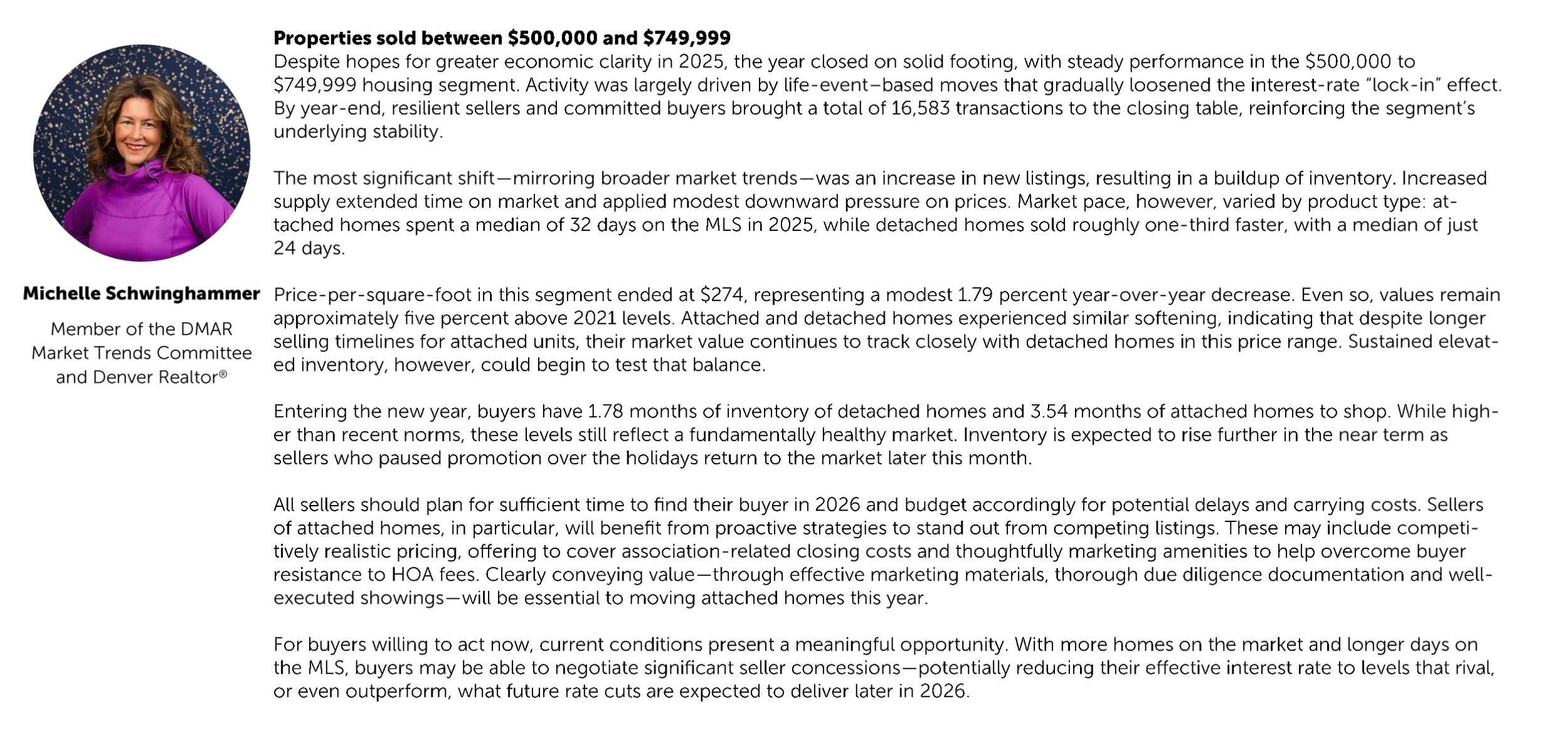
Read on for a deep dive into properties in the $500,000-$749,999 range from West + Main Homes agent, Michelle Schwinghammer. 
What to watch for in 2025 housing market predictions


Housing is not cheap — whether you’re buying or renting

In October, the median sales price for a single-family home in the U.S. was $437,300, up from $426,800 a month prior, according to the latest data by the U.S. Census. 

Meanwhile, the median rent price in the U.S. was $1,619 in October, roughly flat or up 0.2% from a year ago and down 0.6% from a month prior, according to Redfin, an online real estate brokerage firm.

While it can be difficult to exactly pinpoint how the housing market is going to play out in 2025, several economists lay out predictions of what’s likely to happen next year in a new report by Redfin, an online real estate brokerage firm.

“If the housing market were going to crash, it would have already crashed by now,” said Daryl Fairweather, chief economist at Redfin. “The housing market has been so resilient to interest rates going up as high as they have.”

Here are five housing market predictions for 2025, according to Fairweather and other economists. 

Home price growth will return to pre-pandemic levels

The median asking price for a home in the U.S. will likely rise 4% over the course of 2025, a pace similar to that of the second half of this year, according to Redfin.

The 4% annual pace is a “normalization” compared to the accelerated growth last seen in 2020, said Fairweather. 

Earlier in 2024, the rate at which home prices grew slowed down to pre-pandemic levels. In other words, while prices were still rising, the speed of price growth was not as fast as it was in previous years. 

Despite predictions of growth slowing, there may still be some volatility in prices.

In fact, home price appreciation might stay flat, or less than 1%, going into the 2025 spring home buying season, said Selma Hepp, economist at CoreLogic.

But the possibility of President-elect Donald Trump enacting some of his economic policies could drive home prices much higher, said Jacob Channel, senior economist at LendingTree. 

“We kind of have some mixed signals right now in terms of what may or may not happen to home prices,” he said. 

General tariffs on foreign goods and materials as well as mass deportations could result in higher construction costs and slower home-building activity. If fewer homes are built in a supply-constrained market, prices might grow much higher, said Channel.

Flattening rents, with more room to negotiate

At a national level, the median asking rent price in the U.S. will likely stay flat over the course of a year in 2025, as new rental inventory becomes available, according to Redfin.

“If rents are flat, and people’s wages continue to grow, that means people have more money to spend,” Redfin’s Fairweather said, as well as increase their savings.

More than 21 million renter households are “cost-burdened,” meaning they spent more than 30% of their income on housing costs, according to 2023 U.S. Census data.

A stable rental market will also give renters more strength to negotiate with landlords. In some areas, property managers are already offering concessions like one month rent free, a free parking space or waiving fees, experts say.

However, “it’s December,” Channel said. “Rent prices typically decline in the colder months of the year,” as fewer people are apartment hunting in the late fall and winter seasons.

If would-be buyers continue to be priced out of the for-sale market next year through high home prices and mortgage rates, competition in the rental market may ensue, he said.

Also keep in mind that the typical rent price you see will depend on what’s going on in your local market, Hepp explained.

For instance: Austin, Texas was the “epicenter of multi-family construction,” she said, meaning a lot of new supply was added into the city’s rental market, bringing rental costs down. The metro area’s rent prices fell by 2.9% from a year ago, CoreLogic found.

In contrast, supply-constrained metropolitan areas like Seattle, Washington, D.C., and New York City, are experiencing high rent growth of 5% annually.

A ‘bumpy’ and ‘volatile’ year for mortgage rates

Redfin forecasts mortgage rates will average 6.8% in 2025, and hover around the low-6% range if the economy continues to slow.

Yet experts expect 2025 will be a “bumpy” and “volatile” year for mortgage rates.

Borrowing costs for home loans could spike if policies like tax cuts and tariffs are enacted, putting upward pressure on inflation.

“We’re sort of in uncharted territory. It’s really tough to say exactly what’s going to happen,” said LendingTree’s Channel.

Mortgage rates declined this fall in anticipation of the first interest rate cut since March 2020. But then borrowing costs jumped again in November as the bond market reacted to Donald Trump’s election win. Since then, mortgage rates have somewhat stabilized — for now.

“Our expectation is that rates are going to be in the 6% range as we move into 2025,” Jessica Lautz, deputy chief economist and vice president of research at the National Association of Realtors, recently told CNBC.

More home sales than in 2024

Pent-up demand from buyers and sellers on the sidelines may drive home transactions next year.

“People have waited long enough,” Fairweather said.

About 4 million homes are expected to be sold by the end of 2025, an annual increase between 2% and 9% from 2024, according to Redfin.

The market is piling on with “people who need to move on with their lives,” like buyers who are getting new jobs and need homes suitable for life changes, and sellers who have delayed moving plans, Fairweather said.

While more buyers are expected to hit the market next year, the level of competition may not be as aggressive as in recent years, when bidding wars were the norm.

Other affordability factors may come into play, like rising insurance costs and property taxes, in turn slowing down competition, said CoreLogic’s Hepp.

“We’ll definitely see more buyers out there,” she said. “But I don’t see the competition heating up to the levels that it has over the last few years.”

Climate risks will bake into homes prices

The risk of extreme weather and natural disasters may anchor down home prices or slow down price growth in areas like coastal Florida, California and parts of Texas, which are at high risk of hurricanes, wildfires or other disasters, Redfin expects.

If palatable price tags have you eyeing homes in a high-risk market, be aware of potential complications.

For instance, home insurance policies in some of these markets are harder to come by, and tend to carry high price tags. The financial impact of natural disasters may also be felt in rising home maintenance and repair costs, said Redfin’s Fairweather.

What’s more challenging, “every part of the country is vulnerable” because the weather patterns are changing, she said. “Lately, there have been these atmospheric rivers in California that have caused days of heavy flooding, and those homes aren’t built for that.”

While there’s a lot of focus on Florida for hurricane risks, the state is more prepared for this natural disaster, unlike areas like Asheville, North Carolina, a mountainous city battered by the hurricane Milton earlier this year.

“We will probably see insurance increase pretty broadly because that mismatch between what homes were built for and the climate that they are going to be facing in the coming years,” she said.

See more on NBC News

Related Links

If there is a home that you would like more information about, if you are considering selling a property, or if you have questions about the housing market in your neighborhood, please reach out. We’re here to help.

Search Homes in Colorado

Search Homes in North Carolina

Search Homes in Oklahoma