Here are 7 steps homeowners and renters should take after a wildfire, experts say


Firefighters are still working to contain the record-breaking fires that have been raging for more than a week in Southern California.

The fires in the Greater Los Angeles area have burned through 40,000 acres, destroying more than 12,300 structures, according to NBC News. About 88,000 L.A. residents are under evacuation orders and another 89,000 are in evacuation warning zones, meaning they may need to leave at a moment’s notice.

The insured losses from the early January wildfires may cost over $20 billion, according to estimates published last week by JPMorgan. Wells Fargo similarly estimated about $20 billion worth of insured losses with an approximate $60 billion economic loss.

As many affected residents are trying to figure out what’s next, one of the first things to do is kickstart the insurance process, according to Karl Susman, insurance broker and president of Susman Insurance Services in Los Angeles.

“Get your claim filed as quickly as you can,” he said. “You don’t have to have all of the information on hand.”

Insurers are likely to take a longer time than usual to process claims because of the influx of applications, he said, so the sooner you get the ball rolling, the better. 

If your primary residence has been affected by wildfire — whether you rent or own — experts advise taking these seven steps right away.

1. File the claim first, assess damage later

You don’t have to wait for firefighters to completely put out the fire to file an insurance claim.

Even if you’ve already evacuated and are unaware of the status of your home, you can still begin the claims process, Susman said.

Factors like the type and extent of the damage, the complexity of the claim and the volume of insured losses can affect the insurer’s processing time, experts say.

Renters have access to most of the same resources homeowners do, said Shannon Martin, a licensed insurance agent and analyst at Bankrate.com.

“For the most part, renters can follow the same process as homeowners,” she said. “You want to get yourself to safety, set up your insurance claim and then ask if you can get any additional living expenses in advance.”

2. Ask about ‘loss of use’ coverage

Ask your provider about “loss of use” coverage under your home insurance policy, said Jeremy Porter, head of climate implications research at First Street Foundation, an organization based in New York City that focuses on climate risk financial modeling.

The coverage would allow you to secure temporary housing or lodging while you’re out of your home, he said: “It’s there specifically to give people kind of a lifeline when they can’t move back into the dwelling.”

Tenants may have similar coverage — it’s generally known as Coverage D in renters insurance policies, Porter said. 

3. Keep your receipts and document everything

If you have loss of use coverage, make sure to keep every receipt for any clothes, food and temporary housing or hotel stays you may need. Also keep track of your activities and document all of your conversations with insurers, according to Douglas Heller, director of insurance at the Consumer Federation of America.

“The better you document what you are doing as you go through this awful time, the easier it will be to demonstrate your claim for reimbursements,” he said. 

4. Turn off your utilities

If the fire caused severe damage or you suffered a complete loss of your home, contact your utilities — such as electricity, water and trash collection companies — to temporarily shut off service. You may not have to pay for these services for the time being, Susman said.

5. Contact your auto insurer

If you lost a vehicle in the fire, the damage may be covered under your auto insurance policy, Susman said.

“It’s not going to be under your home [insurance policy] exactly, even if the car was in your driveway,” Susman said.

Look for what’s called comprehensive coverage under your auto insurance, he said. 

If you have comprehensive coverage on your car, you’re typically covered for wildfire loss, and “you just have to pay your deductible,” Bankrate’s Martin said.

6. Don’t forget property taxes

If your home suffered damages, or was a total loss, go to your county assessor’s website and type in your address.

If you’ve sustained more than $10,000 in damages, or the home is a total loss, you can file for an application to reduce or eliminate your property tax while the dwelling is under construction or uninhabitable, insurance expert Susman said.

“That’s something that people tend to not know or they overlook it,” he said.

7. Tap local aid opportunities

If you were not previously covered or your coverage was canceled before the disaster hit, keep an eye out for aid that may become available for those affected by the wildfires, Susman said. 

“For people that had zero insurance, [there will] probably be some type of assistance that will be available,” Susman said.

During a White House briefing, President Joe Biden announced a one-time payment of $770 through the Federal Emergency Management Agency is available for the wildfire victims. Nearly 6,000 survivors have registered for the aid and $5.1 million has gone out, according to The White House.

Those impacted can file for aid via DisasterAssistance.gov or FEMA’s hotline at 1-800-621-3362.

California’s Insurance Commission can be reached at 1-800-927-4357 to help individuals navigate the process as well as help uninsured victims.

FEMA is also providing assistance to those affected by the wildfires.

If you were not previously covered by an insurance plan, the agency’s Individuals and Households Program may provide funds for temporary housing.

Affected individuals can apply online at DisasterAssistance.gov or by calling 1-800-621-3362.

Seek out local support groups and workshops. The Insurance Commission of California will host its first workshop involving government representatives and insurers on Jan. 18-19 at Santa Monica College. Follow-up events are scheduled on Jan. 25- 26 at Pasadena College.

Some charities and nonprofits are actively accepting donations and are engaging in recovery efforts in the Pacific Palisades and surrounding areas.

Read more at CNBC

Related Links

If there is a home that you would like more information about, if you are considering selling a property, or if you have questions about the housing market in your neighborhood, please reach out. We’re here to help.


Search Homes in Colorado

Search Homes in North Carolina

Search Homes in Oklahoma

What To Save for When Buying a Home


Knowing what to budget for when buying a home may feel intimidating — but it doesn’t have to be. By understanding the costs you may encounter upfront, you can take control of the process.

Here are just a few things experts say you should be thinking about as you plan ahead.

1. Down Payment

Saving for your down payment is likely top of mind. But how much do you really need? A common misconception is that you have to put down 20% of the purchase price. But that’s not necessarily the case. Unless it’s specified by your loan type or lender, you don’t have to. There are some home loan options that require as little as 3.5% or even 0% down. An article from The Mortgage Reports explains:

“The amount you need to put down will depend on a variety of factors, including the loan type and your financial goals. If you don’t have a large down payment saved up, don’t worry—there are plenty of options available . . .”

A trusted lender will go over the various loan types with you, any down payment requirements on those, and down payment assistance programs you may qualify for. The more you know ahead of time, the easier the process will be. And the key to getting the information you need is working with a pro to see what’ll work best for your situation.

2. Closing Costs

Make sure you also budget for closing costs, which are a collection of fees and payments made to the various parties involved in your transaction. Bankrate explains:

“Mortgage closing costs are the fees associated with buying a home that you must pay on closing day. Closing costs typically range from 2 to 5 percent of the total loan amount, and they include fees for the appraisal, title insurance and origination and underwriting of the loan.”

When it comes to closing costs, a trusted lender can guide you through specifics and answer any questions you may have. They can also give you a better idea of how much you should be prepared to pay so you can cruise through your closing with confidence.

And as you plan ahead for closing day, be sure to budget for your real estate agent’s professional service fee too, in case the seller doesn’t cover it. But don’t worry, you’ll work with your agent ahead of time to agree on what this is, so you won’t be surprised at the finish line.

3. Earnest Money Deposit

And if you want to cover all your bases, you can also consider saving for an earnest money deposit (EMD). According to Realtor.com, an EMD is typically between 1% and 2% of the total home price and is money you pay as a show of good faith when you make an offer on a house.

But, it’s not an added expense. Instead, it works like a credit and goes toward some of your upfront costs. You’re simply using some of the money you’ve already saved for your purchase to show the seller you’re committed and serious about buying their house. Realtor.com describes how it works as part of your sale:

It tells the real estate seller you’re in earnest as a buyer . . . Assuming that all goes well and the buyer’s good-faith offer is accepted by the seller, the earnest money funds go toward the down payment and closing costs. In effect, earnest money is just paying more of the down payment and closing costs upfront.”

Keep in mind, this isn’t required, and it doesn’t guarantee your offer will be accepted. It’s important to work with a real estate advisor to understand what’s best for your situation and any specific requirements in your local area. They’ll advise you on what moves you should make so you can make the best possible decisions throughout the buying process.

Bottom Line

The key to a successful homebuying savings strategy? Being informed about what you need to save for. Because, when you understand what to expect, you can plan ahead. With an expert agent and a trusted lender, you’ll have the information you need to move forward with confidence.

Read more at Keeping Current Matters

Related Links

If there is a home that you would like more information about, if you are considering selling a property, or if you have questions about the housing market in your neighborhood, please reach out. We’re here to help.

Search Homes in Colorado

Search Homes in North Carolina

Search Homes in Oklahoma

California wildfire victims could have up to 12 months of mortgage forbearance


Fannie Mae and Freddie Mac issued reminders designed to keep homeowners and renters informed about forbearance options and other deferrals and modifications.

Government-sponsored enterprises (GSEs) Fannie Mae and Freddie Mac are aiming to remind homeowners and renters impacted by the ongoing wildfires in Los Angeles of various relief options. These include forbearance and other payment deferral plans, as well as disaster recovery counseling programs through the U.S. Department of Housing and Urban Development (HUD).

“The number one priority for those affected by the destruction of these ongoing wildfires is to reach safety,” Mike Reynolds, Freddie Mac’s single-family vice president and head of servicing, said in a statement. “Once out of harm’s way, we encourage homeowners in these affected areas to contact their mortgage servicer to learn about relief options. Freddie Mac and our partners stand ready to provide immediate assistance and aid in the recovery of families and individuals.”

Cyndi Danko, Fannie Mae’s senior vice president and chief credit officer of single-family, added that the company is continuing to monitor developments related to the wildfires and urges impacted homeowners to immediately contact their loan servicer.

“If homeowners have been impacted by the fires, we encourage them to call their mortgage servicer for assistance as soon as possible,” she said in a statement. “Homeowners and renters can learn more about disaster relief resources, including personalized support, by contacting Fannie Mae’s free disaster recovery counseling services.”

At Freddie Mac, disaster relief options are available to anyone with a Freddie-backed mortgage that has been impacted by a natural disaster. This includes anytime the relevant property has been hit with “an insurable loss,” and also covers when a home or “place of employment are located in Presidentially-Declared Major Disaster Areas with individual assistance designations,” according to the company.

“Foreclosure and other legal proceedings are also suspended while homeowners are on a forbearance plan,” Freddie Mac explained.

Fannie Mae also offered a reminder that it has a disaster recovery phone number, which is operated by Money Management International, as well as online resources for impacted borrowers. The phone number is 855-HERE2HELP (855-437-3243).

“Homeowners affected by a disaster are often eligible to reduce or suspend their mortgage payments for up to 12 months by entering a forbearance plan with their mortgage servicer,” Fannie said, echoing some of the information shared by Freddie. “During this temporary reduction or pause in payments, homeowners will not incur late fees and foreclosure and other legal proceedings are suspended.”

Once people are back on their feet, Freddie explains that there are multiple options available for the resumption of payments. These include reinstatement; a repayment plan; payment deferral where payment from a forbearance/relief period are added to the end of the mortgage term and a borrower becomes immediately current; or a loan modification for those borrowers with a long-term financial hardship.

HUD counseling through Fannie Mae can offer assistance for homeowners and renters including a needs assessment and recovery plan; assistance with requests from the Federal Emergency Management Agency (FEMA), insurance companies and others; online resources and guidance for 18 months; and support in multiple languages.

Read more at Housingwire

Related Links

If there is a home that you would like more information about, if you are considering selling a property, or if you have questions about the housing market in your neighborhood, please reach out. We’re here to help.
Search Homes in Colorado

Search Homes in North Carolina

Search Homes in Oklahoma

Time in the Market Beats Timing the Market


Trying to decide whether it makes more sense to buy a home now or wait? There’s a lot to consider, from what’s happening in the market to your changing needs. But generally speaking, aiming to time the market isn’t a good strategy – there are too many factors at play for that to even be possible.

That’s why experts usually say time in the market is better than timing the market.

In other words, if you want to buy a home and you’re able to make the numbers work, doing it sooner rather than later is usually worth it. Bankrate explains why: 

“No matter which way the real estate market is leaning, though, buying now means you can start building equity immediately.” 

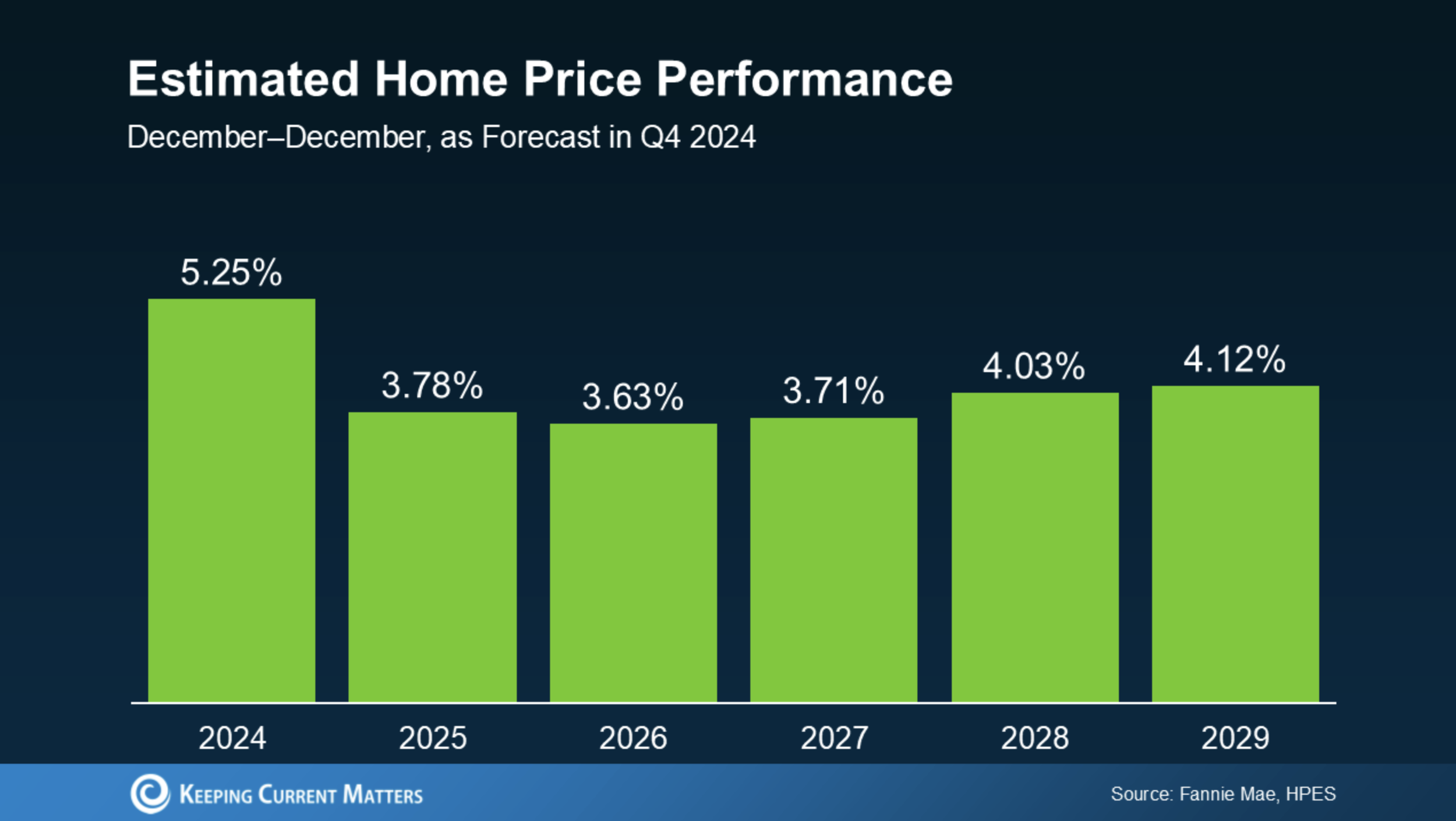
Here’s some data to break this down so you can really see the benefit of buying now versus later – if you’re able to. Each quarter, Fannie Mae releases the Home Price Expectations Survey. It asks over one hundred economists, real estate experts, and investment and market strategists what they forecast for home prices over the next five years. In the latest release, experts are projecting home prices will continue to rise through at least 2029 – just at a slower, more normal pace than they did over the past few years (see the graph below):


But what does that really mean for you? To give these numbers context, the graph below uses a typical home value to show how it could appreciate over the next few years using those HPES projections (see graph below). This is what you could start to earn in equity if you buy a home in early 2025. 


In this example, let’s say you go ahead and buy a $400,000 home this January. Based on the expert forecasts from the HPES, you could gain more than $83,000 in household wealth over the next five years. That’s not a small number. If you keep on renting, you’re losing out on this equity gain.

And while today’s market has its fair share of challenges, this is why buying is going to be worth it in the long run. If you want to buy a home, don’t give up. There are creative ways we can make your purchase possible. From looking at more affordable areas, to considering condos or townhomes, or even checking out down payment assistance programs, there are options to help you make it happen.

So sure, you could wait. But if you’re just waiting it out to perfectly time the market, this is what you’re missing out on. And that decision is up to you.

Bottom Line

If you’re torn between buying now or waiting, don’t forget that it’s time in the market, not timing the market that truly matters. Connect with an agent if you want to talk about what you need to do to get the process started today.

Read more at Keeping Current Matters

Related Links

If there is a home that you would like more information about, if you are considering selling a property, or if you have questions about the housing market in your neighborhood, please reach out. We’re here to help.

Search Homes in Colorado

Search Homes in North Carolina

Search Homes in Oklahoma

Mortgage rates above 7% are clouding the housing market outlook


December jobs data is expected to cool, but how will Fed officials respond at their next meeting?

The new year has arrived, but little has changed regarding the direction of mortgage rates and their impact on the U.S. housing market.

At HousingWire’s Mortgage Rates Center on Tuesday, the 30-year fixed rate averaged 7.09%. That was up 2 basis points (bps) from a week ago. The 15-year fixed rate was slightly higher at 7.11% and was up 11 bps in the past week.

“The 10-year yield is currently close to my peak forecast of 4.70%. However, mortgage rates have not reached my peak prediction of 7.25% because mortgage spreads have improved in the early part of the year,” HousingWire Lead Analyst Logan Mohtashami wrote. “If mortgage spreads had been as unfavorable as they were in 2023, mortgage rates would be around 8% instead of near 7%.”

Mortgage rates have continued to rise since the Federal Reserve meeting on Dec. 18, when the central bank cut benchmark rates by 25 bps to a range of 4.25% to 4.5%. The Fed has implemented a total of 100 bps in cuts over its past three meetings, but mortgage rates have not moved in tandem. The 30-year fixed rate, for instance, has jumped by 78 bps since the rate-cutting cycle began in mid-September.

Market observers believe that the cuts will be paused when the Fed meets again at the end of January. On Tuesday, the CME Group’s FedWatch tool showed that 95% of interest rate traders predict no cut this month. Looking ahead to March, 37% of traders believe there will be an additional 25-bps cut that would lower the federal funds rate to a range of 4% to 4.25%.

The next employment report from the U.S. Bureau of Labor Statistics (BLS) will be released Friday and should provide some direction to Fed policymakers before their next meeting. A Reuters poll of economists calls for 150,000 new jobs to be added in December, down from a figure of 227,000 in November.

Last week, the labor department reported a seasonally adjusted annual rate of 211,000 unemployment claims — a lower-than-expected figure which signaled that “the labor market isn’t breaking,” according to Mohtashami.

“For mortgage rates to go lower, we need to focus on the labor market, which has been critical to every economic cycle in recent history, and particularly the labor market for residential construction and remodeling,” Mohtashami wrote.

“The existing home sales market has been in a recession since June 16, 2022, and hasn’t experienced any significant growth in sales for some time. However, the labor market for those working in in the existing home sales market isn’t substantial enough to impact an economy, since it is a sector that revolves around a transfer of commission.”

There weren’t any surprises in regard to home sales or new listings during the typically slow holiday season, according to Altos Research President Mike Simonsen. Altos data showed a weekly average of 44,000 new pending sales in December, nearly unchanged from the same period last year. Simonsen said he expects activity to rise next week.

“In ‘normal’ years, it’d be early February before inventory hits the absolute low point and starts climbing for the spring,” Simonsen wrote Monday. “When demand was hot during the pandemic, inventory might not reach its low point until March or April. In those times, we just had far more buyers than sellers. That’s not true now, so we should expect inventory to begin building for the year in February 2025.”

Mortgage and real estate professionals may take solace in the fact that homebuyer sentiment is considerably higher than it was a year ago. Survey data released Tuesday by Fannie Mae also showed that 42% of respondents expect mortgage rates to decline in the next 12 months, up from 31% one year ago.

“While respondents remain discouraged by the pandemic-era run-up in home prices and mortgage rates, the upward trend in home buying sentiment in 2024 may reflect a slow acclimatization to the generally less-affordable market conditions,” Fannie Mae chief economist Mark Palim remarked.

Redfin data released this week showed some positive signs for housing affordability. The brokerage reported that the share of income needed to buy the median-priced home fell slightly last year — the first time since the start of the COVID-19 pandemic that had happened. Still, a household earning the median income of $83,782 would need to spend nearly 42% of their paycheck to afford the median-priced home of $429,734, much higher than the typical share of 30% or less during the 2010s.

“For many Americans, buying a home remains more out of reach than ever and that’s unlikely to change anytime soon,” Redfin senior economist Elijah de la Campa said. “Even with inventory trending upwards, we still expect prices to continue rising in 2025 due to a lack of homes for sale — pushing more would-be homebuyers to rent instead.”

Read more at Housingwire

Related Links

If there is a home that you would like more information about, if you are considering selling a property, or if you have questions about the housing market in your neighborhood, please reach out. We’re here to help.

Search Homes in Colorado

Search Homes in North Carolina

Search Homes in Oklahoma