Just Listed: Charming Oasis in Kittredge!


Welcome home to this charming oasis in Kittredge!

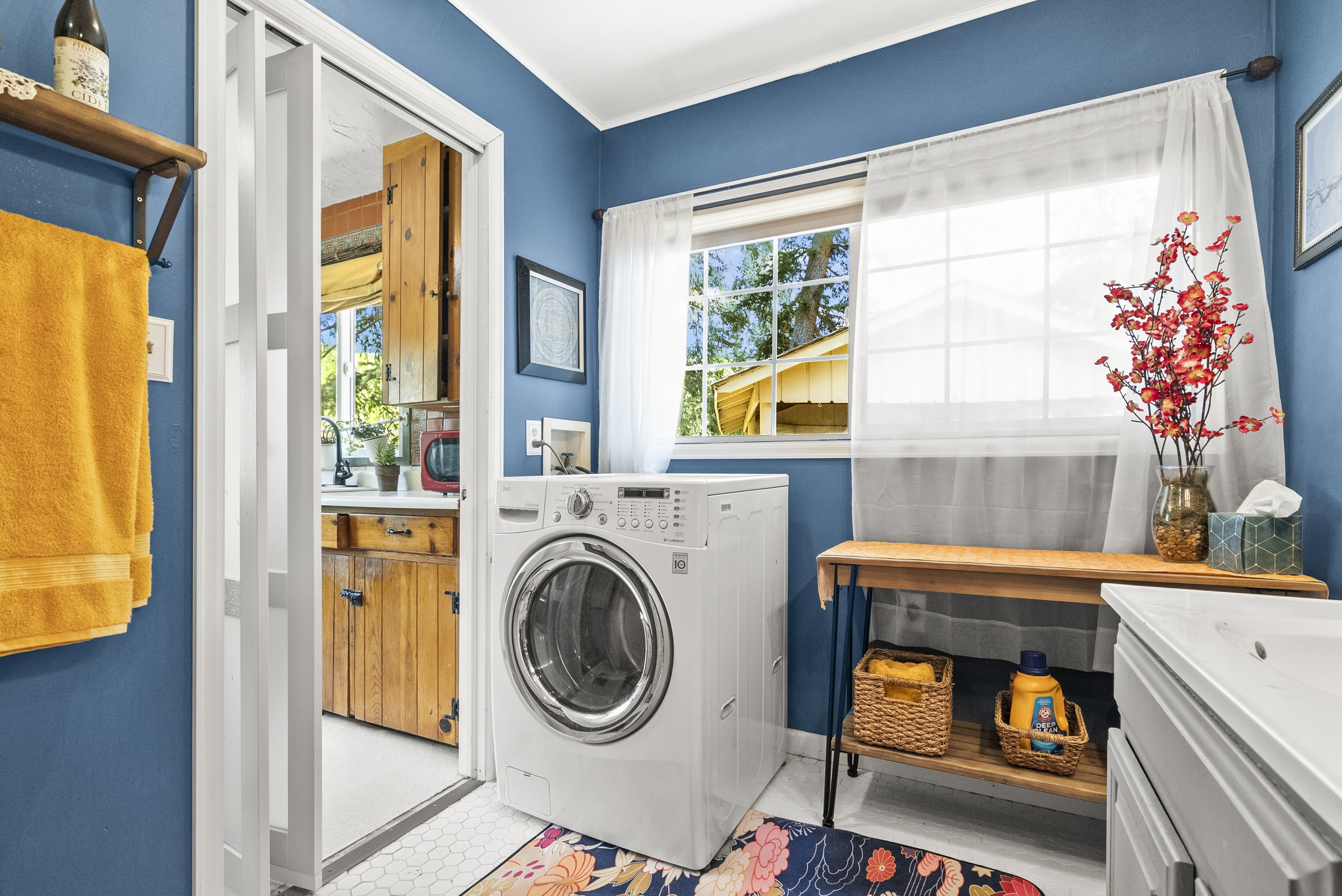
This 2 bed, 1bath home sits on a large, mostly level, double lot. As you enter the spacious mudroom, you’ll find ample storage and room to drop your gear and hang up your coats. From the mudroom, you find yourself in the expansive living room. Here you will enjoy the natural light flooding from the large windows with views to your back patio and yard during the day. Then, you can cozy up to the beautiful stone framed wood burning fireplace at night. You’ll love relaxing on the back patio, where you’re often greeted by various wildlife. Adjacent to the living room, two steps lead you to the bedrooms - one even features a private covered patio overlooking the backyard. On the other side of the living room is the kitchen with original wood cabinets and a dreamy cottage feel. Just off the kitchen is an oversized three quarter bathroom large enough for the included washing machine and to add a dryer if you choose(hookups available). Rounding it all out is your new roof(2022) and new windows throughout(2022). Your new home is only two blocks from Kittredge Community Park - hello summers spent splashing in Bear Creek! You can also reach Kittredge’s town center, Downtown Evergreen, and Evergreen Lake in under 3 miles. From local dining and shopping, to summer paddleboarding and winter ice skating, you’ll certainly enjoy the easy access to Colorado’s outdoors and mountain enjoyment!!  Not to mention the iconic Red Rocks Park and Amphitheater for concerts and Yoga on the Rocks is just 8 miles away! You’re going to love calling this mountain oasis home!

Listed by Kendra Greeney + Paige Acton for West + Main Homes. Please contact Kendra or Paige for current pricing + availability.


Have questions?
West + Main Homes
(720) 903-2912
hello@westandmainhomes.com

Presented by:
Kendra Greeney
(720) 323-1306
kendragreeney@westandmainhomes.com

Paige Acton
(720) 295-2411
paige@westandmainhomes.com


Search homes in Colorado
 

Just Listed: Elegant Escape on Coveted Greenway Park


Elegant custom home in one of Central Park’s most coveted locations on Greenway Park.

5400 square feet of finely crafted living space, this 6-bedroom, 5-bathroom home is a showcase of sophistication and comfort. Well lit, open floor plan. Chef’s kitchen with custom finishes, quartz countertops, large pantry, coffee bar, and a generous island perfect for entertaining. It opens to both the the refined, light-filled dining room and large inviting living area with fireplace. Enjoy seamless indoor-outdoor living with a fully landscaped, private backyard, covered patio, built-in gas grill, hot tub, all on a large 9,160 sq ft lot. Retreat upstairs to the expansive primary suite complete with 5-piece ensuite bath and deep soaking tub, dual vanities and large walk-in closet. A balcony faces the large park and green space adjacent to the home, where you can enjoy mountain views with your morning coffee or cool summer evenings. 3 additional upstairs bedrooms offer spacious comfort and privacy. Convenient second floor laundry with tons of storage. Finished basement with versatile space for a home theater or rec room, and separate room for a gym. Full wet bar and kitchen area, including wine storage perfect for showcasing your vintage collection. Additional guest room, bath, and steam steam shower. 3-car attached garage with electric charging, dual HVAC system, whole-home air purifier and humidifier, and owned solar. The Greenway features three playgrounds, the sand park, dog park, climbing wall, skate park, and an observation tower- right out of the front door!

Listed by John Chapman for West + Main Homes. Please contact John for current pricing + availability.


Have questions?
West + Main Homes
(720) 903-2912
hello@westandmainhomes.com

Presented by:
John Chapman
303-523-2262
chapman@westandmain.com


Search homes in Colorado
 

Thinking about an Adjustable-Rate Mortgage? Read This First.


If you’ve been house hunting lately, you’ve probably felt the sting of today’s mortgage rates. And it’s because of those rates and rising home prices that many homebuyers are starting to explore other types of loans to make the numbers work. And one option that’s gaining popularity? Adjustable-rate mortgages (ARMs).

If you remember the crash in 2008, this may bring up some concerns. But don’t worry. Today’s ARMs aren’t the same. Here’s why.

Back then, some buyers were given loans they couldn’t afford after the rates adjusted. But now, lenders are more cautious, and they evaluate whether you could still afford the loan if your rate increases. So, don’t assume the return of ARMs means another crash. Right now, it just shows some buyers are looking for creative solutions when affordability is tough.

You can see the recent trend in this data from the Mortgage Bankers Association (MBA). More people are opting for ARMs right now.

And while ARMs aren’t right for everyone, in certain situations they do have their benefits.

How an Adjustable-Rate Mortgage Works

Here’s how Business Insider explains the main difference between a fixed-rate mortgage and an adjustable-rate mortgage:

“With a fixed-rate mortgage, your interest rate remains the same for the entire time you have the loan. This keeps your monthly payment the same for years . . . adjustable-rate mortgages work differently. You’ll start off with the same rate for a few years, but after that, your rate can change periodically. This means that if average rates have gone up, your mortgage payment will increase. If they’ve gone down, your payment will decrease.”

Of course, things like taxes or homeowner’s insurance can still have an impact on a fixed-rate loan, but the baseline of your mortgage payment doesn’t change much. Adjustable-rate mortgages don’t work the same way.

Pros and Cons of an ARM

Here’s a little more information on why some buyers are giving ARMs another look. They offer some pretty appealing upsides, like a lower initial rate. As Business Insider explains:

“Because ARM rates are typically lower than fixed mortgage rates, they can help buyers find affordability when rates are high. With a lower ARM rate, you can get a smaller monthly payment or afford more house than you could with a fixed-rate loan.”

On the flip side, just remember, if you have an ARM, your rate will change over time. As Barron’s explains there’s the potential for higher costs later:

“Adjustable-rate loans offer a lower initial rate, but recalculate after a period. That is a plus for borrowers if rates come down in the future, or if a borrower sells before the fixed period ends, but can lead to higher costs if they hold on to their home and rates go up.”

So, while the upfront savings can be helpful now, you’ll want to think through what could happen if you’re still in that home when your initial rate ends. Because while projections show rates are expected to ease a bit over the next year or two, no forecast is guaranteed.

That’s why it’s essential to talk with your lender and financial advisor about all your options and whether an ARM aligns with your financial goals and your comfort with risk.

Bottom Line

For the right buyer, ARMs can offer some big advantages. But they’re not one-size-fits-all. The key is understanding how they work, weighing the pros and cons, and thinking through if they’d be something that would work for you financially. And that’s why you need to talk to a trusted lender and financial advisor before you make any decisions.

Read more at Keeping Current Matters

Related Links

If there is a home that you would like more information about, if you are considering selling a property, or if you have questions about the housing market in your neighborhood, please reach out. We’re here to help.

Search Homes in Colorado

Search Homes in North Carolina

Search Homes in Oklahoma

How Much Do You Really Know About Home Loans? Most Homebuyers Are Still Getting These Basics Wrong


Homeownership remains a cornerstone of the American Dream, but for many, it feels increasingly out of reach. According to KB Home’s second annual survey for National Homeownership Month, 89% of Americans report feeling anxious about being able to afford a home. Yet despite those concerns, 83% still say that owning a home is a vital life milestone.

While rising interest rates and limited housing supply are largely outside individual control, there’s one crucial factor buyers can influence: their understanding of the homebuying process.

And that’s exactly where many are falling short.

The survey uncovered a widespread lack of knowledge around mortgages, financing terms, and loan qualifications: Basics that could spell the difference between feeling stuck and moving forward with confidence.

“This year’s survey shows that the dream of owning a home is still very real, even if many people are unsure how to get there,” shares Rob McGibney, president and chief operating officer of KB Home shared via press release.

From mortgage myths to missing financial vocabulary, here’s where many prospective buyers are getting it wrong, and how better information could make all the difference.

Mortgage rate misconceptions

Roughly 69% of U.S. adults believe mortgage rates are the highest they’ve ever been. But while today’s rates are elevated compared to the record lows of the pandemic and post-2008 crash, they’re still below the historical average of 7.7%.

This widespread misconception can discourage buyers from moving forward, worried they’ll be stuck with a “bad” rate. In reality, today’s 30-year fixed rates are nowhere near the 18.6% peak seen in 1981.

More importantly, it’s unrealistic that rates will return to 3% in the near or even middle future, according to experts we spoke with. That could mean qualified buyers put off homebuying so long, they risk staying on the sidelines forever.

Missing key terms

Home financing can be confusing, and not understanding the basics can cost you.

Nearly half of prospective buyers don’t know what core terms like APR (Annual Percentage Rate) (49%) or PMI (Private Mortgage Insurance) (44%) mean, according to KB Home’s survey. These aren’t just technicalities, these terms directly affect how much a buyer will pay over the life of their loan, and what upfront costs they'll face.

That lack of knowledge extends to other critical facts: Only 37% of respondents knew that a 20% down payment isn’t required, and just 25% were aware that borrowers with credit scores in the 500s can still qualify for a mortgage.

This knowledge gap can lead eligible buyers to overestimate the barriers to entry and miss opportunities to purchase a home with favorable terms.

Lack of advice

For many Gen Zers and millennials, the hardest part of buying a home isn’t the mortgage paperwork or saving for a down payment; it’s knowing where to begin.

According to KB Home’s survey, 25% of Gen Z and 23% of millennial respondents said they felt anxious about where to start the homebuying process. Nearly as many (20% of Gen Z and 18% of millennials) said not having a trustworthy source of advice contributed to their stress.

That’s more than a confidence issue. Without credible guidance, young buyers are more likely to fall prey to misinformation, overlook financial options that could work in their favor, or delay entering the market entirely. 

And as federal consumer protection agencies like the CFPB face political and legal headwinds, reliable, unbiased resources are only becoming harder to find, just when the next generation of homebuyers needs them most.

What to know

If you’re planning to buy a home, or even just thinking about it, brushing up on the basics can make a real difference. Here are some of the most common misunderstandings that could be holding you back:

  • Mortgage rates aren't at historic highs. While rates have risen from the historic lows of the pandemic, they’re still well below the 1980s peak of 18.6% and even under the long-term average of 7.7%. Waiting for them to "come down" may not be necessary or wise, depending on your situation.

  • You don’t need a 20% down payment. Many loan programs, including FHA loans, allow for much smaller down payments. In fact, you may be able to buy with as little as 3.5% down—or sometimes even less with special programs.

  • A lower credit score doesn’t automatically disqualify you. While better credit typically means better rates, some lenders will work with borrowers in the 500s, especially for government-backed loans. Don’t assume you’re out of the running without checking and investigating programs specifically for people with low credit scores.

  • Understanding APR and PMI can save you thousands. APR reflects the true cost of borrowing, while PMI protects lenders—not you—in the event that you default on your loan, and is often required if you put down less than 20%. Knowing how these work helps you compare loan offers and plan for monthly costs more accurately.

  • Reliable advice matters. If you're unsure where to begin, seek out trusted, unbiased sources—like HUD-certified housing counselors or nonprofit financial educators. Social media and TikTok might make it feel easy, but misinformation is rampant, and good decisions require good data.

In this market, it’s more important than ever to arm yourself with the facts. You don’t need to know everything, but knowing the right things can help you make smarter, more confident decisions. In a time when affordability is tight and anxiety is high, understanding your options is one of the few things fully in your control.

Read more at Realtor.com

Related Links

If there is a home that you would like more information about, if you are considering selling a property, or if you have questions about the housing market in your neighborhood, please reach out. We’re here to help.

Search Homes in Colorado

Search Homes in North Carolina

Search Homes in Oklahoma

Home Buyers Are Finding a Silver Lining in a Stalled Housing Market—Especially if They’re in This Group


Nora Douglas was looking to buy a home in Atlanta in January but then hit the brakes on her search. The 27-year-old works in software in the healthcare industry and was looking to buy a multifamily property where she could live in one unit and rent the others out. She already owned a duplex and was looking to expand her real-estate portfolio with a second purchase.

Douglas was keen on buying in January to get a jump on the spring home-buying season, which is normally busy. “I usually have this theory that things tend to be cheaper during the winter,” she said. But mortgage rates were so high in January — over 7% —  that she decided to put her money into the stock market instead.

Since then, the housing market has slowed down meaningfully, and Douglas has decided to jump back in. As sellers become increasingly frustrated, buyers like Douglas are seeing opportunities.

“Properties are staying on the market for much longer. Listing agents are slashing prices by the tens of thousands [of dollars],” she said. “Even though interest rates are high, buyers have a lot of options right now, so I think it’s a really good time right now for buyers.”

The average rate for a 30-year mortgage was 6.86% as of May 22, according to Freddie Mac.

Douglas isn’t the only one feeling more optimistic about the housing market as it tilts away from sellers and toward buyers in many parts of the U.S. Homes are taking longer to sell and inventory is rising quickly, giving buyers in some markets plenty of choices for the first time in years.

“With housing inventory levels reaching five-year highs, home buyers in nearly every region of the country are in a better position to negotiate more favorable terms,” Lawrence Yun, chief economist at the National Association of Realtors, said in a statement.

‘It is all about mortgage rates’

Pending home sales fell in April as buyers pulled back amid economic uncertainty and volatility in the financial markets.

Contract signings in the U.S. fell 6.3% in April from the previous month, according to a monthly index released by the NAR. That’s the biggest drop in over two years, since September 2022.

“At this critical stage of the housing market, it is all about mortgage rates,” Yun said, referring to rates that have been volatile but that have hovered around 6.5%, on average, in 2025. “Despite an increase in housing inventory, we are not seeing higher home sales.”

Pending sales reflect transactions where the contract has been signed for the sale of an existing home, but the sale has not yet closed. Economists view it as an indicator of the direction of existing-home sales in subsequent months.

The pending sales pace missed expectations on Wall Street. The median forecast was for a drop of 1% in April, based on a survey of economists conducted by Dow Jones Newswires and the Wall Street Journal.

More sellers than buyers

Many local real-estate markets now have a glut of inventory, and some sellers are resorting to price cuts to make their property more attractive.

Home-buying sentiment remains mostly glum, but there are signs of a turnaround due to increased inventory and price cuts, even as high mortgage rates and home prices remain a problem for most buyers. Some buyers have also hit pause on their purchase plans because of concerns about job security and fears that the economy could enter a recession.

Mortgage applications, a leading measure of home-buying sentiment, fell in the last week. Purchase applications, which refer to applications for a mortgage with the intention of purchasing a home, fell 1.2% over the week of May 23, according to the Mortgage Bankers Association.

But applications were still up on a year-over-year basis and were running ahead of last year’s pace, the industry group said.

Home buyers can afford to be more selective

Even as houses remain expensive and out of reach for many aspiring homeowners, some buyers, especially people who already own a home, are finding compelling reasons to jump into the market now, while it’s relatively quiet.

Francis Shaw is upgrading to a bigger home in Charlotte, N.C., and said he’s feeling grateful for a slower market, because it has allowed him to be more selective.

The 38-year-old, who works in the staffing industry, has played the real-estate market carefully over the last decade. He bought his first home in 2014 for $100,000, and another in 2017 for $160,000. Both are in Charlotte, and both have brought in significant income as rentals. Both of those homes have also appreciated significantly, he said, and the interest rates on the mortgages that he used to finance them were 3% or lower, which made them worthwhile investments.

Even though the market has radically shifted, it hasn’t put him off buying again. He’s living in his third property and wants to buy a fourth. He figures that with the market being slow, he could potentially benefit from home-price appreciation in the future.

Shaw may have to take on a 30-year jumbo loan at over 7% for his next house, but he isn’t too concerned about the high rate of interest.

“I get to be more selective,” he said. If he waited for rates to go down, he said, he might face more competition, or a seller might go with another buyer who offered more money.

Read more at Realtor.com

Related Links

If there is a home that you would like more information about, if you are considering selling a property, or if you have questions about the housing market in your neighborhood, please reach out. We’re here to help.

Search Homes in Colorado

Search Homes in North Carolina

Search Homes in Oklahoma